Modern Technology and Its Role in Advancing Scientific Research Al-Mustaqbal University – the first university in Iraq.
In recent decades, the world has witnessed tremendous advancements in modern technology, which have had a significant impact on scientific research across various disciplines. Technology has evolved from being a mere supportive tool to becoming an essential part of study design, data collection, information analysis, and dissemination of scientific results. This article aims to highlight the role of modern technology in advancing scientific research, review its key tools and applications, and examine the challenges associated with its use.
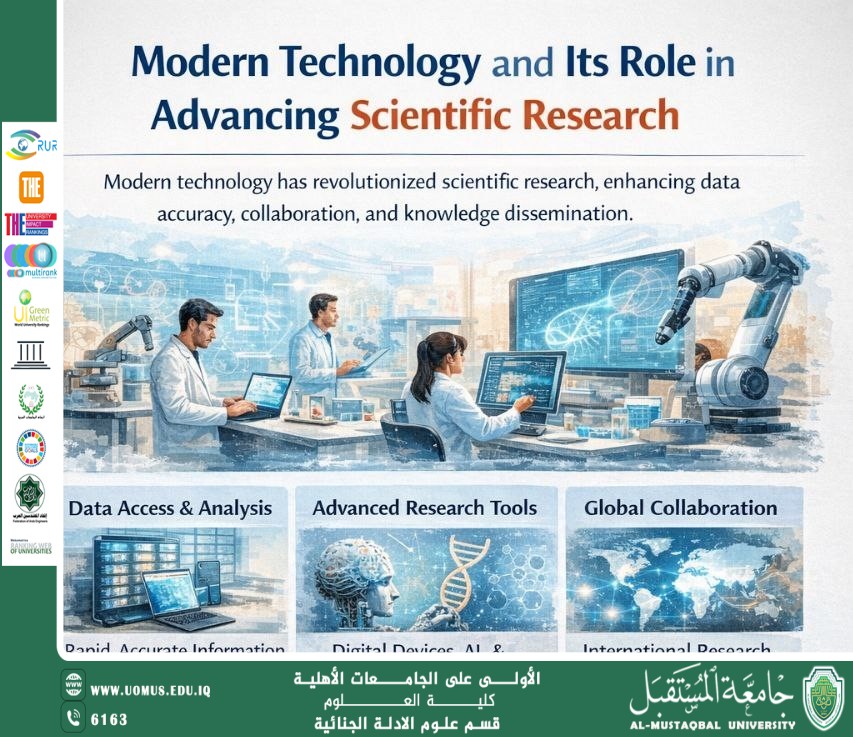
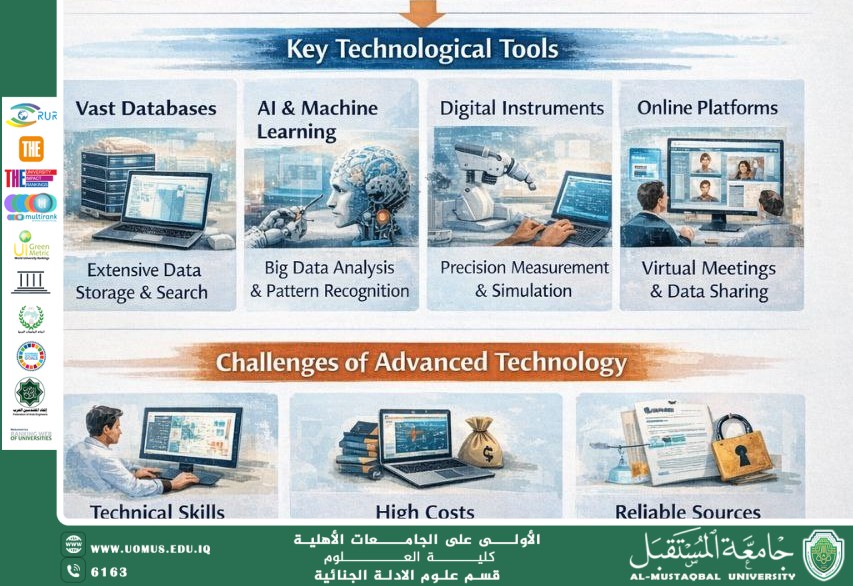
Modern technology enables researchers to access vast databases and diverse sources of information with unprecedented speed and accuracy, thereby accelerating the process of data and literature collection. For instance, systematic reviews and both quantitative and qualitative data analyses can now be conducted using specialized software, along with the ability to track the latest studies in specific fields through electronic databases. These capabilities enhance research quality and reduce the likelihood of human error.
Modern technology also contributes to the development of research tools, such as digital measurement devices, simulation software, and artificial intelligence (AI) techniques. Advanced devices allow researchers to obtain precise and reliable data, while simulation programs enable the study of different scenarios without the need for costly or impractical real-world experiments. Furthermore, AI facilitates the analysis of large and complex datasets efficiently, allowing researchers to draw accurate conclusions and identify patterns that may not be apparent using traditional methods.
The role of technology extends beyond data collection and analysis to fostering global collaboration among researchers. Instant communication with international research teams, data sharing, idea exchange, and conducting joint studies have become feasible thanks to digital tools and online platforms. This collaboration enhances the diversity of expertise and scientific perspectives, contributing to more comprehensive and precise knowledge production.
Additionally, modern technology plays a pivotal role in disseminating scientific knowledge and improving accessibility. Through electronic journals, academic portals, and open-access platforms, researchers and students can easily access the latest studies, increasing opportunities to utilize research findings across various fields. Digital publishing also helps protect intellectual property rights and facilitates proper and reliable scientific citation practices.
However, researchers face challenges related to the use of modern technology, including the need for advanced technical skills, the high costs of sophisticated software and devices, and the risks of over-reliance on digital tools without critical understanding of the data. The abundance of digital information also increases the difficulty of distinguishing between reliable and unreliable sources, requiring researchers to employ rigorous verification methods.
In conclusion, modern technology represents a driving force in advancing scientific research, enhancing data accuracy, accelerating analysis, fostering international collaboration, and facilitating knowledge dissemination. To maximize these benefits, researchers must develop technical skills, adhere strictly to scientific research standards, and balance technological use with critical thinking and independent analysis. In doing so, modern technology becomes an essential partner in the progress of science and the enrichment of human knowledge.
Al-Mustaqbal University – the first university in Iraq.