
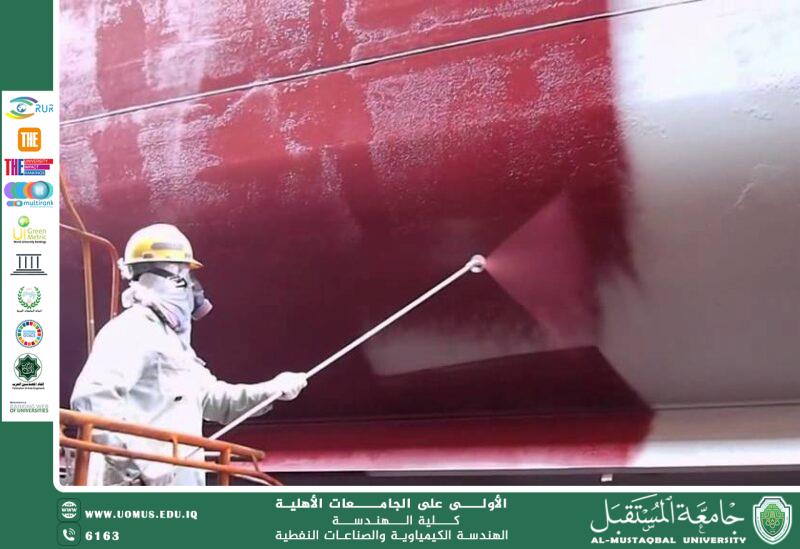
An article for Assistant Lecturer Zainab Hassan Ali in the Department of Chemical Engineering entitled "Polymeric Coatings and Their Role in Protecting Ships from Corrosion and Marine Environments."
Polymer coatings used on ships are chemical substances applied to the hull’s surface to form a strong protective layer that isolates the metal from the harsh marine environment. This coating is not merely a color; it is an integrated system of layers designed to prevent corrosion and enhance the ship’s performance.
When a ship sails at sea, its metal hull is in constant contact with saltwater, an extremely aggressive environment due to its high salt and oxygen content. These factors trigger chemical reactions known as corrosion (rust), which weakens the metal over time. This is where polymer coatings come into play, acting as a barrier that prevents water and oxygen from reaching the metal surface.
These coatings typically consist of polymeric materials such as epoxy and polyurethane, which are characterized by their high adhesion to the surface and resistance to water and chemicals. The coating is applied in several layers, starting with a primer (usually epoxy) that adheres directly to the metal, followed by intermediate layers to increase thickness and protection, and then a topcoat that protects against sunlight and provides an attractive finish.
On the lower part of the ship, which is submerged in water, a special type of coating called antifouling paint is used. The function of this coating is to prevent algae and barnacles from adhering to the ship’s surface, as these organisms increase surface roughness and lead to higher water resistance, which raises fuel consumption and reduces the ship’s speed.
One of the most important advantages of polymer paint is that it extends the ship’s lifespan and reduces the need for frequent maintenance, while also improving its efficiency while sailing. However, the success of this paint depends largely on how it is applied; the surface must be thoroughly cleaned before painting, and the paint must be applied under suitable conditions in terms of temperature and humidity.