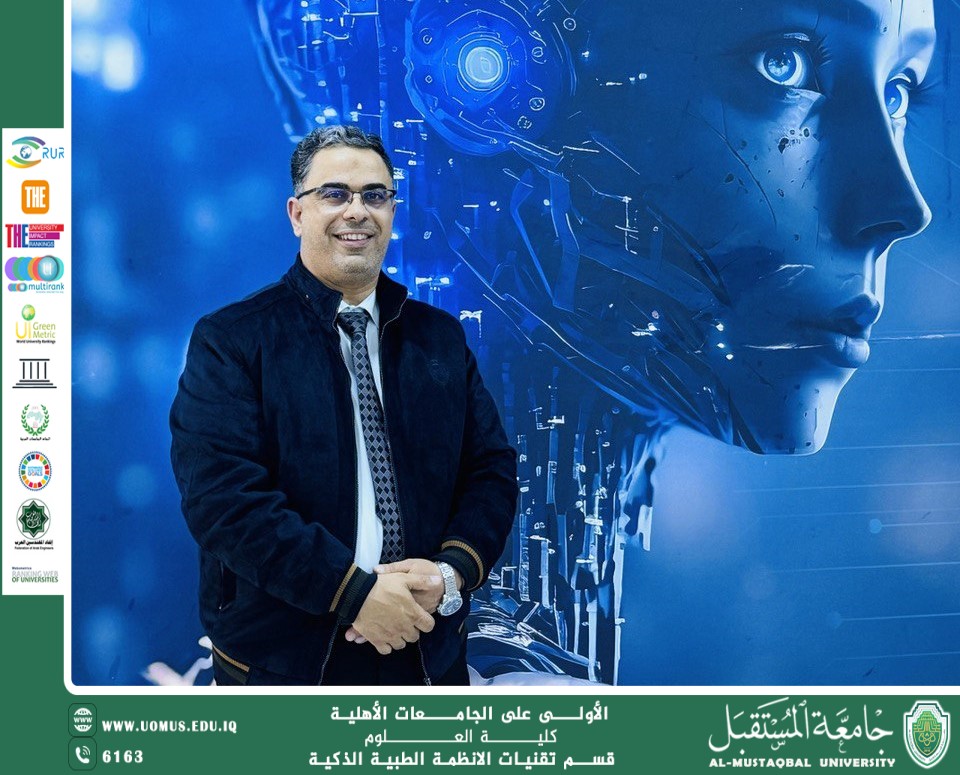



Cybersecurity in the Age of Artificial Intelligence and Distributed Computing (Prof. Dr. Mehdi Ebady Manaa)
Cybersecurity is no longer a narrow technical field concerned only with protecting devices and networks from intrusion. It has become an intellectual and organizational structure that governs the stability of the entire digital society. Every new technological advance, from cloud computing to the Internet of Things, and from artificial intelligence to edge computing, creates both vast opportunities for innovation and new zones of fragility. This duality means that cybersecurity is not merely a response to attacks; it is an ongoing practice of managing trust within a technological environment that expands faster than human intuition can reliably govern. The modern digital world resembles a city being built while people are already living inside it. Every new wall may serve either as protection or as weakness, depending on how it is designed and managed.
Artificial intelligence has transformed the nature of cyber threats just as profoundly as it has transformed the tools of defense. On one side, intelligent systems can process enormous volumes of logs, detect abnormal patterns, and accelerate incident response beyond conventional human capacity. On the other side, AI has enabled attackers to craft more persuasive phishing campaigns, generate adaptive malicious code, and discover vulnerabilities with greater efficiency. Here, the structural contradiction of modern technology becomes visible: the same instrument that enhances defense can become a vehicle of attack once it is placed in adversarial hands. The security question, therefore, no longer concerns only how to build a strong defensive system, but also how to prevent the intelligent infrastructure itself from becoming a new attack surface.
This challenge intensifies as computing shifts from centralized architectures to distributed models built on cloud platforms, edge nodes, and connected smart devices. In traditional environments, it was at least somewhat possible to draw clear boundaries between inside and outside, between trusted networks and untrusted space. Today, that border has eroded. An employee may access data from a personal device, an industrial sensor may transmit information to a cloud platform through multiple intermediary nodes, and a single service may depend on a long chain of software suppliers. Protecting an institution now means far more than securing a server or maintaining a firewall; it requires understanding the movement of data across an interconnected ecosystem of identities, services, interfaces, and digital supply chains. From this reality emerged approaches such as Zero Trust, which reject prior assumptions of trust and instead require continuous verification for every access request.
In such an environment, modern cyberattacks increasingly resemble quiet infiltration rather than forceful entry. Attackers do not always need to break the structure violently; sometimes it is enough to exploit an overprivileged account, a contaminated software library, a misconfigured cloud service, or a simple human action shaped by haste and misplaced trust. The weakest link is therefore not merely “the user” in a simplistic sense, but the system as a whole when it is designed around flawed assumptions about behavior, identity, and control. This reveals a central truth: cybersecurity is not only about tools. It is also about institutional engineering. Who holds authority, how privileges are distributed, how logs are reviewed, and how systems are built around least privilege and rapid containment all determine security outcomes as decisively as any technical appliance.
The future of cybersecurity is also deeply entangled with developments in encryption and quantum computing. Modern cryptography has long served as the silent foundation of digital trust, supporting financial transactions, private communications, identity systems, and software signing. Yet progress in quantum computing compels a serious re-evaluation of that foundation, because some conventional cryptographic approaches may eventually become less resistant to advanced attacks. This does not imply the immediate collapse of digital security, but it does mean that institutions can no longer afford to wait until the threat becomes fully material. The transition toward quantum-resistant cryptography is not simply a technical upgrade; it is a long-term strategic project involving asset inventory, algorithm assessment, and gradual reconstruction of infrastructure.
A common analytical mistake, however, is to portray cybersecurity as a purely mechanical race between attacker and defender. That image is incomplete because it ignores the fact that cybersecurity is also a social and epistemic issue. Organizational culture, technical education, policy clarity, and leadership responsibility all shape security as much as software and monitoring systems do. An institution that invests in the latest detection platforms without cultivating methodological awareness among its people resembles a house with heavy locks on its doors but permanently open windows. True cyber maturity is not achieved by accumulating tools. It emerges when security becomes part of the institution’s ordinary operating logic rather than an emergency reaction activated only after damage has occurred.
In conclusion, cybersecurity in the age of artificial intelligence and distributed computing is no longer a narrow defensive concern. It has become a science of managing trust in a deeply interconnected world. It stands at a decisive intersection between algorithm and policy, infrastructure and human behavior, innovation and restraint. Any serious understanding of modern technological development must therefore acknowledge that progress should not be measured only by the intelligence of the systems we build, but also by our ability to make those systems secure, fair, and accountable. In this sense, cybersecurity is not a technical margin of contemporary technology; it is one of its central ethical and practical conditions.
Al-Mustaqbal University is the first one university in Iraq.