How Do Planes Fly? A Simplified Journey into the World of Aerospace Engineering
Every time we look at an aircraft soaring steadily through the sky, a simple yet profound question might come to mind: How can a massive metallic object overcome gravity and fly so smoothly? The answer lies in an integrated science known as Aerospace Engineering, one of the most exciting and advanced branches of engineering in the modern era.
Aerospace engineering is not just about designing planes; it is a blend of physics, mathematics, and technology aimed at understanding how air behaves around moving objects and developing systems capable of achieving safe and efficient flight. This field relies on several fundamental sciences, such as aerodynamics, fluid mechanics, materials science, and modern control systems.
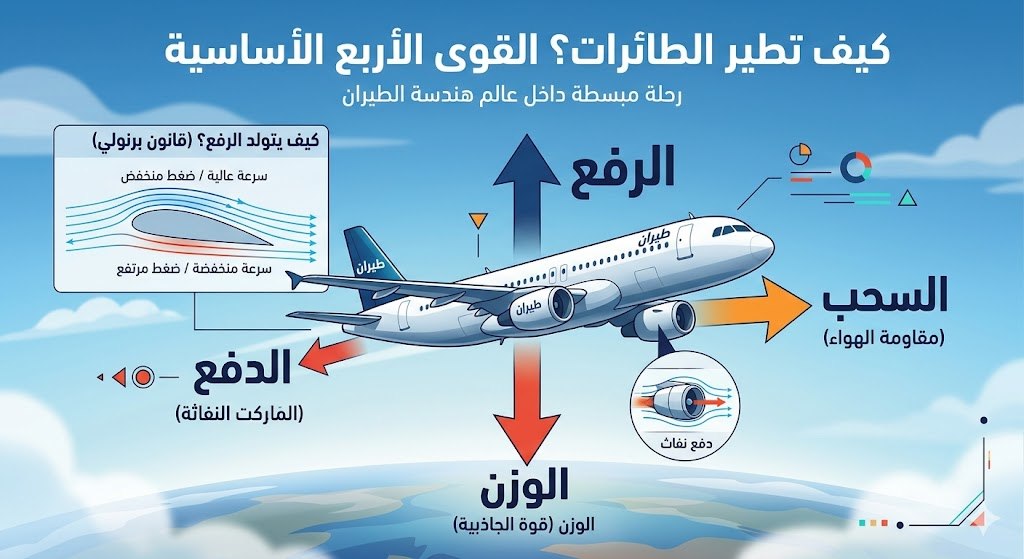
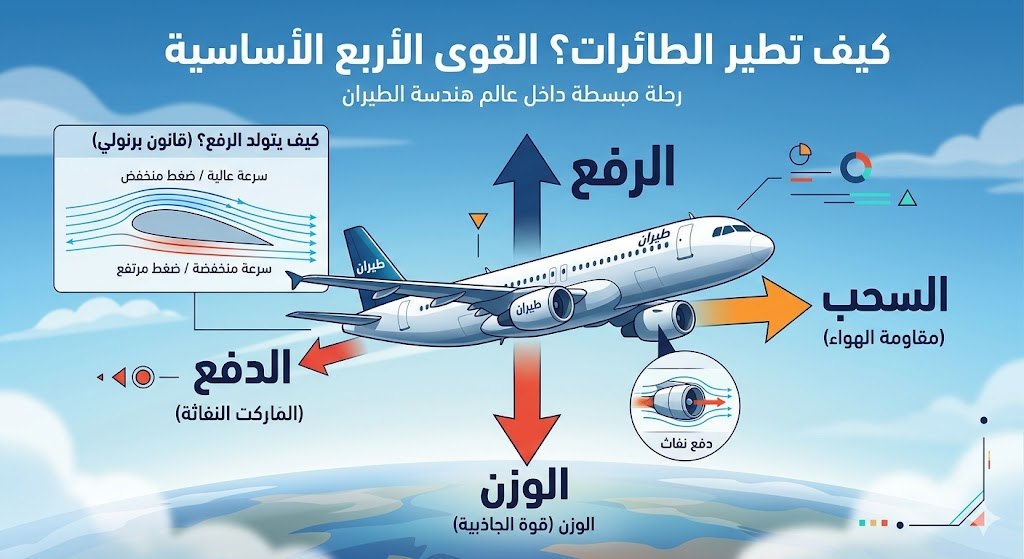
To understand how planes fly, one must recognize the four primary forces that govern their movement. The first force is Lift, which enables the plane to rise. This force is generated by the design of the wings and the way air flows around them. The second force is Weight, which is the effect of gravity pulling the plane downward. The third force is Thrust, generated by the engines to move the plane forward, while the fourth force represents Drag, which is the air resistance to the plane’s movement.
The true secret of flight lies in balancing these forces. When lift overcomes weight, the aircraft begins to soar. The more efficient the aircraft’s design, the more stable this balance becomes.
The wings play a pivotal role in the flight process, as they are designed in a special shape known as an "Airfoil." This shape allows air to pass at a higher speed over the wing compared to underneath it, leading to a decrease in pressure on top and an increase below, thereby generating lift. This explanation is based on physical principles such as Bernoulli’s Principle and Newton’s Laws of Motion.
As for the engines, they are the primary source of Thrust. In modern aircraft, jet engines are used to pull in air, compress it, and then expel it at high speed to the rear, which pushes the plane forward according to the principle of action and reaction. This system allows aircraft to reach high speeds with great efficiency.
The flight process is not complete without a precise control system. Aircraft contain movable surfaces such as ailerons, elevators, and the rudder, which allow the pilot to control the plane’s direction, altitude, and balance during flight. These systems make it possible to fly steadily even in complex weather conditions.
Although the idea of flight may seem complex, at its core, it relies on simple physical principles applied with brilliant engineering ingenuity. Thanks to this science, air travel has become an essential part of our daily lives and has contributed to shrinking distances and connecting the world in an unprecedented way.
In conclusion, it can be said that aerospace engineering represents one of humanity's greatest achievements, as it combined imagination and science to turn the dream of flight into a tangible reality. With continuous technological development, the future seems to hold more innovations, such as eco-friendly aircraft and sustainable aviation, opening new horizons for this remarkable field.