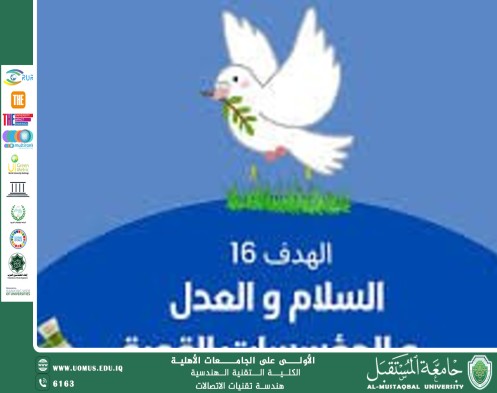

Challenges Facing Developing Countries in Achieving the Sixteenth Goal
The Sixteenth Goal of the United Nations is considered one of the most important objectives, as it seeks to build peaceful societies, achieve justice, and promote strong and effective institutions. However, developing countries face major challenges that hinder the full realization of this goal. These challenges stem from a combination of political, economic, and social factors that overlap and directly affect the stability of these countries and their ability to uphold the rule of law.
Armed conflicts and political instability are among the most significant challenges facing developing countries. Wars and internal conflicts weaken state institutions, destroy infrastructure, and disrupt judicial systems, making it difficult to achieve justice and ensure security for citizens. The استمرار of such conflicts creates an environment conducive to violence and organized crime, increases human suffering, and undermines opportunities for sustainable development.
Another key challenge is the spread of administrative and financial corruption within state institutions. Corruption erodes trust between citizens and governments, reduces institutional efficiency, and negatively impacts the fair distribution of resources. It also obstructs the implementation of laws and makes justice selective, leading to feelings of injustice and inequality among members of society.
Developing countries also suffer from weak judicial systems and a lack of independence. The judiciary may be subject to political pressure or external interference, affecting its integrity and independence in decision-making. This weakens the rule of law and limits individuals’ ability to obtain their rights fairly and promptly. In addition, the shortage of qualified personnel and limited financial and technological resources further hinder the development of judicial systems.
Moreover, poverty and unemployment pose major challenges to achieving the Sixteenth Goal. Poverty contributes to higher rates of crime and violence and weakens individuals’ ability to claim their rights. Unemployment, especially among youth, creates frustration and marginalization, which may push some individuals toward illegal activities or extremist groups.
The role of weak education systems and limited legal awareness cannot be overlooked. A lack of legal culture among citizens means they are often unaware of their rights and responsibilities, reducing their participation in promoting transparency and accountability. Inadequate education also limits society’s ability to build strong institutions based on competence and integrity.
Additionally, developing countries face challenges related to weak governance and ineffective public administration. Poor planning and lack of coordination among institutions lead to weak policy implementation and limit the state’s ability to provide fair and effective services to citizens.
In light of these challenges, achieving the Sixteenth Goal becomes a complex task that requires integrated efforts. These include reforming political systems, enhancing transparency, combating corruption, and developing judicial and security institutions, along with investing in education and improving economic and social conditions. Achieving peace, justice, and strong institutions in developing countries is not impossible, but it requires genuine political will and effective international cooperation to create a stable environment that supports sustainable development for all.
Prepared by: Assistant Lecturer Hassanein Alaa Mohammed