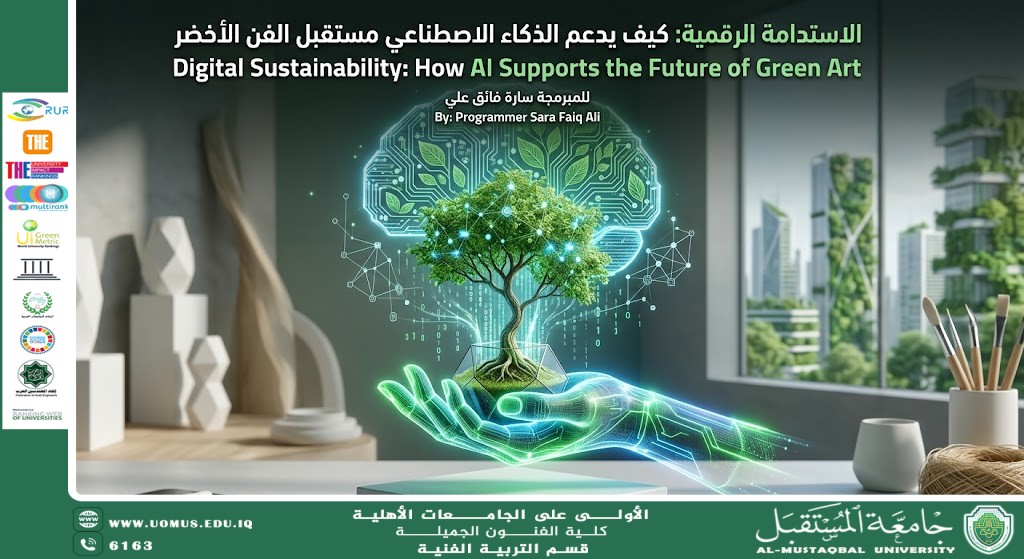
Article Title: "Digital Sustainability: How AI Supports the Future of Green Art"By: Programmer Sara Faiq Ali
In light of current environmental challenges, sustainability has emerged as an urgent necessity across all fields, and art is no exception. Today, Artificial Intelligence (AI) intersects with sustainable art to create "Green Creativity," where digital technologies provide innovative solutions to reduce the environmental impact of the artistic process.
AI as a Tool for Resource Optimization:
AI software allows artists and designers to simulate their artworks (such as sculptures or ceramic pieces) in precise virtual environments before physical execution. This "virtual execution" significantly reduces the consumption of raw materials and limits waste resulting from trial-and-error, especially in demanding arts like ceramics and architecture.
Improving Energy Consumption in Artistic Production:
Through predictive algorithms, AI can optimize firing processes in ceramic kilns or energy consumption in art studios, thereby reducing carbon emissions. It also contributes to inventing new eco-friendly materials by analyzing the chemical reactions of natural and sustainable components.
Digital Art as a Sustainable Alternative:
Art produced by AI and digital platforms represents a sustainable alternative that reduces the need for physical transportation, storage, and traditional chemicals. It is an invitation to rethink the "materiality" of art and transform it into cross-border sustainable visual experiences.
Conclusion:
Integrating AI into artistic sustainability is not merely a technical luxury, but a strategic path to protecting our planet. Through this technology, we can present art that carries high creative energy and a low environmental footprint, achieving the equation of beauty and sustainability...Almustaqbal University, The First University in Iraq.