


Scientific article by teaching in the Department of Business Administration Amjad Hamid Majeed entitled "Importance of value chain in an organization"
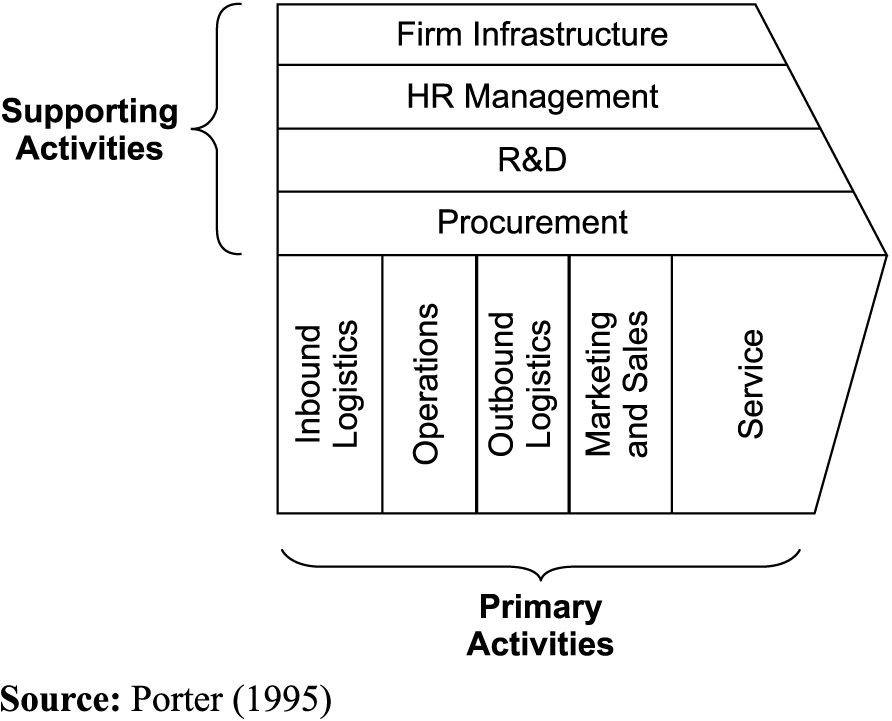
Importance of value chain in an organization<br />Introduction<br /> Due to the increase in firms’ operation to produce goods and services, a firm has depended on a significant technique to overcome its challenges. This call corporation value chain. It refers to a linked of series activities that aim to added value to the product or services beginning from supplier to the end-user. Hence, executives can oversee the multiple tasks of their organizations. The important part of the value chain is a center of gravity. that represents the focal point of the value chain.<br /> Each firm can have the center of gravity that arises from the firms' position of success, strength, and dominant operations. The center of gravity provides strategic focus and order. Strategic changes take place through moves around and from this center of gravity. Therefore, the importance of the value chain lies in the center of gravity. organizations have released the impact of the value chain in their performance; however, very few corporations include the product's entire value chain. So, we understand that the value chain is not approachable for firms regarding their recourses and capabilities. <br /> All in all, the value chain has been one of success requirement for firms that want to survive in its field. However, the governance of the value chain is no easy task as well as applicable for all level of management. So, firms need to invest their recourses and capabilities to establish a value chain that fits with their goals.<br />Keywords: value chain, organization, resources, capabilities, competitive advantages<br />1. The value chain of an organization:<br />I. Value chain definition: <br /> A high-level model of how businesses receive raw materials as input, add value to the raw materials through various processes and sell finished products to customers. <br />II. competitive advantage<br /> An advantage that a firm has over its competitors, allowing it to enervate greater sales or margins and/or retain more customers than its competition. There can be many types of competitive advantages including the firm's cost structure, product offerings, distribution network, and customer support. <br />III. The importance of value chain. <br /> We have explained previously the definition of the value chain for the firms, and the impact of it incorporation performance. Hence, we are going to focus on essential parts of value change that have a significant effect on a particular firm. These are: <br />A. Centre of Gravity. <br />B. Value chain industry analysis. <br />A. Centre of Gravity. <br /> As known, there are three kinds of company competencies.<br />Those are:<br />a) Competencies.<br />b) Core competencies. <br />c) Distinctive competencies. <br /> the core of competencies lies in this part of the value chain(center of gravity) where expertise underlying in this part so the company can operate forward or backward. (Wheelen, 2010). Firms keep their expertise in this part of the value chain. Therefore, it would be kind of smooth for the management to oversee its operation. Besides, the possibility of developing core competencies in order turns it to distinctive competencies. <br />B. Value chain analysis. <br /> It refers to the measures that have been taken from the firm to assure the performance qualitatively. So, the company will be able to gain competitive advantages among its competitors. One of these measures examines the linkage within each product line’s value chain. Such check the connection between the marketing of the product and the cost of this performance. That assists the firm to capture deficiencies in the firm performance. As well as reduce the cost of producing the product or service. <br />IV. Types of activities of the value chain<br />There are two activities regard the value chain: primary activity, secondary activity. <br />Table 1- primary activity.<br />Table 2- secondary activity<br />The two tables explain the functions of each activity of the value chain. The purpose of it is to organize the company activity to gain competitive advantages.<br />3. Conclusion <br /> The framework shows that the value chain of a company may be useful in identifying and understanding crucial aspects to achieve competitive strengths and core competencies in the marketplace as well as market space. The model also reveals how the value chain activities are tied together to ultimately create value for the consumer. <br /> Both activities (primary and secondary) are interdependent that is connected by linkages. Analysts conducting the value chain analysis should break down the key activities of the company according to the activities entailed in the framework, and assess the potential for adding value through the means of cost advantage or differentiation. <br /> Finally, it is important to determine strategies that focus on those activities that would enable the company to attain sustainable. It is important to examine the core competencies of a corporation. The nature of value chain activities differs greatly following the types of companies and industries. However, it has been a useful tool for corporations to gain competitive advantages.