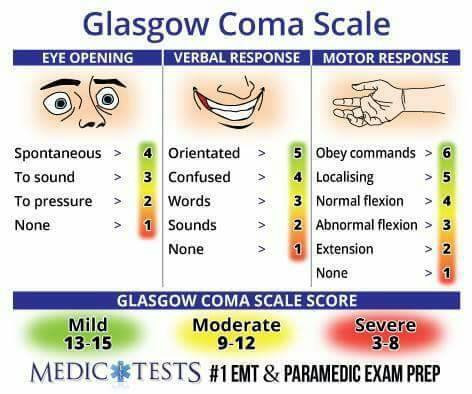
Glasgow Coma Scale
Is a neurological scale which gives a reliable, objective way of recording the conscious state of a person, for initial as well as subsequent assessment. GCS consists of three components (eye opening, best verbal response, and best motor response). The scale uses the numeric system with a total score ranging from 3 to 15. Patient is considered in a coma if he/she has GCS score of ≤ 8<br />Eye Opening Response<br />• Spontaneous--open with blinking at baseline 4 points<br />• To verbal stimuli, command, speech 3 points<br />• To pain only (not applied to face) 2 points<br />• No response 1 point<br />Verbal Response<br />• Oriented 5 points<br />• Confused conversation, but able to answer questions 4 points<br />• Inappropriate words 3 points<br />• Incomprehensible speech 2 points<br />• No response 1 point<br />Motor Response<br />• Obeys commands for movement 6 points<br />• Purposeful movement to painful stimulus 5 points<br />• Withdraws in response to pain 4 points<br />• Flexion in response to pain (decorticate posturing) 3 points<br />• Extension response in response to pain 2 points<br />• No response 1 point<br />The meaning of the total GCS score<br />The GCS scores are used to indicate the severity of the head injuries and coma levels as described below:<br /> If GCS scores ≥ 13, then the patient has mild head injury.<br /> If GCS score is (9-12), then the patient has moderate head injury.<br /> GCS score ≤ 8 then the patient has severe head injury, and considered to be in coma.<br />Other classifications give more details as the following:<br /> If GCS score is 15 with no loss of consciousness or amnesia, then the patient has minimal head injury.<br /> If GCS score is (14-15) with amnesia or less than 5 minutes' loss of consciousness, then the patient has mild head injury.<br /> If GCS score is (9-13) with more than 5 minutes' loss of consciousness or neurological deficit, then the patients has moderate head injury.<br /> If GCS score is (5-8), then the patient has severe head injury.<br /> If GCS score is (3-4), then the patient has critical head injury.<br />Created by dr. Sara Kareem Jabbar