Dr. Malik Mustafa Mohammed, Head of department. Air Quality and its Impact on the Environment and Public Health.
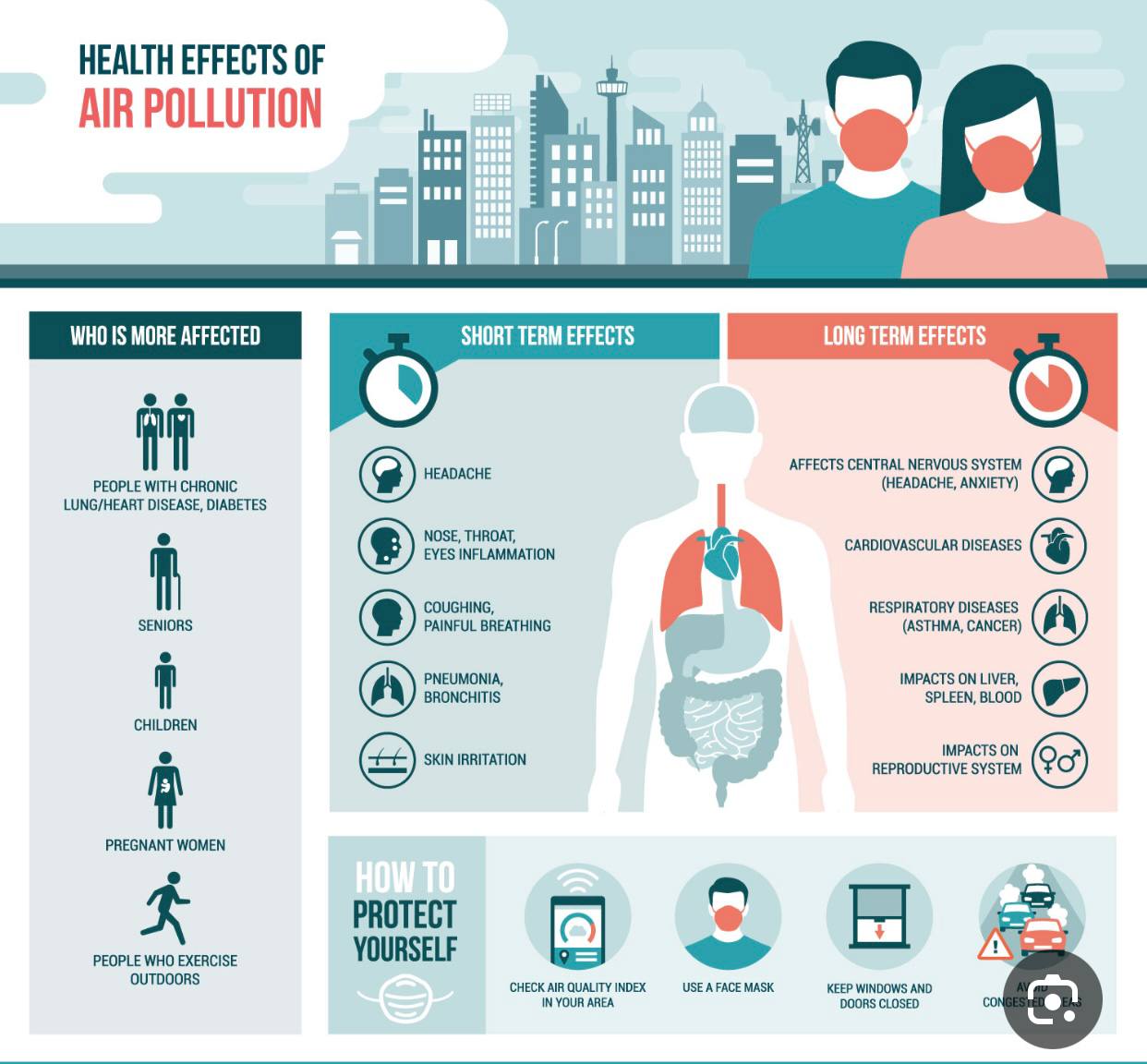
Air Quality and its Impact on the Environment and Public Health<br />Air quality is a fundamental environmental issue that directly affects human health and the ecosystem. Air quality is measured through a set of standards that define the maximum permissible levels of various pollutants in the air. These pollutants include substances such as sulfur dioxide (SO₂), nitrogen oxides (NOₓ), particulate matter (PM₁₀ and PM₂.₅), ozone (O₃), and lead (Pb). These pollutants contribute to the deterioration of air quality and lead to serious health and environmental problems.<br />Air Quality Indicators:<br />• Sulfur dioxide (SO₂): Produced from the combustion of fossil fuels in power plants and factories, it has negative effects on the respiratory system.<br />• Nitrogen oxides (NOₓ): Primarily emitted from transportation and industry, it contributes to the formation of ground-level ozone.<br />• Particulate matter (PM₁₀ and PM₂.₅): Fine particles that can penetrate deep into the lungs and cause chronic diseases.<br />• Ozone (O₃): A secondary pollutant formed from chemical reactions between other pollutants in the presence of sunlight.<br />• Lead (Pb): A pollutant resulting from certain industrial activities and has serious health effects.<br />Global Air Quality Standards:<br />Global standards for air quality indicators are set by international organizations such as the World Health Organization (WHO) and the US Environmental Protection Agency (EPA). For example:<br />• Sulfur dioxide (SO₂): The daily average concentration should not exceed 20 micrograms/m³.<br />• Particulate matter (PM₂.₅): The annual average concentration is recommended not to exceed 10 micrograms/m³.<br />• Nitrogen oxides (NOₓ): The acceptable maximum limit is 53 micrograms/m³.<br />Impact of Air Quality on Public Health:<br />Exposure to high levels of pollutants in the air can lead to a range of health problems, including:<br />• Respiratory diseases: Such as asthma and bronchitis.<br />• Cardiovascular diseases: Fine particles increase the risk of heart disease.<br />• Long-term effects: Such as cancer and developmental disorders, especially in children.<br />Factors Contributing to Deterioration of Air Quality:<br />The main factors contributing to the deterioration of air quality include:<br />• Industrial activities: Emissions from factories and power plants.<br />• Transportation: Emissions from vehicles, ships, and airplanes.<br />• Private generators: Often powered by diesel and emit large amounts of pollutants (as in Iraq and some countries).<br />• Waste burning: Leading to the release of toxic substances into the air.<br />Strategies for Improving Air Quality:<br />Air quality can be improved through several strategies, including:<br />• Strengthening environmental laws: To reduce emissions from factories and transportation.<br />• Developing public transportation: To reduce car emissions.<br />• Using clean energy: Such as solar and wind power to reduce reliance on fossil fuels.<br />• Public awareness: On how to reduce emissions through environmentally friendly daily practices.<br />Analysis and Potential Improvements:<br />The provided text is a comprehensive and informative overview of air quality issues. However, a few potential improvements could be made:<br />• Specificity: While the text mentions the impact of air pollution on health, it could benefit from more specific examples of diseases and conditions linked to particular pollutants.<br />• Regional focus: Given the author's name, "Dhirar Salim," which suggests a Middle Eastern origin, the text could benefit from more specific examples and case studies from the region.<br />• Solutions: While the text outlines potential solutions, it could delve deeper into specific policy recommendations or technological advancements.<br />• Visuals: Adding diagrams or graphs to illustrate concepts such as the formation of smog or the impact of different pollutants on human health could enhance understanding.<br />Overall, the text provides a solid foundation for understanding the complexities of air pollution and its implications.<br />Dhirar Salim Mohammed, chemical engineer.