

Scientific Article by the Doctor Sarah A. Alameedee on the differences in information-processing methods
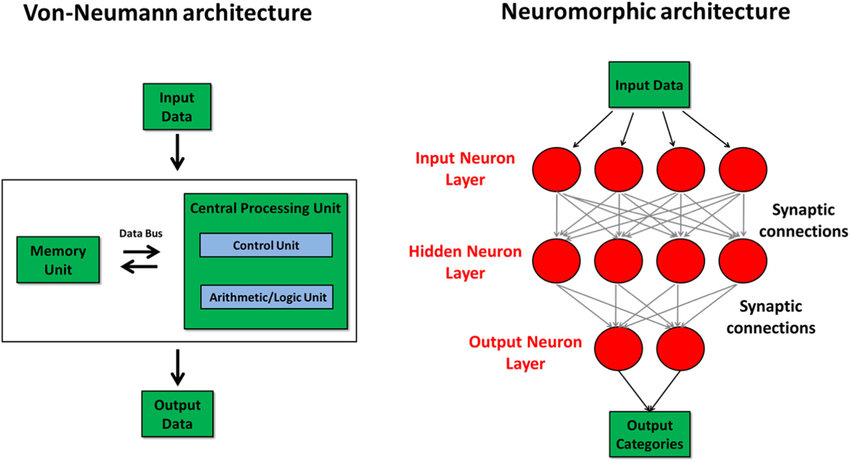
The differences in information-processing methods between the brain system and von Neumann architecture in the information storage modes are different. The biological brain does not have a separate and centralized storage or arithmetic unit; while each neuron combines the functions of storage and computing. Various kinds of information are distributed and stored in the synapses of different neurons, and various kinds of information processing in fine-grained distribution are completed by numerous neurons. The biological brain does not need a program for solving problems, that is, it does not create a model in advance when solving practical problems, but directly changes the memory parameters (connection weights) of the synapses of a neuron to acquire the knowledge for solving certain problems by learning. The information (a processing object) processed by the biological brain is not completely certain and accurate, but has obvious fuzziness and randomness. The processing object can be either a discrete quantum, or a continuous quantum.<br /><br /> The processing method used by the biological brain can be a digital method, an analog method, or a digital/analog (D/A) organic mixed method, and also a random processing method . therefore, the brain and the current computer have great differences in information processing methods. With the addition of the random processing method, and D/A mixed processing, the whole process becomes complex, and it is usually non-repeatable. The switching time of a brain neuron is several milliseconds (of the order of 10^-3 s), which is millions of times longer than that of a current computer (of the order of 10^-10 s). However, the human brain can produce an accurate response to a complex activation in less than one second. This indicates that although the processing and transmission speed of a single neuron are rather slow, the brain can respond quickly due to its high parallelism.