Simulation
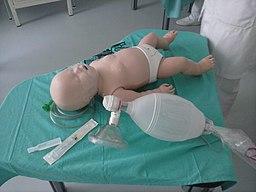
A baby mannequin used in a simulation to teach cardiopulmonary resuscitation.<br /><br /><br />● What is Simulation?<br /><br />Simulation is the realistic re-enactment of real-world scenarios for various reasons, including entertainment, education, preparing for an anticipated event, or troubleshooting a problem.<br />They are typically conducted in a controlled<br />environment that allows for modifications or<br />adjusting of variables as needed. However,<br />simulations cannot account for every variable.<br />Developing a simulation can be a complex process.<br />An example of a simulation is a fire drill. In this situation, a fire drill is used to prepare people for an anticipated event. During fire drills, the fire alarm is activated in the absence of a real fire, and people are instructed to react as they would if the scenario were real. The purpose of this simulation is to teach people the appropriate steps to take in<br />the event of a real fire without their lives actually<br />being in danger. Other examples of simulations<br />include simulating cardiopulmonary resuscitation<br />(CPR), science laboratory experiments, simulations used in movies, sports, and video games.<br /><br /><br /><br />● Processes That Can Be Simulated<br /><br />There are a variety of processes that can be simulated, some of which include:<br /><br />• Science experiments or scientific discovery<br /><br />• Natural disasters drills; examples would include a tornado or fire drill.<br /><br />• Weather forecasting<br /><br />• Flying a plane<br /><br />• Healthcare processes<br /><br />• Movies; for example, a movie scene of actors in an ocean may actually be shot in a swimming pool and edited to look like it occurred in the ocean.<br /><br />• Safety tests<br /><br />Note that high school chemistry laboratory can simulate on a smaller scale experiment conducted by larger laboratories. Also, conclusions derived from simulations may not be error-free.<br /><br /><br /><br />● How Are Simulations Used?<br /><br />Simulations are used in many ways. They're used for scientific discovery, to test designs for safety, to save money, and even to create graphics for movies and video games.<br />Scientists use simulations all the time. For example, you could input the laws of gravitation into a computer, and use it to create a 3D simulation of the planets of the solar system orbiting the Sun.<br />Then you could fire asteroids through the solar system and see what happens. These are the kinds of simulations that save us a lot of work. Years ago,<br />figuring out what would happen would have<br />required weeks of calculations completed by hand.<br /><br />Simulations are also used in meteorology to study weather and climate change, but this is an area where modeling is difficult. Predicting the motions of every particle in the Earth's atmosphere is incredibly hard, and that's why weather forecasts can be so wrong sometimes.<br /><br /><br />Duha Ali Khudair<br />