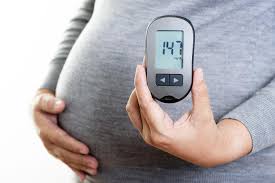
Gestational Diabetes
Pregnancy makes glycemic control more difficult in preexisting type 1 (insulin-dependent) and type 2 (non–insulin-dependent) diabetes but does not appear to exacerbate diabetic retinopathy, nephropathy, or neuropathy (1).<br />Gestational diabetes occurs in approximately 4% of pregnancies, but the rate is above average in people of certain ethnicities (non-Hispanic Asian/Pacific Islander and Hispanic/Latina) (2). Women with gestational diabetes are at increased risk of type 2 diabetes in the future.<br />Guidelines for managing diabetes mellitus during pregnancy are available from the American College of Obstetricians and Gynecologists (ACOG [1, 3]).<br />Risks of diabetes during pregnancy<br />Diabetes during pregnancy increases fetal and maternal morbidity and mortality. Neonates are at risk of respiratory distress, hypoglycemia, hypocalcemia, hyperbilirubinemia, polycythemia, and hyperviscosity.<br />Poor control of preexisting (pregestational) or gestational diabetes during organogenesis (up to about 10 weeks gestation) increases risk of the following:<br />• Major congenital malformations<br />• Spontaneous abortion<br />Poor control of diabetes later in pregnancy increases risk of the following:<br />• Fetal macrosomia (usually defined as fetal weight > 4000 grams or > 4500 grams at birth)<br />• Preeclampsia<br />• Shoulder dystocia<br />• Cesarean delivery<br /><br /><br /><br /><br />Diagnosis of Diabetes Mellitus in Pregnancy<br />• Oral glucose tolerance test (OGTT) or a single plasma glucose measurement (fasting or random)<br />The American College of Obstetricians and Gynecologists (ACOG) recommends that all pregnant women be screened for gestational diabetes, typically at 24 to 28 weeks gestation (1). An OGTT is recommended, but the diagnosis can probably be made based on a fasting plasma glucose of > 126 mg/dL (> 6.9 mmol/L) or a random plasma glucose of > 200 mg/dL (> 11 mmol/L).<br />The recommended screening method has 2 steps. The first is a screening test with a 50-g oral glucose load and a single measurement of the glucose level at 1 hour. If the 1-hour glucose level is > 130 to 140 mg/dL (> 7.2 to 7.8 mmol/L), a second, confirmatory 3-hour test is done using a 100-g glucose load (see table Glucose Thresholds for Gestational Diabetes Using a 3-hour Oral Glucose Tolerance Test ).<br />Most organizations outside the United States recommend a single-step, 2-hour test.<br />Treatment :-<br />• Close monitoring<br />• Tight control of blood glucose<br />• Management of complications<br />Preconception counseling and optimal control of diabetes before, during, and after pregnancy minimize maternal and fetal risks, including congenital malformations (1). Because malformations may develop before pregnancy is diagnosed, the need for constant, strict control of glucose levels is stressed to women who have diabetes and who are considering pregnancy (or who are not using contraception).<br />To minimize risks, clinicians should do all of the following:<br />• Involve a diabetes team (eg, physicians, nurses, nutritionists, social workers) and a pediatrician<br />• Promptly diagnose and treat complications of pregnancy, no matter how trivial<br />• Plan for delivery and have an experienced pediatrician present<br />• Ensure that neonatal intensive care is available<br />In regional perinatal centers, specialists in management of diabetic complications are available.<br />During pregnancy<br />Treatment can vary, but some general management guidelines are useful (see tables Management of Type 1 Diabetes During Pregnancy, Management of Type 2 Diabetes During Pregnancy, and Management of Gestational Diabetes During Pregnancy).<br />Women with type 1 or 2 should monitor their blood glucose levels at home. During pregnancy, normal fasting blood glucose levels are about 76 mg/dL (4.2 mmol/L).<br />Goals of treatment are<br />• Fasting blood glucose levels at < 95 mg/dL (< 5.3 mmol/L)<br />• 2-hour postprandial levels at ≤ 120 mg/dL (≤ 6.6 mmol/L)<br />• No wide blood glucose fluctuations<br />• Glycosylated hemoglobin (HbA1c) levels at < 6.5%<br />Insulin is the traditional treatment of choice because it cannot cross the placenta and provides more predictable glucose control; it is used for types 1 and 2 diabetes and for some women with gestational diabetes. Human insulin is used if possible because it minimizes antibody formation. Insulin antibodies cross the placenta, but their effect on the fetus is unknown. In some women with long-standing type 1 diabetes, hypoglycemia does not trigger the normal release of counterregulatory hormones (catecholamines, glucagon, cortisol, and growth hormone); thus, too much insulin can trigger hypoglycemic coma without premonitory symptoms. All pregnant women with type 1 should have glucagon kits and be instructed (as should family members) in giving glucagon if severe hypoglycemia (indicated by unconsciousness, confusion, or blood glucose levels < 40 mg/dL [< 2.2 mmol/L]) occurs.<br />Oral hypoglycemic drugs (eg, metformin) are being increasingly used to manage diabetes in pregnant women because of the ease of administration (pills compared to injections), low cost, and single daily dosing. Several studies have shown that metformin is safe during pregnancy and that it provides control equivalent to that of insulin for women with gestational diabetes. For women with type 2 diabetes before pregnancy, data for use of oral drugs during pregnancy are scant; insulin is most often preferred. Oral hypoglycemics taken during pregnancy may be continued postpartum during breastfeeding, but the infant should be closely monitored for signs of hypoglycemia.<br /><br />د. رؤى نشأت الصفار <br /><br /><br /><br />The first university in Iraq