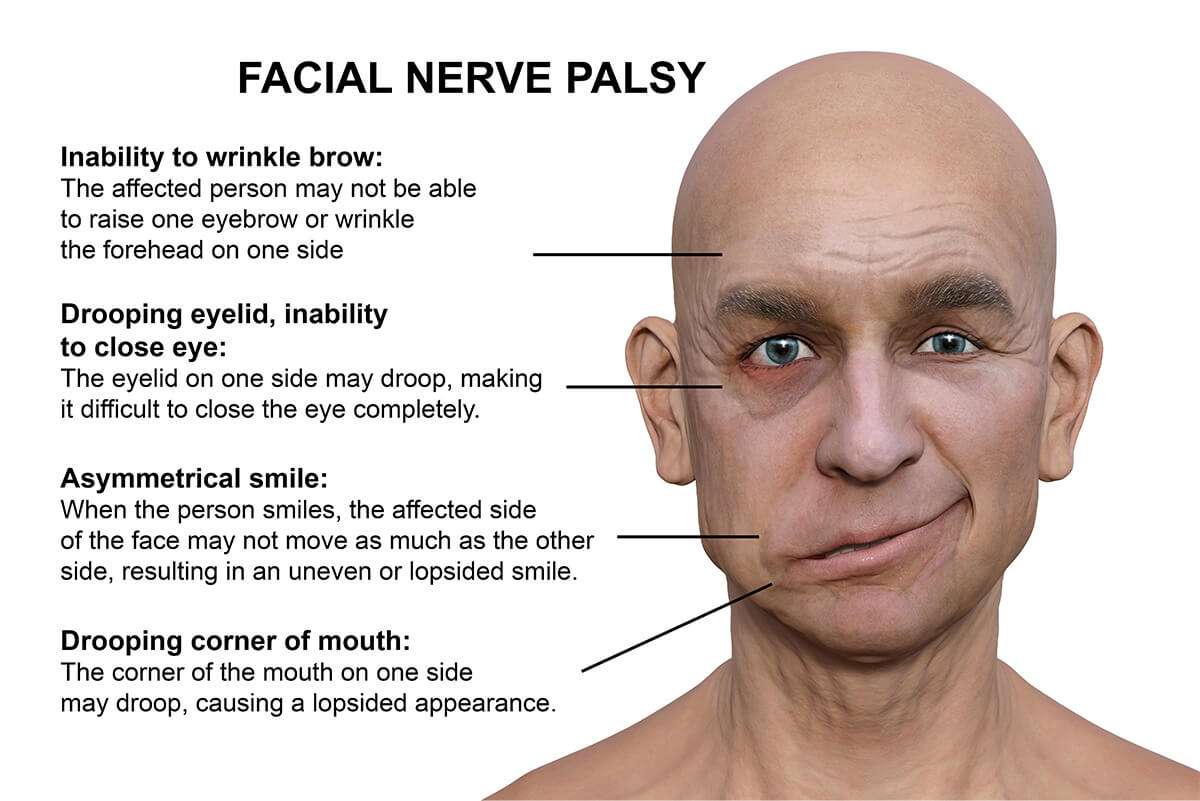
Scientific article entitled Facial palsy
Facial palsy <br /> The term facial palsy generally refers to weakness of the facial muscles, mainly resulting from temporary or permanent damage to the facial nerve.<br />When a facial nerve is either non-functioning or missing, the muscles in the face do not receive the necessary signals in order to function properly. This results in paralysis of the affected part of the face, which can affect movement of the eye(s) and/or the mouth, as well as other areas.<br />There are different degrees of facial paralysis: sometimes only the lower half of the face is affected, sometimes one whole side of the face is affected and in some cases both sides of the face are affected.<br />How do the facial nerves work?<br />Each side of the face has its own facial nerve, so damaging the left facial nerve will only affect the left side of the face, and vice versa. Each nerve starts at the brain and enters the face to the front of the ear where it then divides into five separate branches. These branches supply the muscles which are used for facial expression. Tears, saliva production and taste are also controlled by the facial nerve in different ways. <br />What causes facial palsy?<br />Although the most commonly known cause of facial paralysis is Bell’s palsy, there are actually many different causes of facial palsy, and treatment and prognosis vary greatly depending on the cause. Some of the main causes of facial palsy are listed below:<br />• Bell’s palsy, an idiopathic condition, meaning that no conclusive cause has been established although links have been made with viruses.<br />• Viral infections such as Ramsay Hunt syndrome.<br />• Surgical causes: for example during removal of acoustic neuroma or facial nerve tumour, or when operating on the parotid gland.<br />• Bacterial causes such as Lyme disease or following a middle ear infection.<br />• Neurological conditions such as Neurofibromatosis 2, or Guillain-Barré syndrome.<br />• Traumatic injury such as fractures to the brain, skull or face.<br />• Birth trauma: for example caused by forceps or facial presentation delivery.<br />• Congenital conditions such as an abnormal development of the facial nerve or muscle in the womb.<br />• Rare genetic syndromes such as Moebius syndrome or CHARGE syndrome.<br />• Stroke: although a stroke can cause facial palsy it is slightly different in that the problems are not caused by direct damage to the facial nerve. The paralysis in this case is caused by brain damage and the messages not being transferred properly to the facial nerve.<br />What functions do the facial muscles perform?<br />• Raising the eyebrows (frontalis)<br />• Closing the eyes (orbicularis oculi)<br />• Frowning (corrugator)<br />• Open mouth smiling (zygomaticus)<br />• Closed mouth smiling (risorius)<br />• Pouting (orbicularis oris)<br />• Lifting top lip (levator labii)<br />• Pulling lower lip down (depressor labii)<br />• Sticking bottom lip out (mentalis)<br />• Pulling jaw and corners of mouth gently down (platysma)<br />• Wrinkling nose (procerus/nasalis) <br />Physiotherapy<br />Early stages of Facial Palsy, onset to approx 5 months. In the early stages of facial palsy, the most important thing to do is to check that patients are caring for their affected eye in an appropriate way. As the facial nerve is responsible for production of lubrication to the cornea, patients are highly likely to suffer from a dry eye in the early weeks and months of facial palsy. This puts them at risk of developing exposure keratitis/keratopathy AKA corneal ulcer, which can cause damage to vision in the affected eye: management of the eye is crucial in preventing damage to the cornea and thus preventing loss of vision.The therapist should educate the patient about dry eye management if this has not been done by other medical personnel. If the eye is looking red or the patient reports frequent episodes of redness, an urgent referral to opthalmology is required. Alternatively they should be advised to attend an eye hospital emergency department. <br />Other physiotherapy treatments include:<br />• Neuromuscular retraining (NMR) <br />• Electromyography (EMG) and mirror biofeedback <br />• Trophic electrical stimulation (TES) <br />• Proprioceptive neuro muscular facilitation (PNF) techniques[31]<br />• Kabat technique<br />• Mime therapy<br />o Includes treatments such as: <br /> Self-massage<br /> Breathing and relaxation exercises<br /> Exercises to enhance coordination between both sides of the face and to reduce synkinesis<br /> Exercises to help with eye and lip closure<br /> Letter, word and facial expression exercises<br /><br /><br /><br /> Future University is the first university in Iraq.