
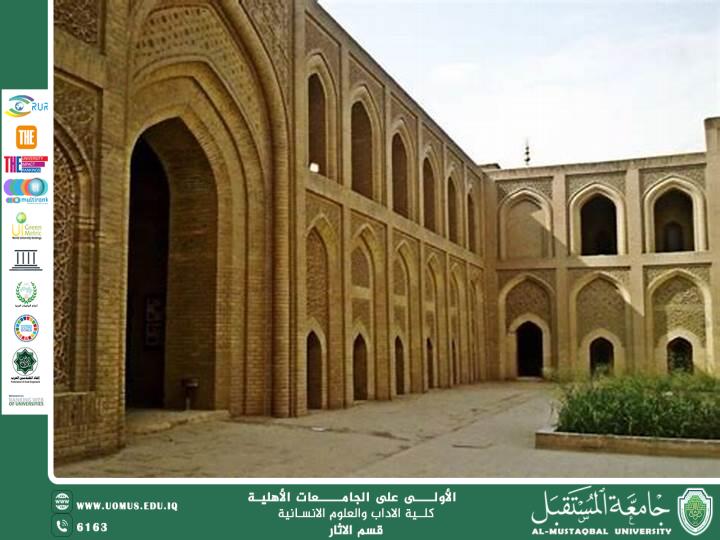
A scientific article by Dr. Fawzia Mahdi Al-Maliki entitled “Education in Ancient Iraq.”
Dr. Fawzia Mahdi Al-Maliki<br />Head of the Department of Archaeology, College of Arts and Humanities<br />Al‑Mustaqbal University<br /><br />The Sumerians made a significant contribution to enriching human thought, and the invention of writing by the Sumerians is considered one of the foremost achievements that benefited ancient peoples. Through writing, words were recorded, preserved, and transmitted to future generations. Numerous examples of their works inscribed on clay tablets have reached us, and it appears that the emergence of writing in the region was one of the direct causes for the appearance of the school—a vital institution that played an active role in preserving the cultural heritage of the peoples that followed the Sumerian civilization.<br /><br />During the Sumerian period, temples served as the primary cultural and educational centers. Education took place in large halls within the temples where scribes and learners gathered. Clay tablets and reed pens were the main tools used in education, as they were employed to write Sumerian texts using cuneiform script.<br /><br />Education at that time encompassed not only learning to read and write but also the study of religious, literary, and legal texts. Sumerian schools were often located within temples, where priests and scribes served as the primary instructors.<br /><br />There were also female teachers and priestesses in the Sumerian era. The Sumerians believed that women could play an important role in society, and women received education in various fields such as medicine, chemistry, and astronomy. In addition, there were priestesses who played a significant role in worship and religious rituals.<br /><br />Regarding attire, at that time there were specific garments worn by teachers and students; the students’ attire was simpler than that of the teachers.<br /><br />Educational institutions were located in Sumerian and Akkadian temples and were usually available only to the upper classes and the wealthy. This is because education required expenses for purchasing educational materials such as clay tablets and reed pens, as well as for covering the costs of teachers and priests. Therefore, it can be said that education was not entirely free; rather, it required a certain amount of financial resources or social support.<br /><br />The arrangement of student rows in Sumerian temples was designed in a coherent and organized manner. Students gathered in multiple rows, with ample space between rows to facilitate movement and control. The rows were arranged so that students could easily see their teachers, a design that helped enhance concentration and attentiveness during lessons.<br /><br />Pre-Islamic Arab education was innate; individuals acquired habits, values, and skills through imitation, tribal traditions, and morals. They excelled in poetry and rhetoric, and among their sciences were astronomy, medicine, genealogy, divination, physiognomy, admonition, and others.<br /><br />One of their means of disseminating their values and ideas was through seasonal conferences held in their renowned markets, such as Souq Ukaz, Dhu al-Majaz, and Majanna. These literary markets served as institutions for exchanging ideas and poetry, sharing experiences in trade and economics, and propagating proverbs and values.<br /><br />Writing existed among the Arabs before Islam, although the number of scribes was very limited, and there were no formal schools for teaching writing; instead, individuals were taught on a one-to-one basis. We can conclude that pre-Islamic Arabs knew how to read and write, but the percentage of those proficient in writing was very low—limited to the wealthy, merchants, and the elite. Writing held a significant status and value among Arabs even in the pre-Islamic era, yet those who could read and write were very few because it was not a necessity in their daily lives.<br /><br />With the advent of Islam and the spread of the Islamic creed, Islam called for the necessity of learning and teaching both religious and other sciences. Numerous verses and hadiths explicitly emphasize the importance of acquiring and transmitting knowledge in its various forms, in harmony with the spirit of Islam.<br />(“And a ransom [as] a duty upon him who is held captive among those captured at Badr. Whoever has no ransom, his affair is to teach ten Muslims to write in the city.”)<br />Thus, these individuals became among the first teachers, and writing spread during that era.<br /><br />In that period, educational institutions were not limited to mosques, as is commonly stated in historical texts on education; rather, other establishments emerged to teach boys the fundamentals of reading and writing independently from the mosque, for it was unacceptable for a Muslim to be illiterate.<br /><br />The Umayyad and Abbasid Eras<br />During these periods, women received education in various fields such as reading and writing, religious sciences, philosophy, medicine, and the arts. Educational institutions—such as schools and universities—advanced to include the education of women alongside men. A prime example is the establishment of schools and universities that taught religious sciences, jurisprudence, and Quranic studies alongside medicine, astronomy, mathematics, pharmacy, and other disciplines—perhaps the most famous being the Al‑Mustansiriya School in Baghdad.<br /><br />Al‑Mustaqbal University – The Premier University in Iraq.