An Article " Desertification in Iraq " By Dr.Hamzah Allawi Muserbet AL alwani
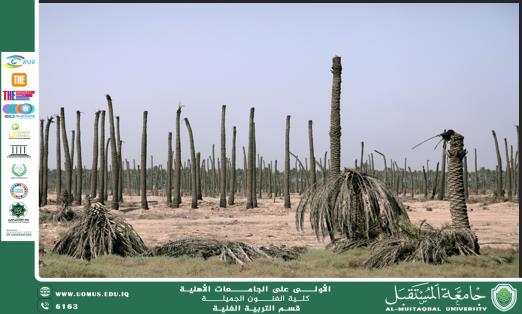
Desertification is a dangerous environmental phenomenon that threatens the economic and living lives of societies, as fertile agricultural lands turn into barren lands, which results in many negative repercussions that affect human life and the country's economy. Desertification is a process of demolition or destruction of the Earth's vital energy, which can eventually lead to desert-like conditions. It is a manifestation of the widespread deterioration of ecosystems, which leads to a decrease in the Earth's vital energy represented in plant and animal production, and thus affects the support of human existence. Climate change affects agricultural areas in Iraq by expanding the desertification area, weakening agricultural development and eliminating livestock, which led to the deterioration and disappearance of natural plants, which negatively affected people and the country's food security. . . Factors of desertification in Iraq:<br />1. 90% of Iraq's area falls within the dry and semi-arid climate zone, where the hot and dry desert climate lies within the borders of the alluvial plain and the western desert plateau, and this climate represents about 70% of Iraq's total area.<br />2. High temperatures in the summer, sometimes reaching more than 50 degrees Celsius.<br />3. Low rainfall, with varying amounts between 5-15 cm, affected by the high evaporation rate, which is low in most areas of Iraq. The rainfall rate in the south does not exceed 40 days and in the north 70 days, with low humidity, which is very important in the biological cycle of the soil and the growth of grasses.<br />4. The prevailing winds in Iraq are dry and hot north-westerly winds that spread local dust, and a hot, dry and long summer. This factor plays an important role in the occurrence of desertification in Iraq.<br /> Economists believe that Iraq is facing the biggest environmental problem in its history, represented by severe desertification that threatens its food security, which is caused by many natural and human factors, and increases its danger to the environmental, economic, social and civilizational aspects, as it loses a lot of productive land, moves sand dunes, and blows severe sand and dust storms, which result in increased air pollution. The construction of dams and reservoirs on the Tigris and Euphrates rivers in Iraq, Turkey and Syria has contributed to increasing the quantity and quality of salts, and the salty waters of the Arabian Gulf flow into the Shatt al-Arab due to its scarcity and the discharge of factory water and military industrial projects into the rivers without chemical treatment due to weak supervision and neglect, if any, and the lack of treatment of city sewage that drains into the rivers. Iraq's soil contains high saline components, as it is estimated that 61% of agricultural land is threatened by salinization, with an average of 8%. This means that all soils will become salty if an appropriate drainage system is not used. When the water level rises during the flood or irrigation season, the salts rise to the top of the soil, so drainage becomes very important. What contributes to salinization is the elevation of Iraq's regions above sea level, which makes it difficult to drain water, and the rise of groundwater and the accumulation of salts in the soil. Therefore, the plane lands known for their fertility have turned into saline lands, and productivity in vast areas has declined to almost zero. It is estimated that about 100 thousand dunums suffer from salinization annually, and the agricultural lands that are lost annually, as a result of salinization, soil erosion and degradation, are large when compared to the total area of cultivated lands. It is clear that desertification is one of the main factors that hinder social and economic development and increases economic problems that exacerbate environmental degradation. Thus, we face a vicious circle in preserving the environment, as the state of the environment cannot be separated from the state of the economy. From here, it becomes clear to us that economic backwardness and environmental degradation reinforce each other to establish their existence.<br /><br />Almustaqbal University, the first university in Iraq .<br />