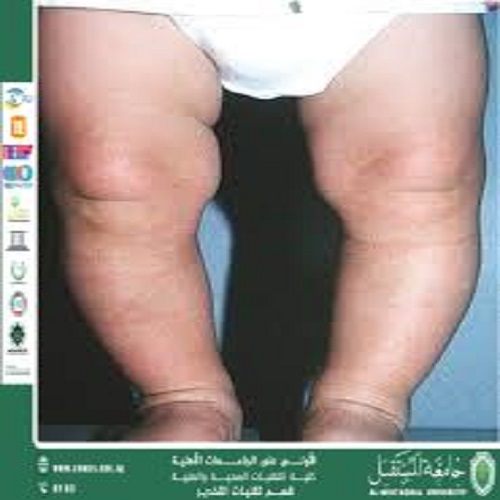
Bowing of the limbs in children
Bow legs is a condition in which a person’s legs appear to bow or bend outward. It occurs when a person who is standing straight with their.<br />Infants often experience bow legs in the first few months of life due to the cramped positioning in the womb. When it occurs in infants, no treatment is typically necessary as the condition will correct itself sometime before the age of 3years old.ankles together appears to have a space between their knees.<br />The natural bowing in infants and toddlers as physiologic genu varum. As the child ages, they will slowly show signs of correction.<br />If a child continues to have bow legs past the age of three, it may be the result of an underlying health condition such as rickets or Blount’s disease.<br />If an adolescent has bow legs, it is often the result of carrying excess weight or having obesityCauses of bow legs<br /> Causes of bow legs in children, including:<br />1-Physiologic genu varum: This is a naturally occurring bowing that happens due to a child’s position in the womb. The condition will gradually correct itself as the child begins to walk and should clear by around the age of 3years old.<br />2-Blount’s disease: This condition occurs due to an abnormality in the growth plate found in the upper shinbone. Before the age of 3old, a doctor may not be able to identify it. After that age, the condition will cause more obvious symptoms and become visible on an x-ray.<br />2-Rickets: it causes deformities as well as weakness in bones. It can result in several symptoms, including bow legs. It is often referred to as nutritional rickets because it occurs often in children who do not get enough vitamin D, calcium, or phosphorus, which the body needs for bone growth and development.<br />3-Other causes:are due to issues and conditions such as injury, certain infections, skeletal dysplasia (often referred to as dwarfism), or tibial hemimelia (shortening of the shin bone<br />Symptoms of bow legs<br />Bow legs become most apparent when a child stands or walks.<br />When standing, a child’s knees will bend away from each other, not touching, even when the child stands with their ankles together.<br />When walking, bowed legs can affect a child’s gait and cause an awkward walking pattern.<br />However, toddlers with bowed legs often do not have any issues with walking. They should develop typically and not experience any issues with coordination or learning to walk.<br />Parents of toddlers may notice significant bowing. They may also notice their child’s feet turn inwards. In children under the age of 3, this is likely typical and will go away over time.<br />Bowed legs do not typically cause pain in toddlers. However, as a child ages into adolescence, the bow in the legs can cause discomfort in the hips, ankles, and knees. They may also trip more frequently.<br />Treatments for bow legs<br />Often, a doctor can diagnose bow legs with a physical examination. Other times, they may need to order imaging, such as x-rays, or blood tests, to rule out possible underlying conditions that may be the cause of the bow legging.<br />During an exam, a doctor will often look for “normal” alignment of the legs. Normal alignment falls within a range, which means a child’s legs would need to be outside the range in order to get a diagnosis of bow legs.<br />Once the doctor makes a diagnosis, how they treat the condition will vary depending on the underlying cause.<br />For naturally occurring bow legs, a doctor will likely not recommend treatment right away. Instead, they will monitor the legs to watch every 6 months to check for signs of improvement.<br />When rickets or Blount’s disease is the cause, the condition will worsen rather than improve. A doctor will likely recommend treatments such as:<br />1-bracing<br />2-medication (for rickets)<br />3-surgical correction<br />Surgical correction falls into one of two types. They include:<br />1-Guided growth: The most common form of correction. It involves using a staple or metal plate to slow the growth of the healthy side of the shin to allow the other side to catch up.<br />2-Tibial osteotomy: This involves cutting the shin bone below the knee and then reshaping it to allow it to grow in correct alignment.<br />د طالب جيجان طاهر استشاري جراحة العظام والكسور \ قسم تقنيات التخدير<br /><br /><br /><br />Al-Mustaqbal University is the first university in Iraq<br /><br />