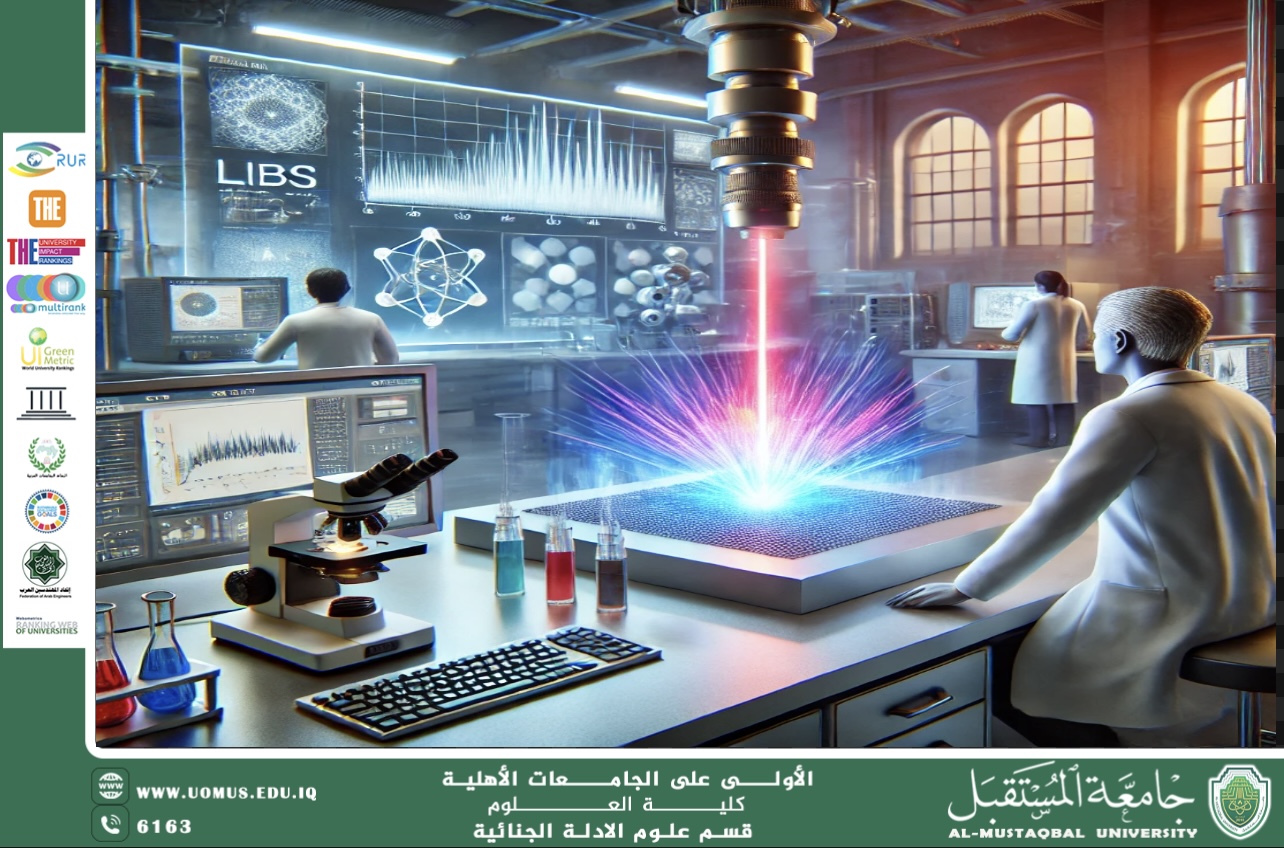
Laser-Induced Breakdown Spectroscopy (LIBS): Theory, Principles, and Applications (dr-sami abdalhussien habana)
Introduction<br />Laser-Induced Breakdown Spectroscopy (LIBS) is an atomic emission spectroscopy technique that utilizes a high-powered laser to create a plasma from a sample. By analyzing the emitted light, LIBS provides qualitative and quantitative elemental composition of various materials. It is a rapid, real-time, and non-contact analytical technique applicable in diverse fields.<br />2. Theory of LIBS<br />LIBS is based on the interaction between a high-intensity laser pulse and a material, leading to plasma formation and subsequent emission of characteristic spectral lines. The process can be divided into several stages:<br />1. Laser-Material Interaction:<br />o A short-pulsed, high-energy laser (typically nanosecond or femtosecond) is focused onto a sample.<br />o The laser energy is absorbed, leading to localized heating, vaporization, and ionization of the material.<br />2. Plasma Formation and Expansion:<br />o The vaporized material forms a microplasma consisting of free electrons, ions, and excited atoms.<br />o As the plasma expands, it undergoes cooling and recombination.<br />3. Light Emission and Detection:<br />o The excited species in the plasma emit characteristic wavelengths of light during relaxation.<br />o A spectrometer detects and records these emitted wavelengths, which correspond to specific elements.<br />4. Spectral Analysis:<br />o The recorded spectra are analyzed to determine the elemental composition of the sample.<br />o Signal processing and calibration are often used for quantitative analysis.<br />3. Principles of LIBS<br />Several fundamental principles govern LIBS:<br />3.1 Plasma Physics and Emission Spectroscopy<br />• Plasma Temperature & Electron Density: Plasma temperature affects the excitation state of atoms and ions, influencing emission intensities.<br />• Boltzmann and Saha Equations: Describe the population distribution of excited states and ionization equilibrium.<br />3.2 Spectral Line Identification<br />• Each element emits unique spectral lines, enabling identification.<br />• Optical emission spectrometers and databases (e.g., NIST) are used for spectral comparison.<br />3.3 Calibration and Quantitative Analysis<br />• Calibration-Free LIBS (CF-LIBS): Uses plasma physics models to quantify elements without external standards.<br />• Standard-Based LIBS: Relies on reference samples with known compositions.<br />3.4 Signal Enhancement Techniques<br />• Double-Pulse LIBS (DP-LIBS): Uses two laser pulses to enhance signal intensity and sensitivity.<br />• Resonant LIBS: Uses resonant excitation to selectively enhance specific spectral lines.<br />4. Applications of LIBS<br />LIBS is widely used in various scientific and industrial applications:<br />4.1 Environmental Monitoring<br />• Detection of heavy metals in water, soil, and air pollution studies.<br />• Analysis of hazardous substances and toxic elements.<br />4.2 Industrial and Material Analysis<br />• Quality control in metallurgy, mining, and manufacturing.<br />• Elemental analysis of alloys, ceramics, and coatings.<br />4.3 Biomedical Applications<br />• Detection of trace elements in biological tissues.<br />• Analysis of dental and bone compositions.<br />4.4 Space and Planetary Exploration<br />• LIBS is used in NASA’s Mars rovers (e.g., Curiosity) for planetary surface composition analysis.<br />• Remote sensing of extraterrestrial materials.<br />4.5 Cultural Heritage and Forensics<br />• Non-destructive analysis of historical artifacts and paintings.<br />• Forensic analysis of trace evidence.<br />5. Advantages and Challenges of LIBS<br />5.1 Advantages<br />• Real-time and in-situ analysis.<br />• Minimal sample preparation.<br />• Ability to analyze solids, liquids, and gases.<br />• Multi-element detection capability.<br />5.2 Challenges<br />• Matrix effects affecting accuracy.<br />• Need for calibration for precise quantification.<br />• Plasma variability and laser-induced damage.<br />6. Conclusion<br />Laser-Induced Breakdown Spectroscopy (LIBS) is a versatile analytical technique with applications spanning multiple industries. Ongoing research is focused on improving sensitivity, quantification accuracy, and expanding its use in remote sensing and biomedical diagnostics.<br /><br />Al-Mustaqbal University – The First University in Iraq