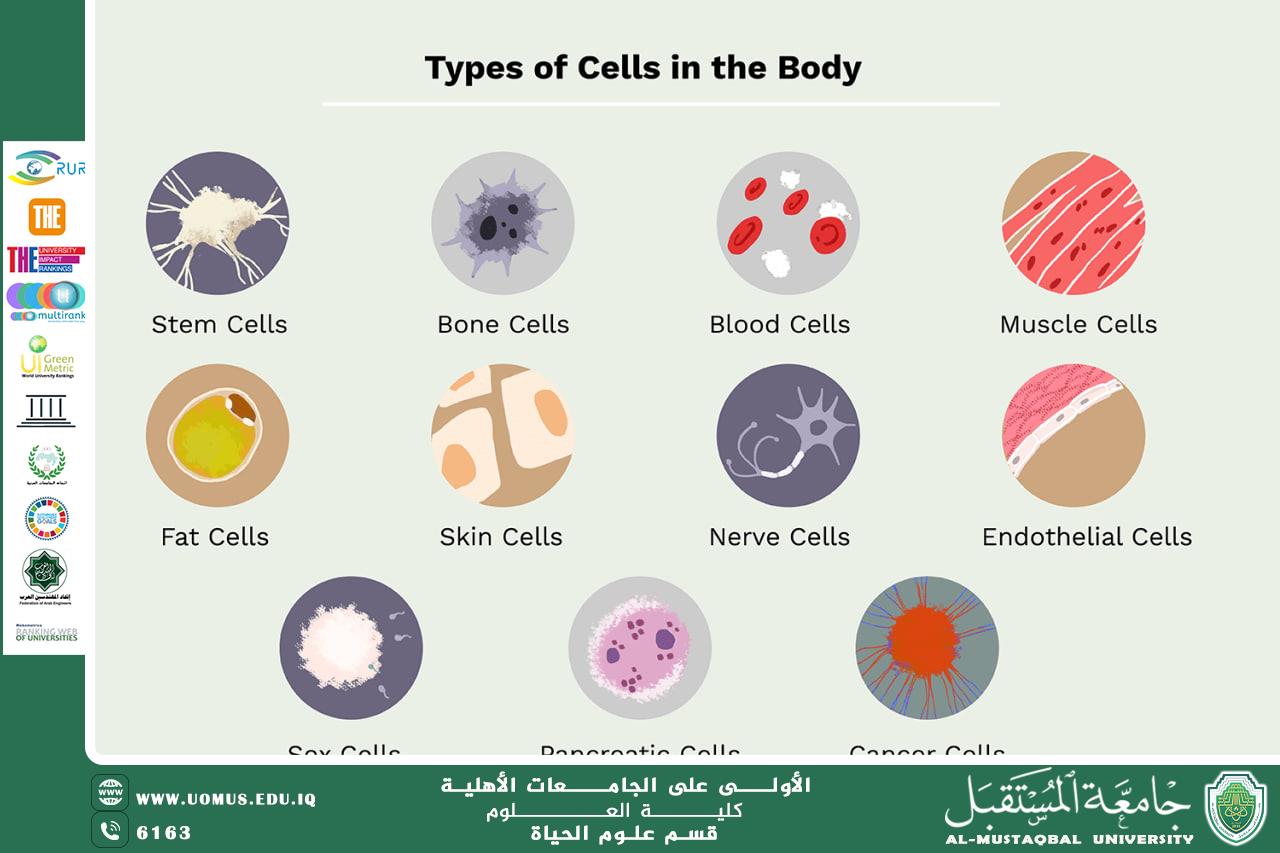
A scientific article by Ms. Noor al-Huda Azmi Hassan entitled "Cell types and the ability to identify them"
Cells are the basic units of living organisms, and they represent the basic structure that makes up the body. Cell types in living organisms vary based on their functions, structures, and the environment in which they are found. Here are some of the main types of cells with their ability to be defined:<br /><br />1. Plant Cells<br />Definition: They are the cells that form tissues in plants. They are characterized by the presence of a cell wall containing cellulose, which gives them rigidity. Plant cells also contain chloroplasts (which contain chlorophyll) necessary for photosynthesis.<br />Characteristics:<br />A rigid cell wall.<br />The presence of chloroplasts.<br />The presence of a large central vacuole for water.<br />There is a nucleus and cell organelles such as mitochondria, ribosomes.<br />2. Animal Cells<br />Definition: They are the cells that form tissues in animal organisms. Animal cells lack a cell wall and the chlorophyll pigment found in plant cells.<br />Characteristics:<br />A flexible cell membrane.<br />The presence of a nucleus containing genetic material.<br />They do not contain chloroplasts or a cell wall.<br /><br />They have mitochondria and help in energy production.<br /><br />3. Stem Cells<br />Definition: They are unspecialized cells that have the ability to divide and grow into different types of specialized cells. They are essential in the processes of regeneration and repair.<br /><br />Characteristics:<br />The ability to differentiate into different types of cells.<br />They are mainly found in regenerating tissues such as bone marrow.<br /><br />4. Neurons<br />Definition: They are the cells that transmit electrical and chemical signals between different parts of the body. These cells represent the basic unit of the nervous system.<br />Characteristics:<br />The presence of branches (axons and nerve trees) to transmit signals.<br />The ability to receive and send nerve signals through synapses.<br />They do not divide again after specialization.<br /><br />5. Blood Cells<br />Definition: They are the cells found in the blood and include red cells (red blood cells), white cells (white blood cells), and platelets.<br />Characteristics:<br />Red cells: carry oxygen and lack a nucleus.<br />White cells: play a role in defending the body against infection and contain a nucleus.<br /><br />Platelets: participate in blood clotting.<br /><br />6. Muscle Cells<br />Definition: They are cells specialized in muscle contraction to facilitate movement. They are found in skeletal, cardiac, and smooth muscles.<br />Characteristics:<br />Contain protein fibers such as actin and myosin that help in contraction.<br />They are characterized by the ability to contract and stretch.<br />They are characterized by their ability to generate energy and movement.<br /><br />7. Hepatocytes<br />Definition: They are specialized cells in the liver and participate in metabolic processes, glucose storage, and detoxification.<br />Characteristics:<br />Contain many enzymes that help in detoxification.<br />Play a major role in the metabolism of fats and carbohydrates.<br /><br />8. Epithelial Cells<br />Definition: They are the cells that form the epithelial tissues that cover the internal and external surfaces of living organisms. Such as the skin, mucous membranes, and blood vessels.<br />Characteristics:<br />These cells are tightly packed to form layers.<br />Provide protection and help in the absorption and transport of materials.<br />9. Germ Cells<br />Definition: They are the cells responsible for sexual reproduction in living organisms. They include egg and sperm cells in animals.<br />Characteristics:<br />They contain half the number of chromosomes compared to somatic cells.<br />They contribute to the transfer of genetic material to future generations.<br />10. Adipose Tissue Cells (Adipocytes)<br />Definition: They are cells that store fat in the body and play a role in thermal insulation and organ protection.<br />Characteristics:<br />They contain large fat vacuoles.<br />They are used to store energy in the form of fat.<br /><br /><br /><br />AL_mustaqbal University is the first university in Iraq