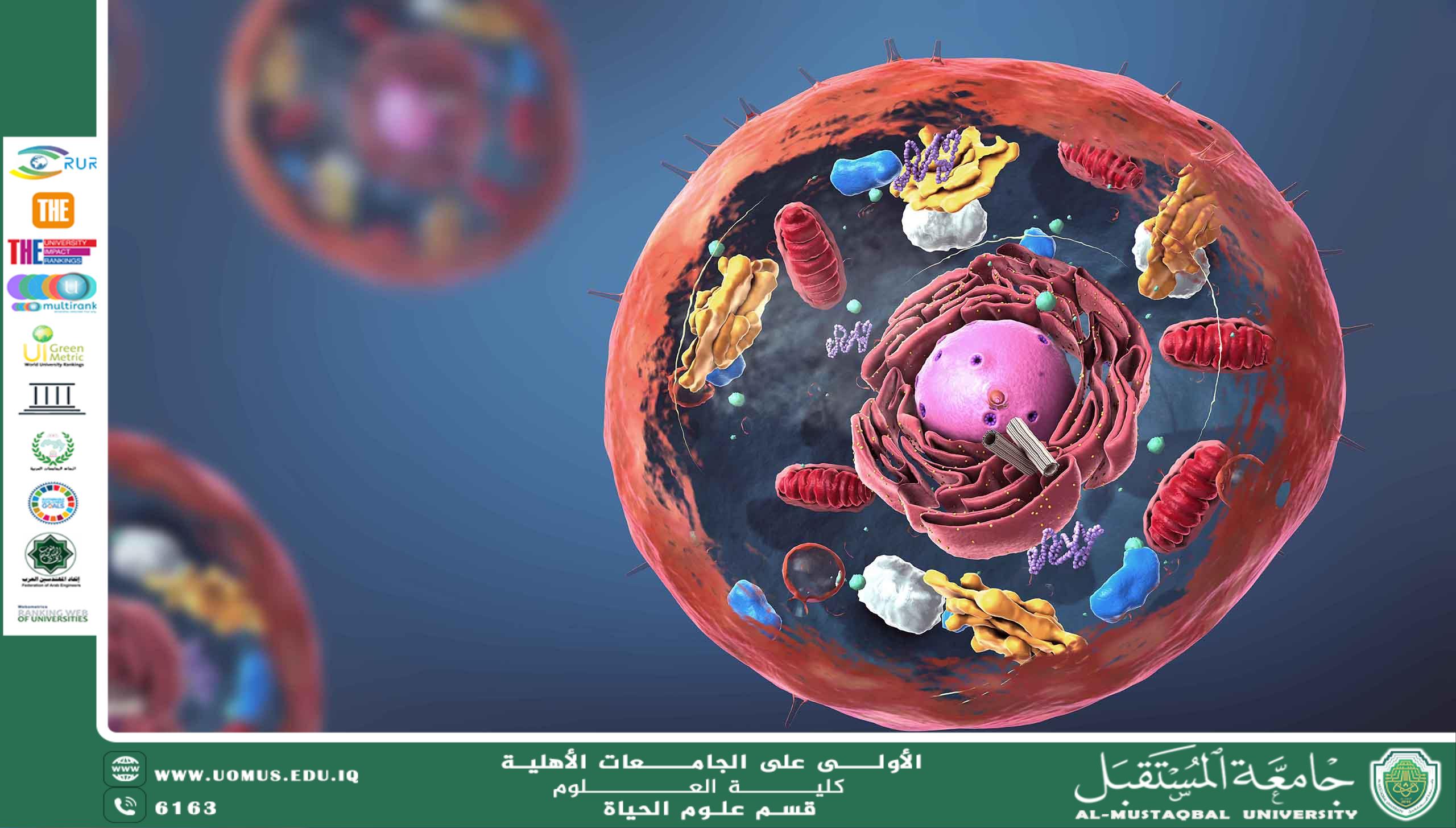
A scientific article by Ms. Ala Adel Rasmi entitled " Cell Biology "
Cell Biology is a branch of biology that studies the structure and function of cells, and how they interact with each other and with their surrounding environment. Cell biology focuses on cells as the smallest structural and functional unit in living organisms. This field covers a variety of topics, including:<br /><br />1. Cell Structure<br />Cell Membrane:<br />It is the membrane that separates the cell from the external environment, and consists of a bilayer of phospholipids. It controls the passage of materials into and out of the cell.<br />Nucleus:<br />It contains the genetic material (DNA) and is considered the control center of the cell, where cellular activities such as cell division and protein synthesis are regulated.<br />Cytoplasm:<br />It is the fluid that fills the cell and contains many organelles. Many cellular processes such as energy metabolism take place in it.<br />Mitochondria:<br />It is considered the "power station" of the cell, where energy is produced in the form of ATP through cellular respiration.<br />Ribosomes:<br />These are the sites of protein synthesis in the cell, and can be free in the cytoplasm or attached to the endoplasmic reticulum.<br />Endoplasmic Reticulum:<br />Divided into two types:<br />Rough endoplasmic reticulum: Contains ribosomes and participates in protein synthesis.<br />Smooth endoplasmic reticulum: Involved in fat synthesis and calcium storage.<br />Golgi Apparatus:<br />Participates in modifying proteins, packaging them and directing them to the correct places in the cell or outside it.<br />2. Cell Functions<br />Cell reproduction:<br />It occurs through the process of cell division (mitosis or meiosis) where the cell divides into two or more new cells.<br />Metabolism:<br />Includes all chemical processes that occur in the cell, such as breaking down molecules to obtain energy or building cellular compounds.<br />Protein production:<br />Cells rely on the process of transcription and translation to make proteins that are the basis for many cellular functions.<br />Cellular transport:<br />Involves active and passive transport of compounds across the cell membrane using carrier proteins.<br />3. Cellular organelles<br />Lysosomes:<br />Contain digestive enzymes used to break down unwanted materials inside the cell.<br />Peroxisomes:<br />Contain enzymes that break down fatty acids and eliminate toxic free radicals.<br />Cytoskeleton:<br />A network of protein fibers that provides structural support to the cell and contributes to the movement of cells and objects within it.<br />4. Cellular communication<br />Communication via cell signals:<br />Cells are able to communicate with each other through chemical signals, such as hormones and molecular messengers, to control many vital processes such as growth, differentiation, and metabolism.<br />Cell Junctions:<br />These are specialized structures that connect cells to each other, such as tight junctions that prevent fluid leakage, and adherens junctions that help connect cells to each other.<br />5. Practical study of cell biology<br />Advanced techniques such as electron microscopy and light microscopy are used to study cells at a very precise level.<br />Techniques such as gel electrophoresis and polymerase chain reaction (PCR) are used to analyze molecules within cells, such as DNA, RNA, and proteins.<br />6. Cell-related diseases<br />Many diseases begin with problems at the cellular level, such as cancer (which occurs when cells divide uncontrollably) or genetic diseases that arise from mutations in genetic material.<br />Neurological diseases such as Alzheimer's or Parkinson's disease are associated with damage to nerve cells.<br />Autoimmune diseases can arise when the immune system attacks healthy cells.<br />7. Future development of cell biology<br />Research is directed towards the study of stem cells and genetic technology to develop targeted treatments for diseases that affect cells.<br />Artificial intelligence is also used to analyze cellular data and provide new insights into the functions of cells.<br />Cell biology is an interdisciplinary science that combines biology, chemistry, physics and engineering, and plays a fundamental role in understanding the biological foundations of all living organisms and treating diseases that relate to cells.<br /><br /><br />AL_mustaqbal University is the first university in Iraq