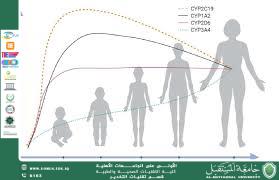
The effect of age on pharmacokinetics
There are significant changes in physiology throughout aging, which affects<br />the pharmacokinetics of many medications. Changes in body composition<br />during aging affect the distribution of many drugs, with subsequent,predictable effects on plasma and effect site concentrations, accumulation<br />and onset and offset of action.<br />The normal ageing process causes a decline in the function of many<br />organs, particularly the kidneys, and therefore drugs dependent on renal<br />clearance may have significantly prolonged effects in the elderly.<br />The cumulative effects of acquired pathology throughout life can affect the<br />response to various medications.<br />I n the neonatal period, increased total body water and a relatively low<br />proportion of body fat results in high volumes of distribution. Lower<br />concentrations of plasma proteins increase the fraction of unbound, active<br />drug in the plasma. Overall, this results in an increased per-weight dose<br />requirement for most drugs, although those that are highly protein bound<br />may need to be adjusted to account for the increased free drug fraction.<br />Metabolic pathways and renal elimination are immature in neonates;<br />therefore drugs that are activated by cytochrome P450 are rendered<br />ineffective, and drugs that undergo hepatic clearance, such as midazolam,<br />risk accumulation.<br />With increasing age there is a general decline in lean body mass and total<br />body water. The proportion of body fat increases in middle age and declines<br />in the elderly. This results in a reduced volume of distribution, thereby<br />increasing plasma concentrations.<br />Additionally, the age-related decline in renal function results in reduced<br />clearance. The combination of these effects can result in increased plasma<br />concentrations of drugs, requiring dose adjustment.<br />The combination of increased plasma concentrations with a frailty<br />phenotype and coexistent multisystem decline and development of<br />pathological conditions can result in enhanced response to many<br />medications, necessitating cautious titration, particularly for anaesthetic<br />agents.The effects of obesity on pharmacokinetics<br />With increasing total body weight, there is an increase in both lean and fa�y<br />mass, although in the obese the majority of the additional weight is due to<br />adipose tissues. This results in an increased volume of distribution for fat-<br />soluble drugs and presents a significant risk of drug accumulation and<br />delayed offset.<br />Clearance increases linearly with increases in lean body mass, although the<br />excess adiposity of obesity does not reflect any further increase in clearance.Therefore using total body weight for drug dosing may be associated with<br />drug toxicity, and for the majority of drugs, lean body weight is used. The<br />major exceptions to this are suxamethonium and atracurium (dosed by total<br />body weight).<br />د. ميعاد عدنان عبدالسلام <br /><br />AL_mustaqbal University, the first university in Iraq<br />