
Improvement Surface Properties of Ti Biomedical alloy
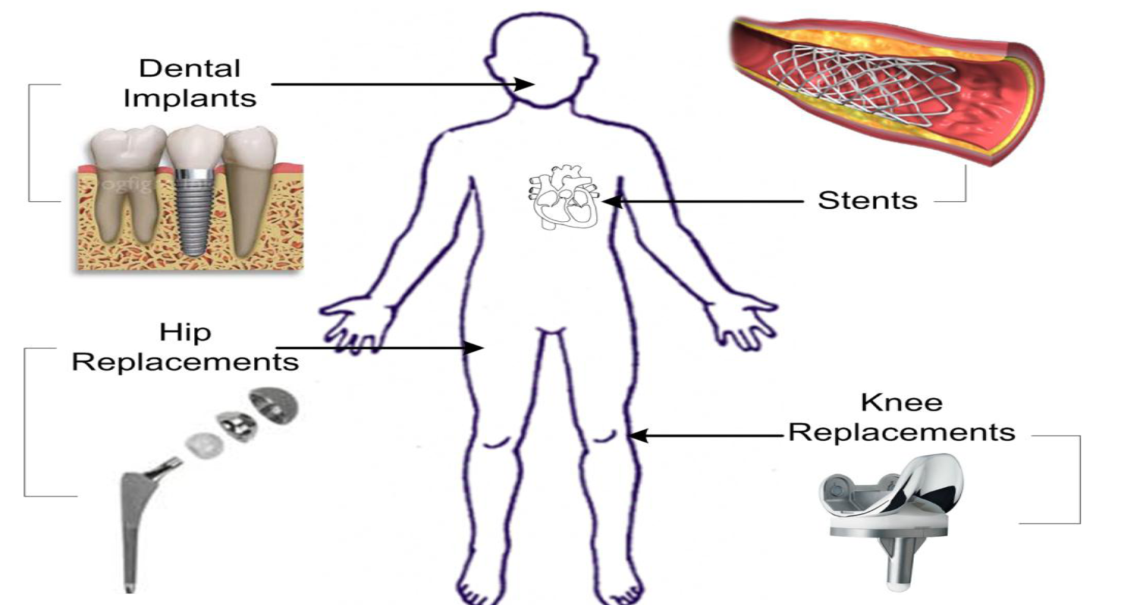
Biocompatible materials are any materials of natural of synthetic origin that are in contact with live tissue and/or biological liquids. Certain physical, chemical and mechanical features are required for the biological applications, based on the intended use in the living organism, for example, there will be different requirements for the bone substitutes and different for the substitutes of tendons and ligaments. In all the cases, the materials do have to be compatible with the body. In other words, the biocompatibility and in some case also the bioactivity are the key features in the successful implementation of the implants into the body. Biocompatible materials have to meet the requirements for high values of mechanical properties during the static and cyclic tests, in which the yield strength, tensile strength, elastic modulus, fatigue resistance, creep resistance compressive strength and resistance to abrasion are all monitored. The requirements for properties are different depending on the nature of application. The success of biomaterials in the body depends on factors such as: The material properties, Design, Biocompatibility of the material used, The technique used by the surgeon, The health and condition of the patient and The activities of the patient. <br /> <br />Titanium has become in the latter years a very important technical material whether in form of a technically pure metal or an alloy. In nature, it is the tenth most common element, but its use is limited primarily due to its high affinity to all non-metals (except noble gases). Despite being very chemically reactive, it exhibits great resistance to corrosion because - similar to aluminum - it covers itself with a oxide coating (TiO2).<br />Titanium occurs in two crystallographic structures. Pure titanium (commercial purity-CP) has hexagonal closed packed lattice (HCP) at room temperature, which is called an α phase. At 882°C (according to some authors at 880 or 885°C) this structure is changed into a body centered cubic lattice (BCC) called a β phase. Commercially pure (CP) titanium, alpha and near alpha titanium alloys: Generally non-heat treatable and weldable, Medium strength, good creep strength, good corrosion resistance, Alpha-beta titanium alloys: Heat treatable, good forming properties, Medium to high strength, good creep strength and Beta titanium alloys: Heat treatable and readily formable, Very high strength, low ductility<br /> <br /><br />