The Thymus Gland in Humans مقالة علمية للسيدة ايات حلمي بعنوان
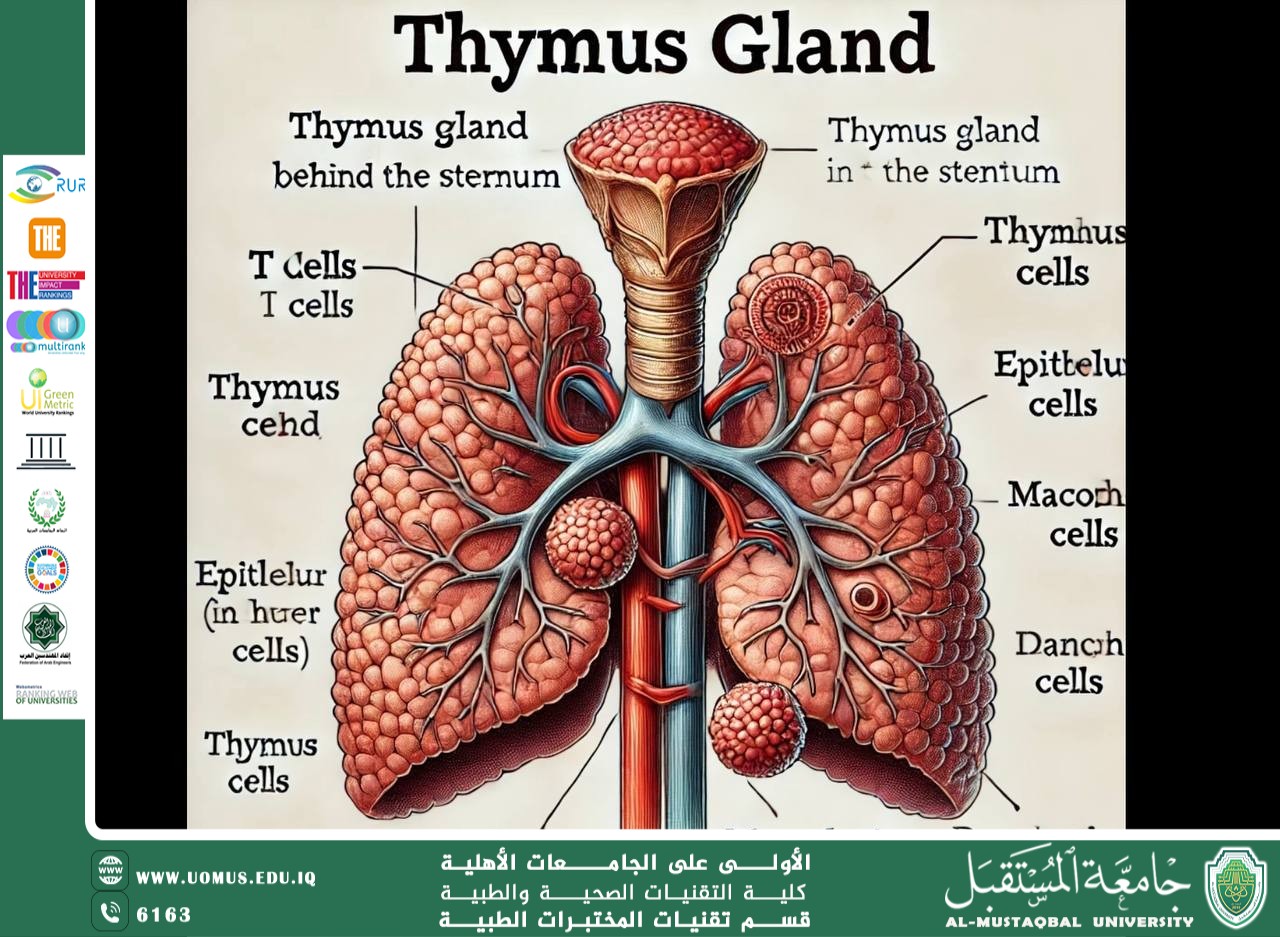
The Thymus Gland in Humans<br />Structure, Function, and Immunological Importance<br />Abstract<br />The thymus gland is a vital organ in the immune system, playing a key role in the maturation of T cells, which are responsible for adaptive immune responses. The gland consists of two lobes and is located in the upper chest behind the sternum. It grows significantly during childhood and begins to atrophy after puberty, leading to the replacement of its tissue with fat. The thymus is crucial for immune tolerance, ensuring the development of immune cells capable of recognizing pathogens without attacking the body’s own tissues. Dysfunction of the thymus can lead to immune disorders such as autoimmune diseases and chronic infections.<br /><br />1. Introduction<br />The thymus is a central lymphoid organ that is crucial for T cell maturation. Its immunological significance was first recognized in the mid-20th century when researchers found that thymectomy in newborn animals resulted in severe immunodeficiency (Miller, 1961).<br /><br />2. Anatomical and Structural Composition<br /> • The thymus consists of two main lobes, enclosed by a fibrous capsule containing multiple lobules.<br /> • The lobules are divided into two regions:<br /> • Cortex (rich in immature T cells).<br /> • Medulla (where final T cell differentiation occurs).<br /> • It contains supportive cells, including epithelial cells, macrophages, and dendritic cells, which aid in T cell maturation (van Ewijk et al., 1999).<br /><br /><br /><br />3. Immunological Function<br />3.1 T Cell Maturation<br />Immature T cells originate from the bone marrow and migrate to the thymus, where they undergo selection processes:<br /> 1. Positive selection: The thymus retains cells that can recognize major histocompatibility complex (MHC) molecules.<br /> 2. Negative selection: Cells that strongly react to self-proteins are eliminated to prevent autoimmune diseases (Klein et al., 2014).<br /><br />3.2 Hormonal Regulation of Immunity<br /> • The thymus secretes hormones such as thymosin and thymopoietin, which promote T cell maturation (Bodey et al., 1997).<br /> • These hormones also regulate immune responses against infections.<br /><br />4. Thymic Development Across the Lifespan<br /> • The thymus is highly active in childhood, playing a vital role in shaping the immune system.<br /> • After puberty, it undergoes gradual involution, leading to reduced T cell production (Gui et al., 2007).<br /> • However, the thymus retains some immune activity even in old age and continues producing new T cells, albeit at a slower rate.<br /><br />5. Thymus-Related Diseases<br />5.1 Immunodeficiency<br /> • Thymectomy or dysfunction in early life results in impaired immune responses and increased susceptibility to infections.<br /> • In some cases, early thymic involution can lead to severe combined immunodeficiency (SCID).<br /><br />5.2 Autoimmune Diseases<br /> • Failure of the thymus to eliminate self-reactive T cells can cause autoimmune disorders, such as myasthenia gravis (Gilhus, 2016).<br /><br />5.3 Thymic Tumors<br /> • Thymomas and thymic carcinomas can affect immune function and respiratory health.<br /><br />6. Strategies to Support Thymus Health<br /> 1. Proper Nutrition: Consuming foods rich in zinc and vitamin C to support <br />immune function.<br /> 2. Regular Exercise: Moderate physical activity enhances immune system activity.<br /> 3. Stress Management: Research has shown that chronic stress accelerates thymic involution (Sapolsky et al., 2000).<br /><br />7. Conclusion<br />The thymus gland is a key organ in the immune system, responsible for T cell maturation and immune regulation. Although it atrophies with age, its impact on immune health remains significant throughout life. Ongoing research is exploring ways to stimulate thymic function in aging individuals to maintain effective immune responses.<br /><br /><br /><br /><br /><br />جامعة المستقبل الجامعة الاولى في العراق<br />قسم تقنيات المختبرات الطبية الاول في التصنيف الوطني العراقي<br />