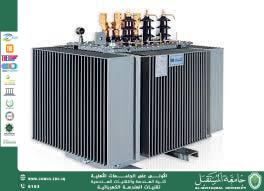
Electrical Transformers
Electrical Transformers<br />Introduction<br />Electrical transformers are essential components in power systems, facilitating the efficient<br />transmission and distribution of electrical energy. They function based on the principles of<br />electromagnetic induction, allowing voltage levels to be adjusted to meet the requirements of<br />different applications. This report explores the types, working principles, applications, and<br />maintenance of electrical transformers.<br />Working Principle of Transformers<br />A transformer operates on the principle of electromagnetic induction. It consists of primary and<br />secondary windings wrapped around a magnetic core. When an alternating current (AC) flows<br />through the primary winding, it generates a changing magnetic field that induces a voltage in the<br />secondary winding. The voltage transformation depends on the turns ratio of the windings:<br />Where: Vs = Vp ×́́́́ 𝑁𝑆<br />𝑁𝑃<br />• Vs = Secondary voltage<br />• Vp= Primary voltage<br />• Ns= Number of turns in the secondary winding<br />• Np= Number of turns in the primary winding<br />Types of Electrical Transformers<br />Transformers are classified based on several criteria:<br />1. Based on Voltage Level:• Step-Up Transformer: Increases voltage, used in power generation stations.<br />• Step-Down Transformer: Decreases voltage, used in distribution networks.<br />2. Based on Core Construction:<br />• Core-Type Transformer: Windings surround the core.<br />• Shell-Type Transformer: Core surrounds the windings.<br />3. Based on Cooling Method:<br />• Oil-Cooled Transformer: Uses insulating oil for cooling.<br />• Air-Cooled Transformer: Uses air for cooling.<br />4. Based on Application:<br />• Power Transformers: Used in substations for high voltage applications.<br />• Distribution Transformers: Used in local distribution networks.<br />• Instrument Transformers: Includes current and potential transformers for measurement<br />and protection.<br />• Isolation Transformers: Used for safety and noise reduction.<br />Applications of Transformers<br />Transformers are used in various sectors, including:<br />• Power Generation and Transmission: Enhancing voltage for long-distance power<br />transmission.<br />• Industrial Applications: Providing appropriate voltage levels for machinery.<br />• Electronics: Used in power supplies, amplifiers, and electronic circuits.<br />• Renewable Energy Systems: Integrating solar and wind power into the grid.<br />Transformer Losses and Efficiency<br />Transformers experience different types of losses, which impact their efficiency:<br />• Copper Losses: Due to the resistance of windings.<br />• Iron Losses (Core Losses): Includes hysteresis and eddy current losses.<br />• Stray Losses: Caused by leakage flux.<br />• Dielectric Losses: Occur in insulation materials.<br />Efficiency is calculated using: 𝐸𝑓𝑓𝑖𝑐𝑖𝑒𝑛𝑐𝑦 = 𝑜𝑢𝑡𝑝𝑢𝑡 𝑝𝑜𝑤𝑒𝑟<br />𝐼𝑛𝑝𝑢𝑡 𝑝𝑜𝑤𝑒𝑟<br />∗ 100%<br />Maintenance and Testing of TransformersRegular maintenance ensures the longevity and reliability of transformers. Common practices<br />include:<br />• Oil Testing: Checking for moisture and insulation degradation.<br />• Insulation Resistance Testing: Measuring insulation quality.<br />• Thermal Imaging: Identifying overheating issues.<br />• Transformer Turns Ratio (TTR) Test: Verifying winding ratios.<br />Conclusion<br />Electrical transformers play a vital role in power systems, enabling the efficient transmission and<br />distribution of electricity. Understanding their working principles, types, and maintenance<br />practices ensures their optimal performance and longevity. With advancements in transformer<br />technology, future developments aim to enhance efficiency and reliability while integrating<br />renewable energy sources into power grids.<br />م.م زهراء إبراهيم مهدي<br />جامعة المستقبل الجامعة الأولى في العراق