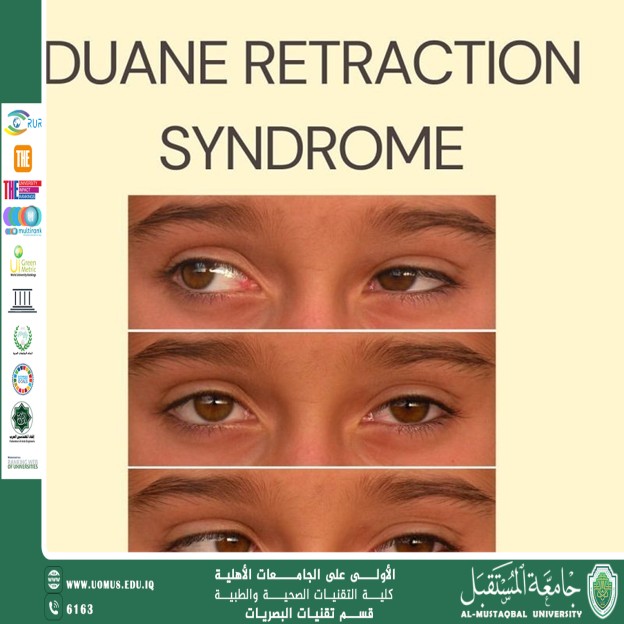
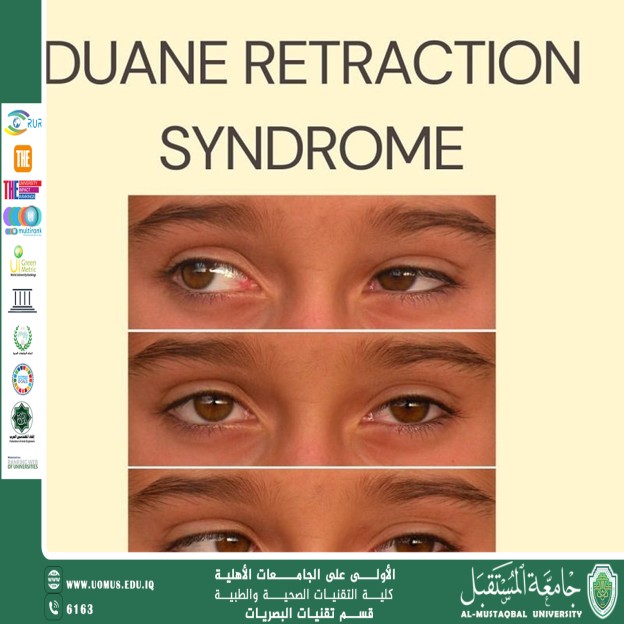
An article by the lecturer Noor Khamis entitled(What is Duane Syndrome)
What is Duane Syndrome?<br />Duane Retraction Syndrome (DRS) is a congenital eye movement disorder characterized by abduction and/or adduction restriction, palpebral fissure narrowing, and adduction retraction of the globe3 Patients with DRS display an anomalous head position to obtain single binocular vision and may have an upshoot/downshoot when the affected eye is adduced.<br />DRS, also known as Stilling-Turk-Duane Syndrome.<br />Classification:<br />DRS was classified into three types; Type I, II and III However, Some researchers simplified DRS types into three subtypes, including esotropic, exotropic and orthotropic, based on the deviation in the primary position. <br />Signs:<br />DRS is identified by any or all of the following signs: complete or less often partial absence of abduction, retraction of globe on adduction, narrowing of palpebral fissure during adduction (induced 3 ptosis), partial deficiency of adduction, oblique movement with attempts at adduction, upshoot or downshoot of globe with adduction (Leash Phenomenon), widening of palpebral aperture with abduction, deficiency of convergence.<br />Adduction in DRS patients has a feature of over elevation (up shoot), over depression (down shoot), or both. <br />Prevalence: <br />The prevalence of DRS is found in 1-4 % of the strabismic patients. The prevalence of DRS in previous studies was usually (80% cases) commonly affecting females more than males and more frequently was observed in the left eye of the patients.<br /><br />“Al-Mustaqbal University is the top-ranked among private universities.”<br />