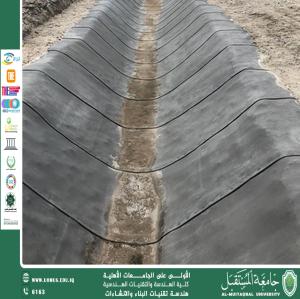
Concrete Blanket: An Advanced Technology in Construction
Introduction<br />With the continuous advancement in construction technologies, modern materials have emerged to offer innovative solutions to traditional challenges. Among these is the Concrete Canvas, a type of fabric impregnated with cement that hardens upon hydration. This technology combines the properties of traditional concrete with ease of use, making it an ideal choice for various engineering and construction applications.<br /><br />Components of the Concrete Blanket<br />The concrete blanket consists of three main layers:<br /><br />Cement-impregnated fabric: Contains a special cement mixture that reacts with water to harden.<br />Water-resistant support layer: Prevents water leakage and maintains material stability during curing.<br />Reinforced fiber layer: Enhances durability and increases resistance to tearing and abrasion.<br />Working Mechanism of the Concrete Blanket<br />Using the concrete blanket is simple and involves the following steps:<br /><br />Spreading the blanket over the desired surface, whether it is ground, a slope, or a channel.<br />Securing the edges to prevent movement during water interaction.<br />Hydrating the blanket according to specifications, initiating the cement's chemical reaction.<br />Allowing the material to cure, which typically takes 24 to 48 hours, resulting in a strong, weather-resistant surface.<br />Advantages of the Concrete Blanket<br />The concrete blanket offers numerous benefits compared to traditional concrete, including:<br /><br />Ease and speed of installation: Requires no heavy equipment and can be deployed quickly.<br />Flexibility in application: Can be cut and shaped to fit various engineering needs.<br />Cost reduction: Lowers labor and material costs compared to conventional concrete.<br />Resistance to wear and damage: Ensures long-lasting durability in harsh environmental conditions.<br />Eco-friendly: Requires less water and reduces carbon emissions compared to traditional concrete.<br />Applications of the Concrete Blanket<br />Thanks to its unique advantages, the concrete blanket is used in various fields, such as:<br /><br />Slope and soil protection: Prevents erosion and degradation in areas exposed to environmental factors.<br />Lining of channels and waterways: Reduces water loss and enhances fluid flow efficiency.<br />Road and infrastructure repairs: Reinforces roadside areas and covers potholes and cracks.<br />Military and emergency applications: Used for creating temporary shelters and rapid engineering solutions in field projects.<br />Protective wall construction: Applied in industrial sites and areas prone to floods and landslides.<br />Future of the Concrete Blanket<br />Given its numerous benefits, the concrete blanket is expected to become more widespread in the future, particularly with the growing demand for fast and sustainable construction technologies. Additionally, new types with enhanced properties, such as increased compressive and abrasion resistance, are being developed, making them an attractive option for modern projects.<br /><br />Conclusion<br />The concrete blanket represents a significant advancement in improving construction efficiency and providing durable and effective solutions to various engineering challenges. With its ease of use and high resistance, it is an ideal choice for infrastructure projects and modern construction, making it a promising technology in the sustainable building sector.