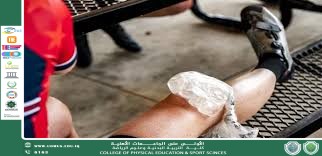
An article by the lecturer, Ms. Taiba Faisal Jaber, entitled: Can ice be used to treat sports injuries
Can ice be used to treat sports injuries?<br />Scientific and practical experiments have proven that using ice to treat sports injuries has a significant and effective effect if used at the beginning of the player's injury, as it helps to get rid of 50% of the size of the injury due to the effective therapeutic properties of ice that protect against complications and side effects that affect the injured organ after the injury.<br /><br />What are the benefits of ice to treat sports injuries?<br />- The benefit of using ice to treat sports injuries lies in its contribution to:<br />- Reducing blood circulation and narrowing capillaries.<br />- Reducing swelling of the injured organ and limiting its occurrence.<br />- Stopping bleeding.<br />- Relieving and numbing pain.<br /><br />When can ice be used to treat sports injuries?<br />The cases in which sports injuries can be treated with ice include the following:<br />- Cases of bleeding.<br />- Muscle tears.<br />- Swellings resulting from exposure to a bruise or fracture.<br />- Dislocations that affect the joints.<br />- Simple inflammations.<br />- Deep muscle spasms.<br />- Small, shallow wounds.<br />How does ice work to treat sports injuries?<br />The principle of using ice to treat sports injuries is that ice:<br />Helps get rid of inflammation and swelling at the site of the injury, thus eliminating pain.<br />Ice causes numbness in the injured tissues, thus anesthetizing the site of the injury.<br />Ice helps reduce the speed of nerves in transmitting the sensation of pain, thus breaking the cycle of pain.<br />Ice helps reduce metabolic processes, thus helping to reduce the resulting heat that increases the degree of injury in the muscles.<br />Using ice to treat sports injuries is very useful in the first period immediately after the injury because ice causes blood vessels to contract, and after removing the ice, the blood vessels expand and the injured tissues are washed and rid of the chemical residues of the injury, and the muscles are fed with oxygen or sugar.<br />What are the ways to use ice to treat sports injuries?<br />The benefits of ice to treat sports injuries can be obtained through one of the following methods:<br />Cold compresses: A piece of cloth is immersed in water mixed with ice, then placed on the area to be treated and the process is repeated for twenty minutes.<br />Ice massage: This is done by taking a piece of ice and making circular or back-and-forth movements around the affected area. The process lasts for twenty minutes.<br />Ice bags: A quantity of crushed ice is placed in a plastic bag and then placed on the affected area for twenty minutes.<br />Cold baths: This method is used to treat injured limbs by placing the injured limb in cold water mixed with ice for fifteen minutes.<br />Alternative baths: This method is used to use ice to treat sports injuries during the first 48 hours of the injury in order to prevent calcifications in the affected areas. It is as follows:<br />- Place the injured part in hot water for three minutes.<br />- Then place it in cold water for a minute.<br />This process is repeated for a quarter of an hour and the hot water bath ends.<br />- Use of ice spray: Which usually contains ethyl chloride, which is a fast-acting cold local anesthetic used to treat sports injuries during matches. It is a first aid and anti-inflammatory.<br />What are the contraindications to using ice to treat sports injuries?<br />There are a number of cases in which treating sports injuries with ice is harmful and should therefore be avoided, which may include:<br />- Ice should not be applied directly to the skin or the area of bone protrusion.<br />- Ice should not be applied to the injury for more than twenty minutes at a time and treatment can be repeated three times a day.<br />- Ice should not be used in cases of rheumatoid arthritis, Raynaud's syndrome, cold allergies, paralysis, or numbness in the extremities for any reason.<br />Can ice be used to treat back pain?<br />Yes, ice can be used to treat sports injuries in all parts of the body, including the back. Although applying ice to the affected back muscles is beneficial, massaging with ice is much more beneficial according to the results of studies and research.<br />How to massage the back with ice<br />Regular ice cubes can be used to massage the back as they do the job, but it is preferable to use large pieces as they are better. It is also recommended that someone else do the massage because massaging the patient's back is difficult and useless. The process of massaging the back with ice includes the following instructions:<br />The massage is done by placing ice on the area of the back pain and moving the ice in a circular motion.<br />The massage should be focused on the specific area only.<br />The bony prominences of the spine should be avoided.<br />The duration of placing ice on the injury should be limited to no more than five minutes at a time to avoid burning with ice.<br />Ice should not be placed directly on the skin to avoid skin burns with ice. With the movement of ice and massage, these complications are overcome.<br />It should also be known that the key to success with ice treatment is to reach the stage of numbness in the painful area without burns. Once the numbness stage is reached, gentle movement and simple massage of this area should be started until the numbness ends, then a second cycle of ice should be started to reach the stage of numbness and so on. In this way, we can get two or three cycles.<br />If it is not possible to use ice massage, it is possible to benefit from placing ice on the injury site for a period of fifteen to twenty minutes, provided that a barrier is placed between the skin and the ice to avoid burning the skin.<br />A roll of cloth can be made, soaked in water, placed in a plastic bag, and then placed in the freezer.<br />In emergency cases where ice packs are not available, frozen food bags can be used on the painful area and massaged after wrapping them in a cloth. Be careful not to use ice for more than the specified period and do not put ice packs on and sleep with them.