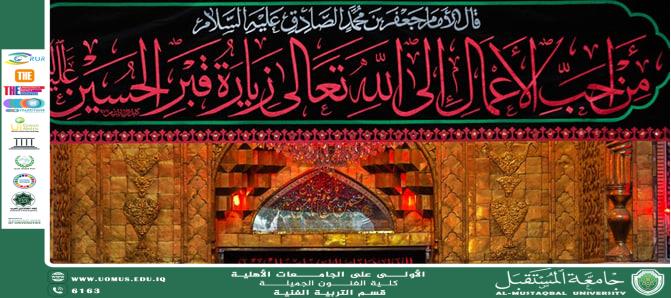

An article entitled “Aspects of Islamic Architecture in the Shrine of Imam Hussein and his brother Abbas (peace be upon them)” by the lecturer "Suhaila Kazim Al-Saadouni."
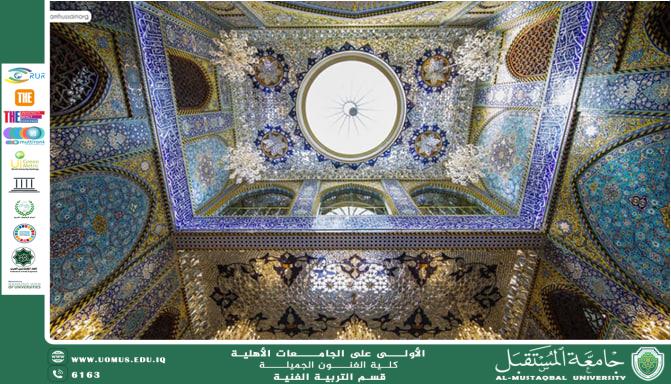
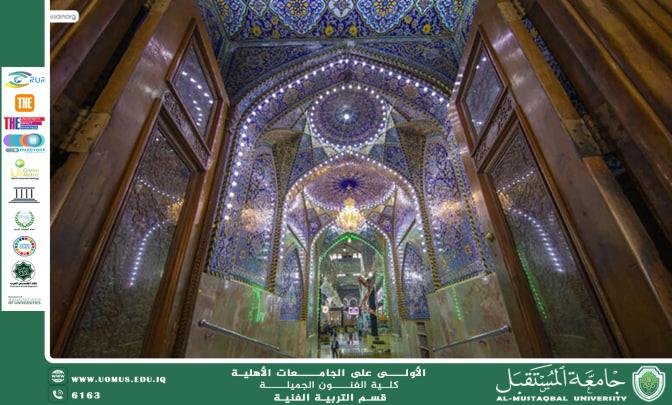
The magnificent architectural arts and beautiful Islamic decorations in the shrine of Imam Hussein (peace be upon him) in the holy city of Karbala captivate visitors and observers, where the language of creativity blends in its finest form in the designs.<br /><br />Islamic architecture is considered one of the most unique forms of visual arts, as this creative genre produced by Islamic culture left a significant mark on the history of arts across the ages. Muslim artists proved their excellence in this field through the construction of mosques and large places of worship, succeeding in its complex calculations based on precise scientific methods to analyze and complete architectural structures in a realistic way, using towering building elements such as columns, arches of various types, domes, minarets, muqarnas, windows, and other Islamic architectural elements in religious buildings, which added vibrant diversity to the architectural and decorative compositions, achieving functional, aesthetic, and expressive results for these artistic creations.<br /><br />Anyone who examines the architecture of the holy shrines and other religious buildings that flourished in Karbala over the centuries can clearly see the pure Islamic characteristic that reflects the artistic sophistication achieved by Islamic civilization in various eras.<br /><br />The shrines and mosques of Imam Hussein and his brother Abbas (the Hussaini and Abbasi shrines) are among the most prominent examples of Islamic architectural art in the city, with the artistic treatment of gold and silver, and the stunning decorative formations of mosaics and small mirror pieces that adorn the two shrines, giving them an air of grandeur and splendor.<br /><br />The complex muqarnas were used as a key element of architectural decoration, especially inside the shrines and at the external entrances to their courtyards.<br /><br />The architecture of the sacred shrines is characterized by important architectural features such as their grandeur, tall walls, doors, and the use of the finest imported building materials like marble, precious stones, and rare woods.<br /><br />Another distinctive architectural feature of the religious buildings in Karbala, particularly the holy shrines, is the use of local building materials such as brick (adobe), plaster, and glazed colored tiles (qashani), for which the city of Karbala is famous, decorating the domes, minarets, walls, arches, and entrances, among other elements.<br /><br />The two shrines of Karbala are also distinguished by their domes and minarets, which are covered with a thin layer of gold, while other parts are adorned with qashani decorations, beautifully inscribed with Kufic script in the form of decorative elements and verses from the Holy Qur'an.<br /><br />The design includes several formations that were handled with contrasting and comparable color treatments to highlight the architectural features. For example, yellow was used for geometric decorations to fill the space of the door and window, contrasting with the open spaces that gave them depth. In addition, the contrast of colors between those parts and the other parts' spaces, along with the harmony with some of the decorative colors, achieved clear prominence for the formations. The contrast between the side formation of the yellow door and its blue cup-shaped decorations, and the handling of the space of the vessel in dark green and some black for the decorative areas, made the cup-shaped decorations stand out as if they were emerging from the structure. Additionally, blue was used for the pointed arch space, yellow for its plant motifs, and other parts with diamond-shaped geometric forms and their color and structural organization helped highlight the architectural shape within the overall design of the arch in this blessed spot.<br />The above article effectively contributes to the achievement of sustainable development goals, particularly Goal 4 related to "Quality Education," as it highlights the importance of improving the quality of education and providing inclusive educational opportunities for all.<br /><br />Almustaqbal University, the first university in Iraq.