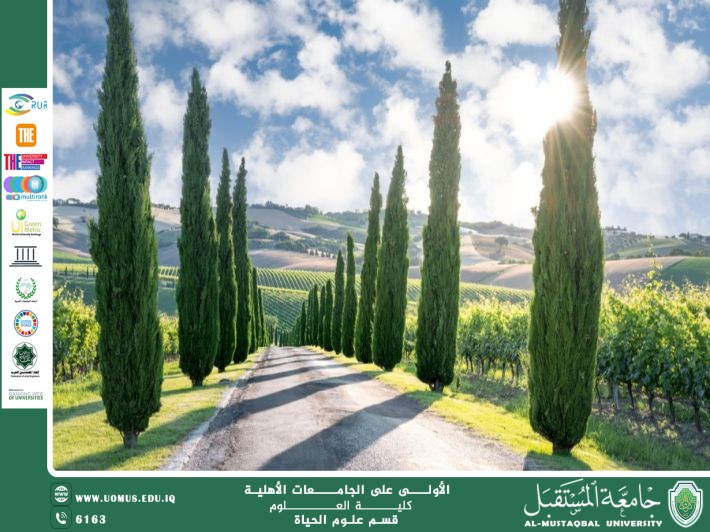
A scientific article by the lecturer ( Zainab Nazim Aziz) entitled “The Cypress Tree”
The cypress tree is an evergreen tree known for its beauty and fragrant scent. It is a perennial tree that lives for hundreds of years. It is used for decoration, wind protection, and timber production, and it also has numerous medicinal and agricultural benefits.<br />Scientific Classification of the Cypress Tree<br />Kingdom: Plantae<br />Division: Angiosperms<br />Order: Pinales<br />Family: Cupressaceae<br />Genus: Cupressus<br />Species: Various species, such as Cupressus sempervirens (evergreen cypress).<br />Types of Cypress Trees<br />1. Evergreen Cypress (Cupressus sempervirens)<br />One of the most widespread species in the Mediterranean region.<br />It is characterized by its needle-like leaves and strong aromatic scent.<br />2. Desert Cypress (Cupressus arizonica)<br />Grows in arid regions, particularly in North America.<br />It is drought-tolerant and used for decoration and wind protection.<br />3. Italian Cypress (Cupressus italica)<br />It is widely planted in gardens and parks due to its attractive conical shape.<br />4. Mexican Cypress (Cupressus lusitanica)<br />It is characterized by its rapid growth and is used in the timber industry.<br />Physical Characteristics of the Cypress Tree<br />Height: 10 to 40 meters.<br /><br />Leaves: Needle-shaped, evergreen, and aromatic.<br />Fruits: Spherical and contain small seeds.<br />Trunk: Straight with a brown or gray bark.<br />Native Habitat and Distribution<br />Cypress grows in temperate and warm regions, especially in the Mediterranean, North America, and parts of Asia.<br />It is widely planted in gardens and farms due to its attractive shape and resistance to harsh climatic conditions.<br />Benefits and Uses<br />1. Environmental Benefits<br />It absorbs carbon dioxide and improves air quality.<br />It is used as a windbreak to protect agricultural crops.<br />Its roots help prevent soil erosion.<br />2. Medicinal Benefits<br />It contains essential oils used in herbal remedies.<br />It helps treat respiratory diseases such as asthma and bronchitis.<br />It is used in aromatherapy to relieve stress and anxiety.<br />3. Industrial Uses<br />Its wood is used in the manufacture of furniture, doors, and boats due to its high resistance to moisture.<br />Its essential oils are used in the perfume and soap industries.<br />4. Agricultural and Cosmetic Uses<br />It is planted in public and private gardens to beautify the landscape.<br />It is used in landscaping roads and paths due to its attractive conical shape.<br />How to Grow and Care for a Cypress Tree<br />Soil: It grows in a variety of soil types, but prefers well-drained soil.<br />Climate: It tolerates dry and moderate conditions but does not grow well in extremely cold regions.<br /><br />Watering: It requires moderate watering, especially during the dry months.<br />Pruning: It is best to prune regularly to maintain its shape and prevent the spread of excess branches.<br />Diseases and Pests Affecting the Cypress Tree<br />1. Fungal blight: Causes yellowing and drying of the leaves.<br />2. Aphids and spider mites: Feed on the sap, impairing its growth.<br />3. Root rot: Caused by overwatering or poorly drained soil.<br />Prevention and Treatment Methods:<br />Use fungicides when fungal blights appear.<br />Control insects with natural pesticides.<br />Improve soil drainage and avoid overwatering.<br />Conclusion<br />The cypress tree is a perennial tree that is beneficial environmentally, medicinally, and agriculturally. Thanks to its aesthetic and aromatic properties, it is used in landscaping, windbreaks, and the production of wood and essential oils. Its cultivation and care contribute to improving the environment and benefiting from its many benefits.<br /><br />Al-Mustaqbal University is the leading university in Iraq.