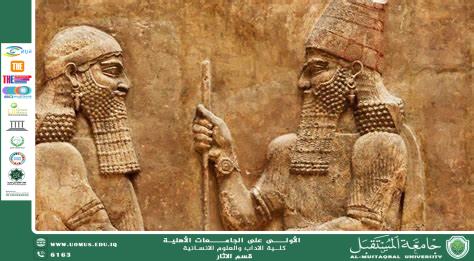
Faculty member Riya Naseef Jasem from the Department of Archaeology writes a scholarly article titled "The General Principles of Religion in Mesopotamia."
The General Principles of Religion in Mesopotamia<br />(Presented within the framework of Sustainable Development Goal 4: Quality Education)<br /><br />Religion in Mesopotamia was characterized by a number of attributes that have remained preserved throughout most historical eras. Among the most prominent is the principle of vitalism, which was based on the belief in an inherent force in nature that was personified in the deities. The ancient man attributed to each natural phenomenon a specific god, each differing in form and characteristics. It is only natural that the heavens received the greatest attention from man since they encompass most of the earth; accordingly, the Sumerians assigned to each cosmic phenomenon a personified deity and ordained the occurrence of that phenomenon. These personifications were similar to human beings, serving as the "driving force" or "administrator" of those phenomena. Furthermore, anthropomorphism was a distinctive feature of Sumerian religious thought, as the ancient man likened the gods to human society—they ate, drank, and traveled.<br /><br />However, the deities possessed a unique attribute: they retained immortality for themselves, while death and decay were reserved for humans. People believed that the abode of the gods was in the heavens, the underworld, or in deep waters. Special temples were dedicated to these deities, where offerings, vows, prayers, and supplications were performed according to specific rituals carried out by both the people and the temple priests.<br /><br />Another characteristic is plurality, which emerged due to the multitude of natural phenomena that significantly impacted human life. This abundance led to an increase in the number of gods worshipped, with each phenomenon having its own designated deity. Additionally, continuity was a prominent trait: religious customs maintained their essence consistently over time; the gods that were sanctified and worshipped in ancient eras remained the same ones revered in later periods, and the same applied to the rituals and ceremonies practiced by the ancient people. Moreover, some cities specialized in the worship of certain deities, elevating their status above others, or a group of deities was distinguished and exalted through dedicated worship and adoration—a concept known as the principle of exclusivity or preference.<br /><br />Al‑Mustaqbal University – The Premier University in Iraq.