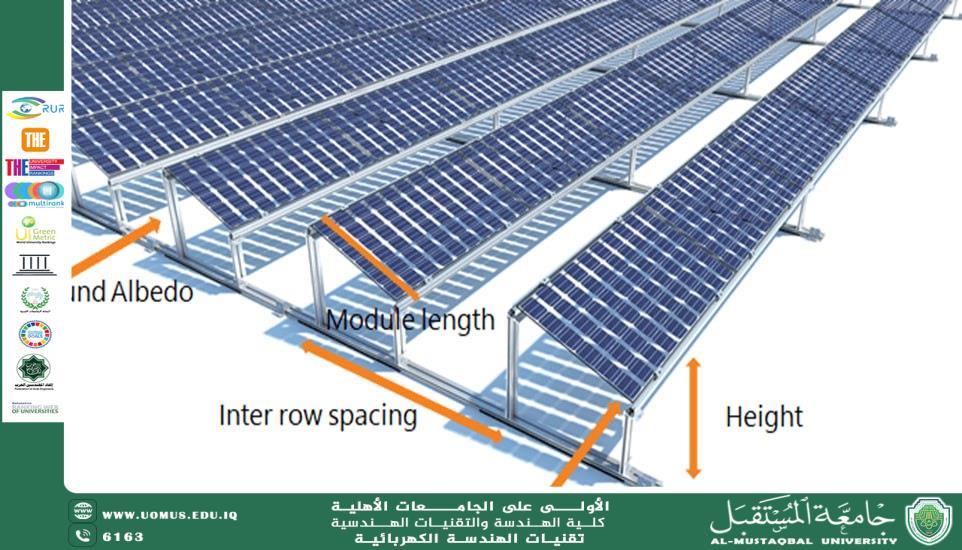
Impact of Tilt Angles on the Power Generation of
م.م زهراء ابراهيم <br />Impact of Tilt Angles on the Power Generation of Photovoltaic (PV) Panels<br /><br />Introduction<br /><br />The efficiency of photovoltaic (PV) systems is influenced by multiple factors, including solar irradiance, temperature, and the tilt angle of the solar panels. The tilt angle plays a crucial role in optimizing the incident sunlight on the panel surface, thereby enhancing energy generation. This report analyzes the impact of different tilt angles on the power output of PV panels and identifies the optimal angle for maximum energy harvesting.<br /><br />Methodology<br /><br />To assess the effect of tilt angles on PV power generation, a series of experiments were conducted under controlled environmental conditions. The following parameters were considered:<br /><br />Tilt Angles: Panels were tested at various angles ranging from 0° (horizontal) to 90° (vertical) in increments of 10°.<br /><br />Environmental Conditions: The experiments were conducted under clear sky conditions to minimize variations due to cloud cover.<br /><br />Measured Parameters: The power output, solar irradiance, and panel temperature were recorded for each tilt angle.<br /><br />Location: The study was conducted at a fixed geographic location with known solar path characteristics.<br /><br />Results and Discussion<br /><br />The results indicate a significant correlation between the tilt angle and the power output of the PV panels. Key findings include:<br /><br />Optimal Tilt Angle: The maximum power output was observed at a tilt angle that closely matched the latitude of the location, confirming theoretical expectations.<br /><br />Low Tilt Angles (0° - 20°): Panels at lower tilt angles received more direct sunlight during midday but suffered from lower overall daily energy collection due to suboptimal morning and evening angles.<br /><br />High Tilt Angles (70° - 90°): These angles resulted in reduced power generation due to increased reflection losses and less effective sunlight incidence.<br /><br />Seasonal Variations: The optimal tilt angle was observed to shift slightly depending on the season, with lower angles being preferable in summer and higher angles in winter.<br /><br />Conclusion<br /><br />The study confirms that the tilt angle has a substantial impact on PV panel performance. Adjusting the tilt angle according to seasonal variations can enhance energy generation. For fixed-tilt systems, setting the tilt angle close to the geographic latitude yields the best overall performance. Future studies could incorporate real-time tracking systems to further optimize energy yield.<br /><br />Recommendations<br /><br />Fixed PV systems should be installed at an angle close to the latitude of the installation site.<br /><br />Seasonal tilt adjustments can enhance annual energy generation.<br /><br />Further studies should explore the impact of bifacial panels and reflective surfaces on energy efficiency at different tilt angles.<br />Al-Mustaqbal University is the first university in Iraq.