
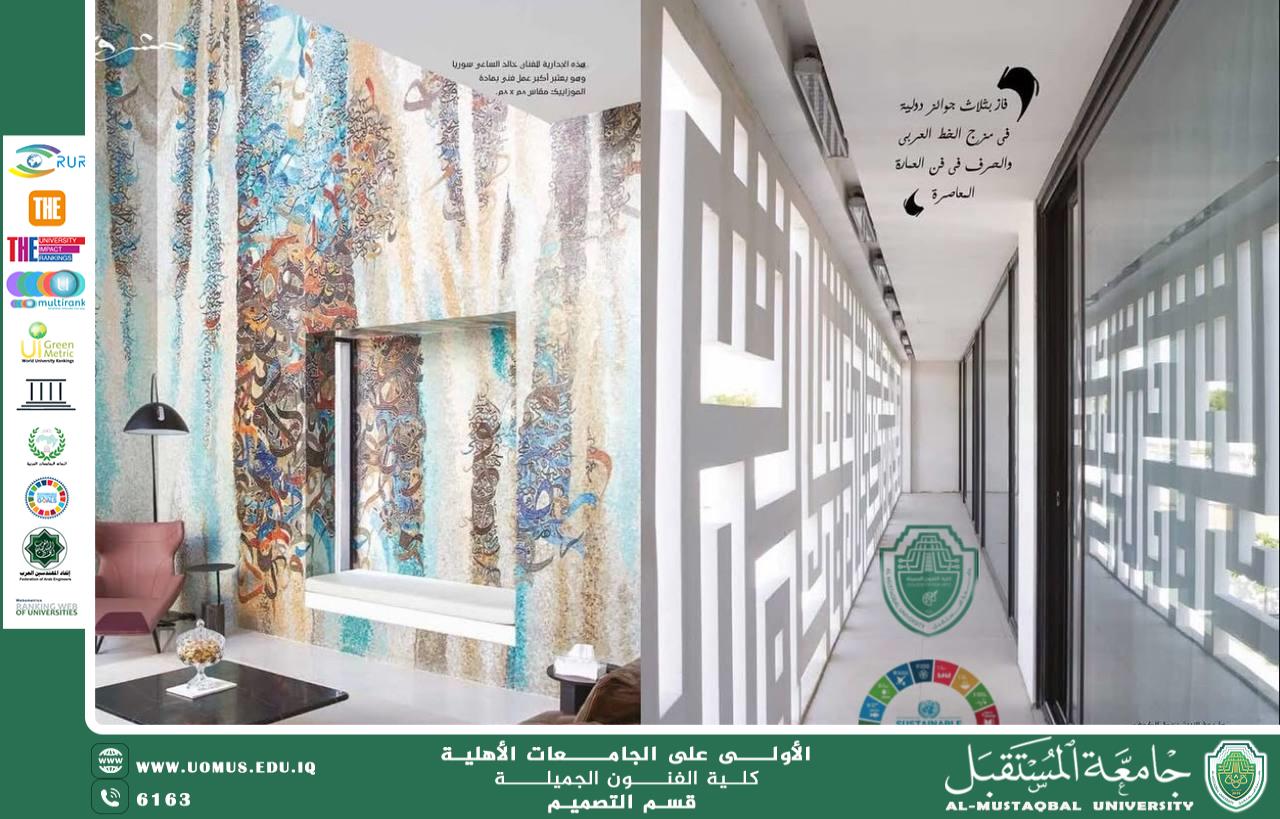
An Article "Islamic Architecture and Arts in Iraq: Embodying Sustainability through Design and Art" By The Teaching assistant musa dhyaa alaq
Islamic Architecture and Arts in Iraq: A Testament to Sustainability and Environmental Balance Islamic Influences on Iraqi Architecture:<br /><br />Since the Islamic conquest, Iraq has witnessed a remarkable architectural evolution that reflects Islamic values and principles. This is evident in the design of mosques, schools, and homes that feature unique architectural elements, such as:<br /><br />The Inner Courtyard (Housh): A central element in traditional homes, the courtyard provides an internal green space that improves the indoor climate and offers privacy, reflecting a deep understanding of interaction with the environment.<br /><br />Arches and Domes: Used to distribute loads efficiently and create spacious interiors without requiring many columns, showcasing skillful use of available resources.<br /><br />Mashrabiyas (Shanasheel): A technical solution that provides ventilation and natural lighting while maintaining privacy, exemplifying the combination of aesthetic and functional elements.<br /><br />Islamic Influences on Iraqi Arts:<br /><br />Islamic principles are also reflected in decorative arts, where:<br /><br />Geometric and Floral Decorations: Used to embellish walls, ceilings, and furniture, avoiding depictions of living creatures, thus reflecting a commitment to religious values and an appreciation for abstract beauty.<br /><br />Arabic Calligraphy: Became a major artistic element, decorating mosques and manuscripts, linking art to culture, language, and religion.<br /><br />The Relationship Between Islamic Architecture, Art, and Sustainability:<br /><br />Islamic architecture and arts in Iraq demonstrate a strong commitment to sustainability principles through:<br /><br />Use of Local Materials: Such as brick and adobe, reducing energy consumption and transportation costs while enhancing integration with the surrounding environment.<br /><br />Climate-Sensitive Design: Buildings consider natural ventilation and reduce heat absorption, minimizing the need for artificial cooling.<br /><br />Attention to Green Spaces: Courtyards and internal gardens contribute to improved air quality and provide a comfortable living environment.<br /><br />Practical Examples:<br /><br />Baghdad: The urban planning demonstrates a balance between buildings and open spaces, with extensive use of arches and domes contributing to both aesthetic and functional values.<br /><br />Samarra: An example of Islamic architecture that embraces sustainability, utilizing local materials and designs adapted to the local climate.<br /><br />Conclusion:<br /><br />Islamic architecture and arts in Iraq highlight a profound understanding of the relationship between humans and the environment, with a commitment to sustainability principles that ensure resource continuity and environmental balance. This rich heritage serves as an inspiration for modern architecture in the pursuit of sustainable development.<br /><br /><br />Almustaqbal University, The First University in Iraq