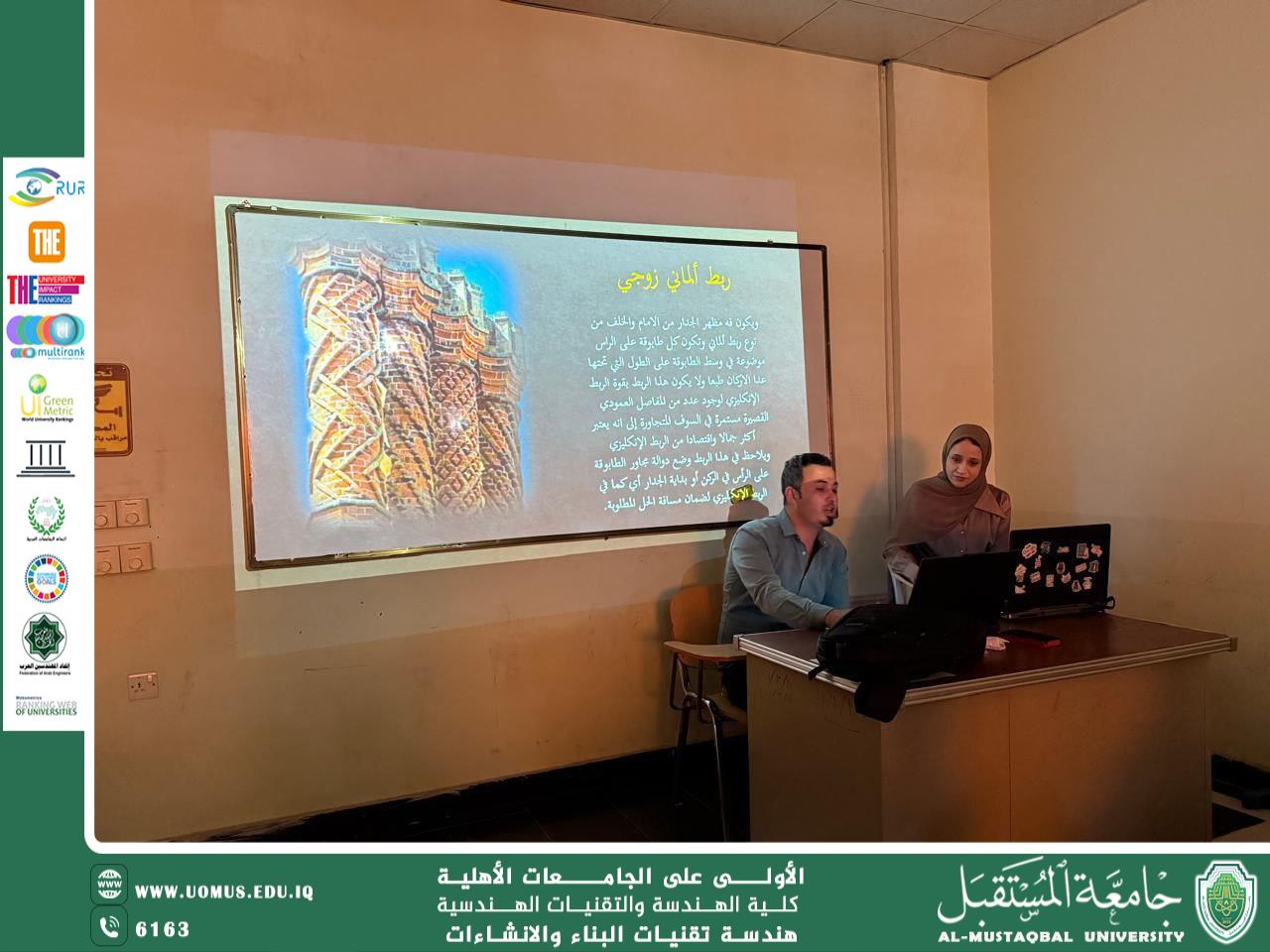


Types of brick bonding and their importance in strengthening walls
Under the supervision of the Head of the Civil and Construction Engineering Department and in alignment with the fourth goal of the Sustainable Development Goals (Quality Education), Dr. Sabah Mohammed and lecturer Noora Fawzi organized an awareness activity titled "Types of Brick Bonding and Their Importance in Strengthening Walls."<br /><br />Brick bonding in wall construction using clay and limestone bricks must be appropriate and structurally sound, ensuring proper spacing between successive courses and carefully filling the joints with the mortar used. The vertical and horizontal joints, as well as those parallel to the applied forces, must be perfectly aligned.<br /><br />Brick bonding refers to the arrangement of bricks in a structure to ensure the units are interlocked in a way that provides good structural stability. The types of brick bonding include:<br /><br />English Bond: This type of bonding consists of alternating courses of bricks laid lengthwise (stretcher course) and widthwise (header course) along the wall.<br /><br />German Bond: In this method, each header brick is placed next to a stretcher brick, alternating throughout all courses of the wall.<br /><br />University of Al-Mustaqbal – The First University in Iraq