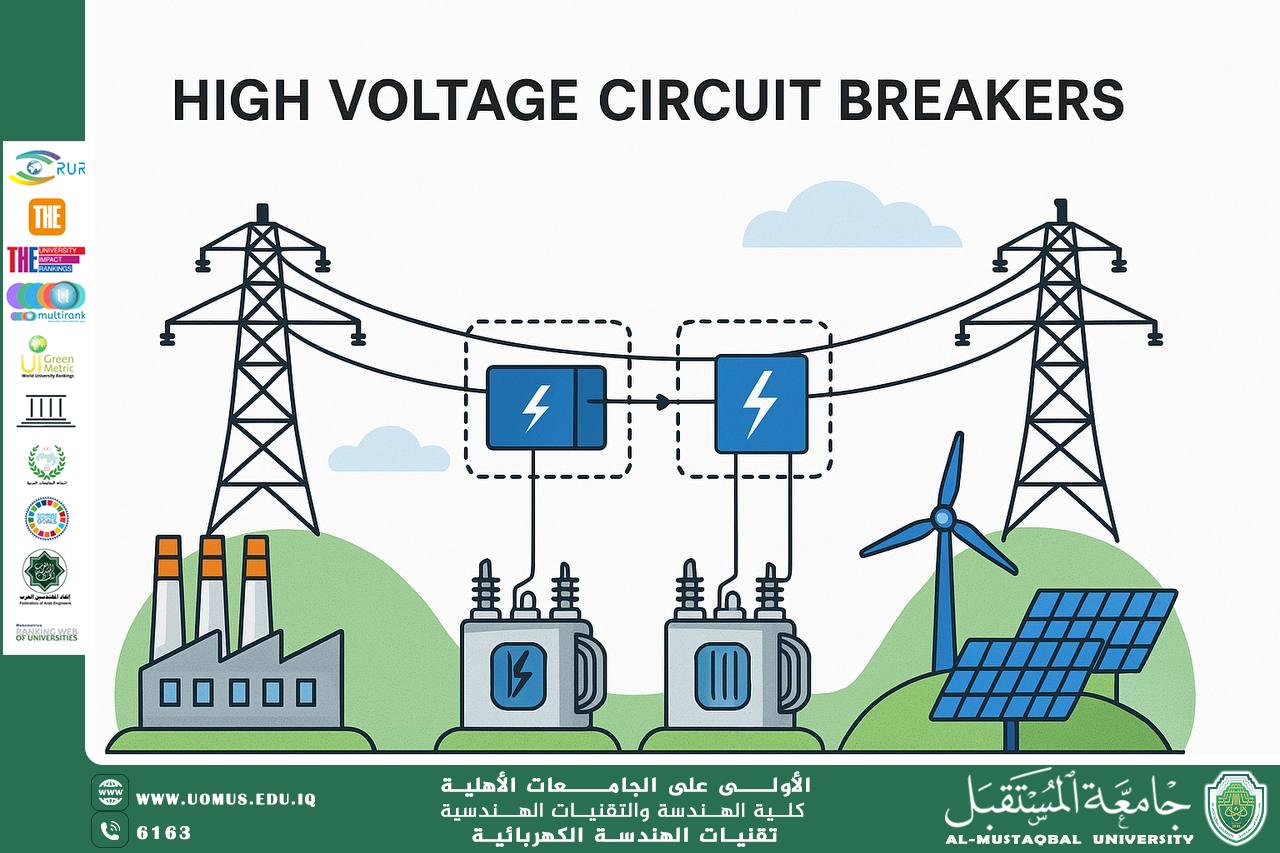
High Voltage Circuit Breakers
<br />High Voltage Circuit Breakers<br />Dr. Ahmad T. Jaiad <br /><br /><br />High voltage circuit breakers are critical components in electrical power systems, designed to interrupt or break the flow of electrical current in high voltage circuits. They are essential for protecting electrical equipment and ensuring the safety and reliability of power systems. Here’s an overview of high voltage circuit breakers:<br /><br /><br /><br />Functions:<br />1. Interrupt Fault Currents: They can quickly interrupt the flow of current during faults (e.g., short circuits or overloads) to prevent damage to equipment and ensure system stability.<br />2. Isolate Circuits: They allow for the isolation of sections of the power system for maintenance or repair.<br />3. Control Power Flow: They enable the switching of circuits during normal operations, such as connecting or disconnecting loads or generators.<br />Types of High Voltage Circuit Breakers:<br />1. Oil Circuit Breakers (OCB):<br /> - Use oil as an arc-quenching medium.<br /> - Older technology, less common in modern systems due to environmental and safety concerns.<br />2. Air Blast Circuit Breakers:<br /> - Use compressed air to extinguish the arc.<br /> - Suitable for high-voltage applications but require complex air compression systems.<br />3. SF6 (Sulfur Hexafluoride) Circuit Breakers:<br /> - Use SF6 gas, which has excellent insulating and arc-quenching properties.<br /> - Widely used in modern high-voltage systems due to their efficiency and compact design.<br />4. Vacuum Circuit Breakers (VCB):<br /> - Operate in a vacuum environment to extinguish the arc.<br /> - Commonly used in medium-voltage applications but can also be adapted for high-voltage systems.<br /><br />5. Hybrid Circuit Breakers:<br /> - Combine technologies (e.g., vacuum and SF6) to optimize performance.<br /><br />Components:<br />1. Contacts:<br /> - Fixed and moving contacts that separate to interrupt the current.<br />2. Arc Extinction System:<br /> - Mechanism to quench the arc formed when contacts separate (e.g., SF6 gas, vacuum, or air blast).<br />3. Operating Mechanism:<br /> - Mechanical or hydraulic system to open and close the contacts.<br />4. Control System:<br /> - Relays and sensors to detect faults and trigger the breaker.<br /><br />Applications:<br />- Power Transmission and Distribution: Protect high-voltage transmission lines and substations.<br />- Industrial Facilities: Safeguard large motors, transformers, and other equipment.<br />- Renewable Energy Systems: Used in wind and solar farms to manage high-voltage connections.<br /><br />Selection Criteria:<br />- Voltage Rating: Must match the system voltage.<br />- Breaking Capacity: Ability to interrupt fault currents.<br />- Speed: Faster operation reduces damage during faults.<br />- Environmental Considerations: SF6 breakers, for example, have a high global warming potential (GWP), leading to a push for alternatives.<br /><br />Challenges and Trends:<br />1. Environmental Concerns: SF6 gas is a potent greenhouse gas, driving research into eco-friendly alternatives like clean air or fluoronitrile-based gases.<br />2. Digitalization: Integration with smart grid technologies for remote monitoring and control.<br />3. Higher Voltage Levels: Development of breakers for ultra-high-voltage (UHV) systems to support long-distance power transmission.<br /><br />High voltage circuit breakers are a cornerstone of modern electrical infrastructure, ensuring the safe and efficient operation of power systems. Advances in materials, design, and technology continue to improve their performance and sustainability.<br />Al-Mustaqbal University is the first university in Iraq.<br />