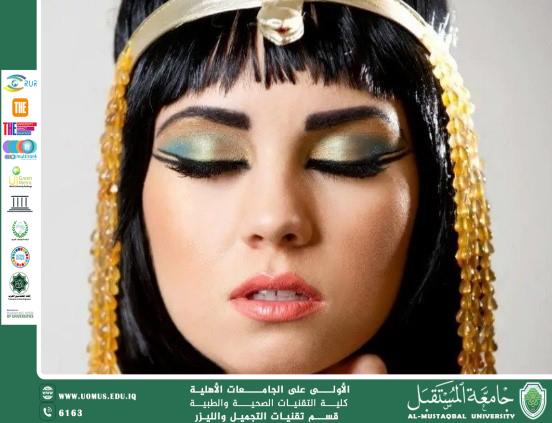
Beauty in Ancient Times: Between Religious Rituals and Concepts of Beauty
Humanity has known the concept of beauty since ancient times. It was not limited to enhancing one's appearance, but was also linked to religious rituals, protection from evil spirits, and the expression of social and cultural identity. Beauty methods and techniques varied among civilizations, from the use of kohl in ancient Egypt, to lead powders in Rome, and even herbs and oils in the civilizations of Mesopotamia. This article aims to review the most prominent beauty traditions in ancient times and analyze their symbolic and social connotations.<br />1. Beauty in Ancient Egypt<br />Pharaonic Egypt was one of the first civilizations to adopt cosmetics in a systematic manner, as it was a part of daily and religious life. The Egyptians used:<br />• Kohl made from soot or galena to define the eyes, believing it protected against the "evil eye" and prevented disease.<br />• Natural red from iron oxides to color the lips and cheeks.<br />• Henna to dye hair and nails. Cosmetics were also placed in special ivory or Pottery, indicating its high value.<br />2. Beauty in Mesopotamia<br />In civilizations such as Sumerian, Akkadian, and Assyrian, beauty indicated social status. Women used:<br />• Aromatic oils and herbs to enhance body odor.<br />• Lead powder to lighten the skin.<br />• Eye makeup extracted from coal and minerals.<br />Archaeological inscriptions also reveal a great interest in men's hairstyles and beards.<br />3. Beauty in Ancient Greece<br />Beauty had a philosophical connotation in Greek culture, as philosophers linked it to perfection and virtue. Women used:<br />• Skin-lightening powders made of lead or white clay.<br />• Natural juices to rosy the cheeks and lips. Blond hair was considered a standard of beauty, so the use of lightening products was common, despite their toxicity.<br />4. Beauty in Ancient Rome<br />In the Roman Empire, beauty became more common and varied, but it was sometimes a source of moral controversy. Among the cosmetics used:<br />• Foundation creams made from animal fats and starch.<br />• Skin-lightening powder.<br />• Artificial nail and hair dyes. Men also considered women's excessive interest in cosmetics a form of "unrewarded luxury."<br />5. The Religious and Symbolic Dimension of Beauty<br />In most ancient civilizations, beauty was not merely an ornament; it was also associated with rituals, such as:<br />• Preparing the dead in Egypt with cosmetics to accompany them in the "afterlife."<br />• The use of perfumes and oils in temples.<br />• The use of colors and symbols to protect against spirits or to identify class or sectarian affiliation.<br />Conclusion<br />Historical and archaeological evidence has proven that beauty has been an integral element of human life since the dawn of history, used for purposes that go beyond outward appearance to include symbolic, spiritual, and social significance. Despite the development of methods and technologies, the human drive for beauty and self-expression persists in every era.<br />Al _ Mustaqbal University, the first university in Iraq