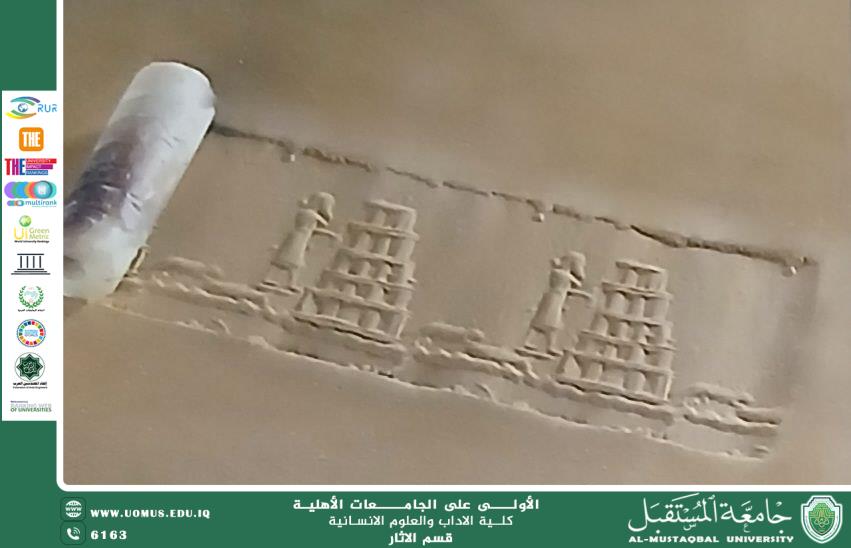
Dr. Mariam Imran Musa from the Department of Archaeology writes a scholarly article titled “Cylinder Seals in Ancient Iraq.”
They are considered hallmark cultural elements inseparable from ancient Mesopotamian civilization throughout all its eras, first appearing in the latter half of the Uruk period around 3000 BCE. They are critically important for dating archaeological strata during excavations and are therefore among our most valuable sources for understanding key aspects of ancient Mesopotamian culture. Cylinder seals were carved with a wide variety of scenes—religious motifs, images of deities and their symbols—reflecting diverse aspects of life. A cylinder seal is exactly what its name implies: a small cylinder, typically 1–8 cm in height. Some were made from easily worked soft stones such as calcite or limestone, others from harder stones like diorite or hematite, and still others from pottery, ivory, metals, or glass paste. Each is drilled lengthwise, suggesting it was once worn around the neck.<br /><br />They were first used to seal the clay stoppers of jars: a piece of cloth was placed over the jar’s mouth, covered with soft clay, and then impressed with the seal, leaving the intricate design in the clay. These impressions served as a personal signature guaranteeing the jar’s contents remained secure, thus marking individual ownership. In a later phase, cuneiform writing began to appear on seals for the first time during the Jemdet Nasr (late Uruk) period.<br /><br />Artisans carved seals using chisels, burins, scrapers, and sharp styluses. To date a seal, archaeologists consider the layer in which it was found, the scenes it bears, the symbols depicted, and the material from which it is made—since the style of imagery evolved over time, allowing seals to be placed in chronological context. Prominent themes include religious scenes (temple facades, offerings and gifts to the gods, processions toward sanctuaries), hunting scenes, animal combats, and more. Cylinder seals remained in continuous use through every major period of Mesopotamian history until the end of the Achaemenid era, when they were largely supplanted by flat stamp seals—though they experienced a revival in the Neo‑Assyrian period.<br /><br />Al‑Mustaqbal University – The Premier University in Iraq.<br/><br/><a href=https://uomus.edu.iq/En/Default.aspx target=_blank>The Official Website of Al‑Mustaqbal University</a>