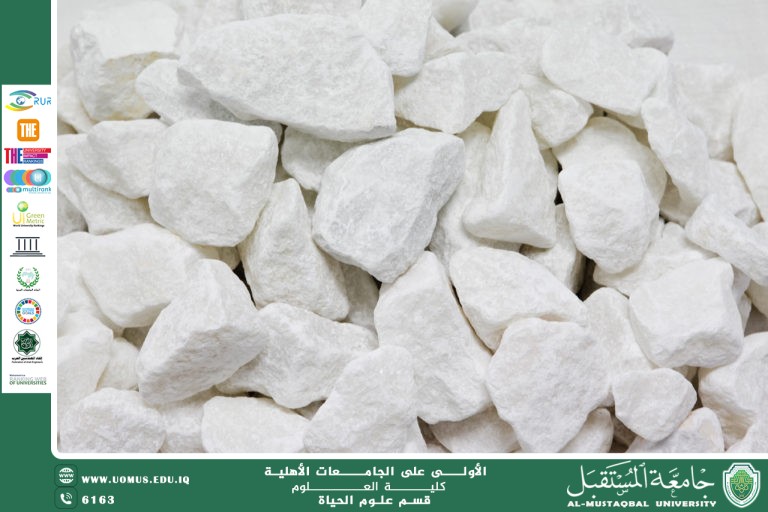
A scientific article by Ms. Nour El-Huda Azmi Hassan entitled "Limestone in biology"
Limestone is one of the most important sedimentary rocks, playing a significant role in biology , especially in the fields of ecology, paleontology, and biogeology.<br /><br />The Importance of Limestone in biology<br />1. Natural Fossil Record<br />Limestone contains large quantities of fossils, making it an important resource for studying:<br /><br />The evolution of living organisms.<br /><br />Paleogeneous environments.<br /><br />Extinctions and climate change.<br /><br />2. Indicator of Ancient Environments<br />The presence of limestone suggests that the area was once a warm, shallow marine environment.<br /><br />Scientists use this information to understand the history of life and the environmental conditions in which organisms evolved.<br /><br />3. Interaction with Living Organisms<br />Some microscopic organisms, such as fossilized bacteria (stromatolites), contributed to the formation of limestone.<br /><br />Microorganisms also currently contribute to the precipitation of calcium carbonate.<br /><br />4. Soil Formation and Plant Support<br />When limestone breaks down, it forms calcium-rich soil, which benefits some plants.<br /><br />Its powder is also used to improve acidic soil (in agriculture).<br /><br />5. Environmental Impact<br />In environmental science, limestone is studied for its effect on the pH of water and soil.<br /><br />It is sometimes used to neutralize acids in lakes or treat acid pollution.<br /><br />al Mustaqbal University is the first university in Iraq.