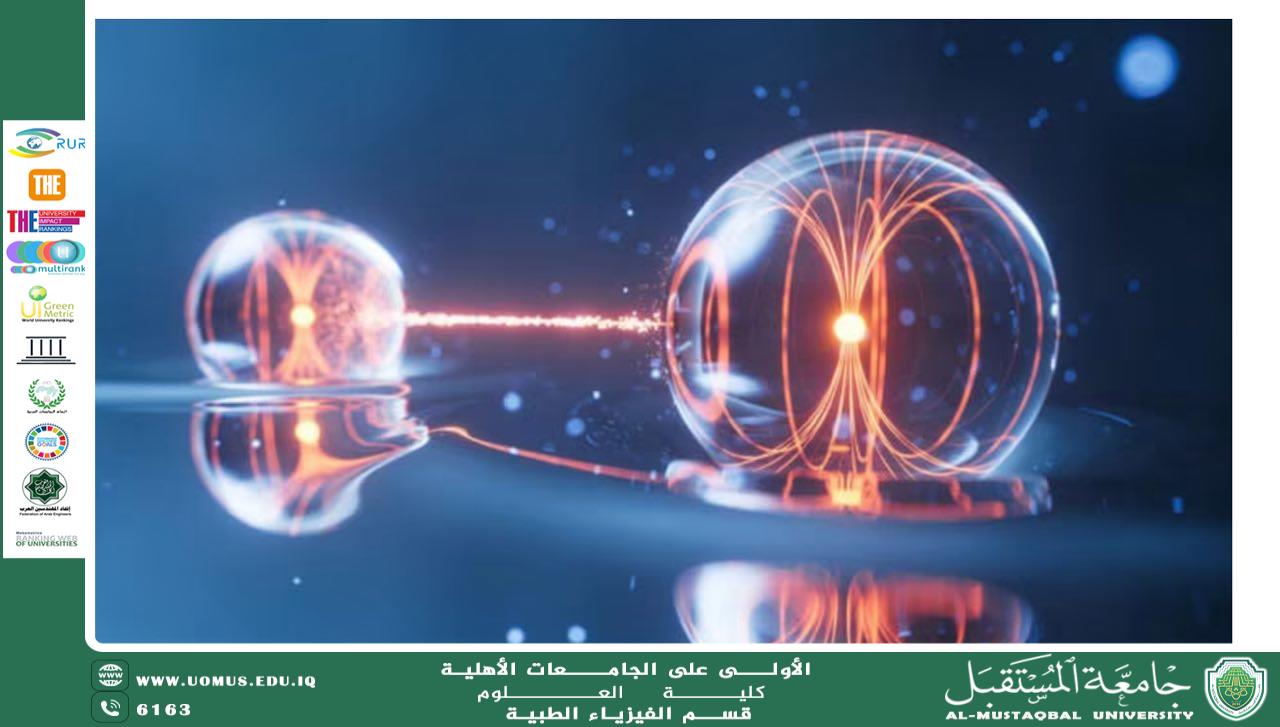
A scientific article by the lecturer (Dr. Karim Abis Handoul) entitled “A Leap for Humanity: The Success of the First ‘Instant Transfer’ Operation Between Two Computers”
Scientists Successfully Achieve Quantum Teleportation Between Two Supercomputers for the First Time<br /><br />Quantum teleportation is built upon the theory of quantum entanglement to drive physical evolution.<br /><br />This technology could open the door to a global quantum communication network that significantly boosts information transfer speed.<br /><br />This marks a revolutionary step in data processing and unprecedented communication security.<br /><br />What may seem like a dream inspired by Hollywood films and science fiction novels—where an object vanishes from one place and instantly reappears somewhere else—has become closer to reality. Scientists have, for the first time in history, successfully achieved quantum teleportation between two supercomputers, a revolutionary milestone considered one of the most significant achievements in quantum physics.<br /><br />To clarify, quantum teleportation does not involve an object physically disappearing and reappearing in its entirety elsewhere. Instead, what has been achieved is the transfer of quantum information, a complex concept based on the theory known as quantum entanglement. This theory refers to two particles being physically linked in such a way that any change in one instantaneously affects the other, regardless of the distance between them. Albert Einstein once described this phenomenon as "spooky action at a distance" due to its strange and counterintuitive nature; in the quantum world, particles do not possess definite properties until they are measured.<br /><br />This connection brings us directly to the breakthrough made by a scientific team at the University of Oxford. The team employed a method known as ion trapping, which involves controlling ions—atoms that carry a specific electric charge—and keeping them suspended in electromagnetic fields using lasers.<br /><br />Although this may sound simple on the surface, the process behind the scenes involved years of meticulous experiments to ensure high precision and full control over the entangled state. This was necessary to successfully transfer the state of a qubit—the basic unit of information in quantum computing—from one quantum processor to another accurately and without any data loss.<br /><br />This raises the question: What sets this achievement apart from conventional methods of data transfer used in our everyday computers? In traditional computing, information is transferred via wires and cables through the flow of electrons or photons. But in quantum teleportation, the key element is the direct quantum link (entanglement), which allows the structure of information to be reassembled instantly at the other location, as if bypassing the physical barriers we’re accustomed to.<br /><br />It thus becomes clear that if this technology can be deployed on a wider scale among multiple quantum computers worldwide, massive data exchanges could occur with unprecedented speed and without delay. Computers could build a new global network of quantum communication, representing a true revolution in how data is shared, processed, and secured. Governments, medical institutions, and major corporations would be able to exchange encrypted data at extraordinary speeds, with security that is nearly impossible to breach.<br /><br />This experiment is not merely a passing technological feat—it is a concrete example of how scientific vision can achieve what was once deemed impossible. It is a step that brings humanity closer to realizing a global quantum internet. It also prompts a reassessment of our understanding of communication and the legal frameworks that govern information transfer.<br />In conclusion, the value of this achievement lies not only in its technological and technical aspects but also in the scientific and philosophical progress it represents. It lays the groundwork for freeing information from the constraints of traditional physical transport systems, replacing them with a digital system that is invisible yet remarkably effective. Perhaps using words like revolutionary or game-changing better conveys the profound impact this is expected to have on science, technology, and society—and makes the message more inspiring for the future.<br /><br /><br />"AL_mustaqbal University is the first university in Iraq"<br/><br/><a href=https://uomus.edu.iq/Default.aspx target=_blank>al-mustaqbal University Website</a>