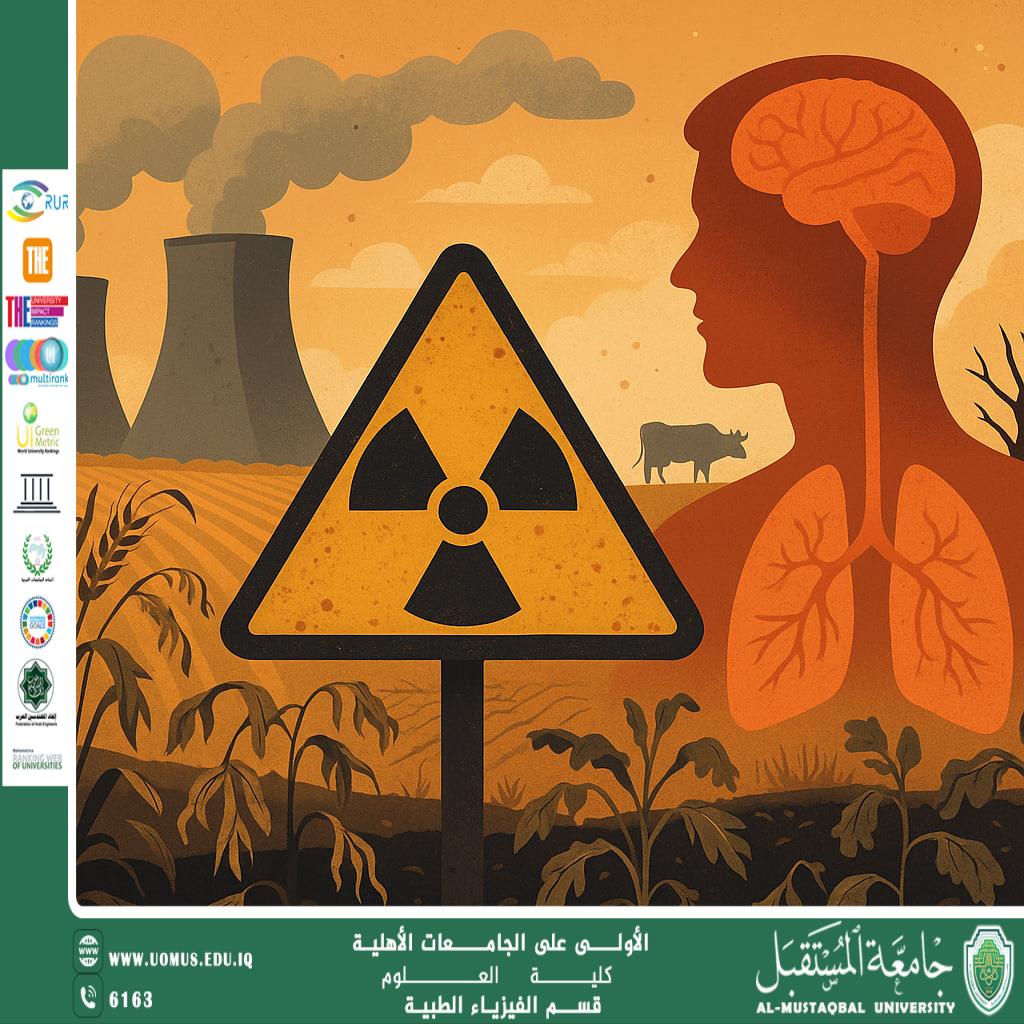
A scientific article by the lecturer ( Assistant Lecturer Fatima Basem) entitled “The risks of environmental radiation on agricultural production and human health”
Introduction<br /><br />With the expansion in the use of nuclear technology and radioactive energy sources, environmental radiation has become one of the factors that may affect various aspects of life, including agriculture and human health. Although radiation has significant benefits in medicine and industry, uncontrolled exposure poses a real threat to the environment and the food chain.<br /><br />First: What is Environmental Radiation?<br /><br />Environmental radiation refers to ionizing or non-ionizing radiation present in the environment, which may originate from:<br /><br />Natural sources such as radioactive rocks (e.g., radon, uranium).<br /><br />Man-made sources such as nuclear reactor waste or nuclear accidents (as in Chernobyl and Fukushima).<br /><br />Second: Effects of Radiation on Agricultural Production<br /><br />Crop Damage:<br />Continuous exposure to ionizing radiation leads to DNA damage in plant cells, causing growth deformities, reduced productivity, or even plant death.<br /><br />Soil and Water Contamination:<br />Radioactive isotopes such as Cesium-137 and Strontium-90 settle in the soil and are absorbed by plant roots, rendering crops unsafe for consumption.<br /><br />Impact on Seeds:<br />Radiation affects seed germination, reduces plant resistance, and can lead to genetic mutations.<br /><br />Third: Radiation and Human Health Through the Food Chain<br /><br />When soil or water is contaminated with radioactive substances, these materials transfer to plants, and subsequently to animals and humans through:<br /><br />Consumption of contaminated food.<br /><br />Drinking polluted water.<br /><br />Inhaling radioactive dust from contaminated land.<br /><br />Potential health effects include:<br /><br />Increased risk of cancer.<br /><br />Thyroid disorders.<br /><br />Birth defects.<br /><br />Weakened immune system.<br /><br />Fourth: Lessons from Past Disasters<br /><br />Chernobyl (1986): The nuclear leak contaminated vast agricultural lands in Ukraine, Russia, and Belarus.<br /><br />Fukushima (2011): Radioactive water polluted the ocean and affected marine life and nearby crops.<br /><br />Fifth: Ways to Reduce Radiation Impacts<br /><br />Continuous environmental monitoring using radiation detection devices.<br /><br />Treating contaminated soil using methods such as bioremediation or isotope stabilization.<br /><br />Agricultural and medical education for workers in fields and areas near reactors or radiation facilities.<br /><br />Strict laws and regulations to monitor the use of radioactive materials and the storage of waste.<br /><br />Conclusion<br /><br />Although environmental radiation cannot be seen or smelled, its effects are real and dangerous. Therefore, it is essential to integrate efforts between experts in agriculture, medical physics, and environmental science to mitigate its risks and ensure sustainable food and health security.<br /><br /><br /><br />"AL_mustaqbal University is the first university in Iraq"<br/><br/><a href=https://uomus.edu.iq/Default.aspx target=_blank>al-mustaqbal University Website</a>