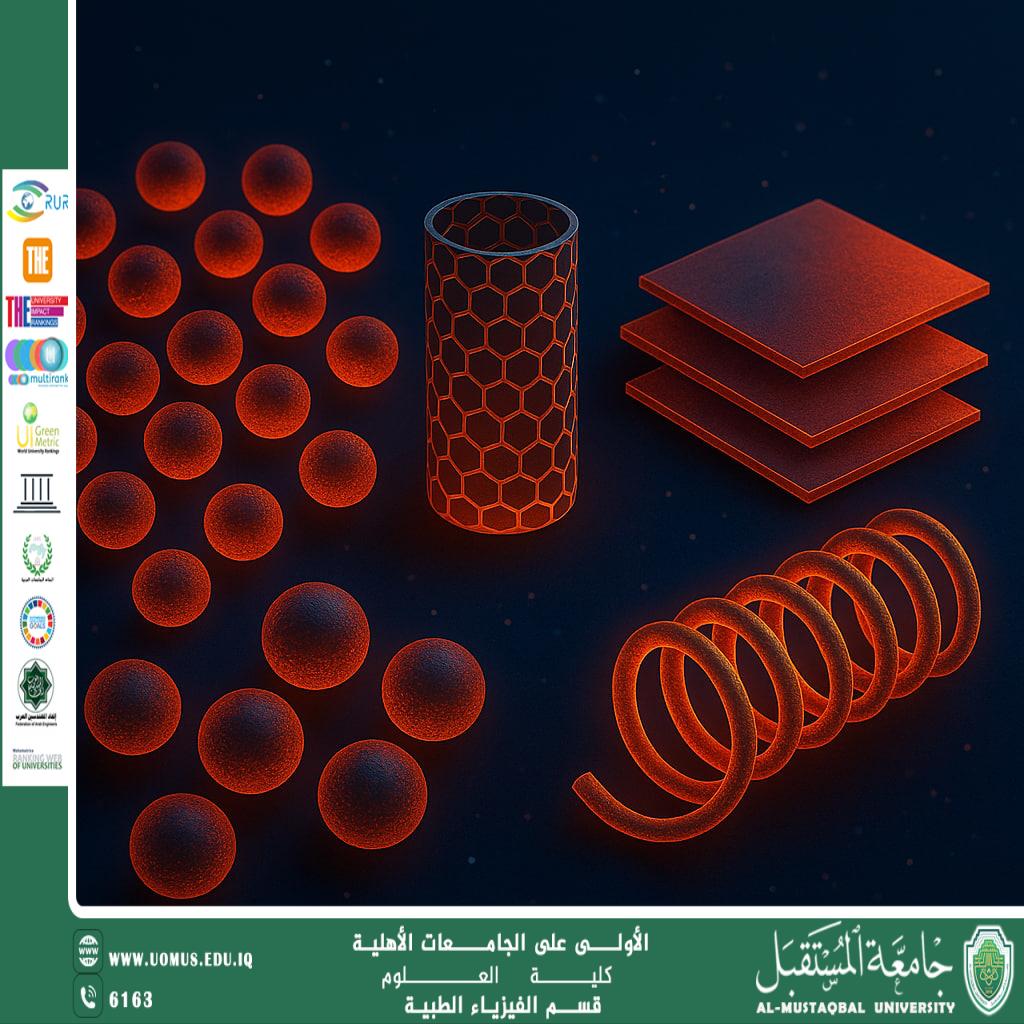
A scientific article by the lecturer (Assistant Lecturer Ammar Karim) entitled "Magnetism in nanomaterials: Properties and Applications"
Introduction<br />Nanomaterials have become one of the most rapidly advancing scientific fields of the 21st century, leading to revolutionary innovations across many domains. Among these, magnetic nanomaterials hold a special place due to their unique magnetic behaviors at the nanoscale, which differ significantly from those of conventional magnetic materials.<br /><br />1. What Are Magnetic Nanomaterials?<br />Magnetic nanomaterials are materials with dimensions smaller than 100 nanometers that exhibit unique magnetic properties due to their size and atomic structure. These materials may appear as:<br /><br />Magnetic nanoparticles<br /><br />Magnetic thin films<br /><br />Nanowires or nanotubes with magnetic properties<br /><br />2. Distinct Physical Properties<br />Size and Surface Effects:<br />As particle size decreases to the nanoscale, the proportion of atoms on the surface increases, which alters properties such as magnetic moment and energy.<br /><br />Superparamagnetism:<br />At certain temperatures, some nanomaterials lose their permanent magnetization and behave like individual magnets, responding to external magnetic fields without retaining residual magnetism—an advantage in biomedical applications.<br /><br />Magnetic Anisotropy:<br />The ease or difficulty of changing a nanoparticle’s magnetic orientation depends on its shape and crystalline structure, affecting its stability and application potential.<br /><br />3. Technological Applications<br />Nanomedicine:<br /><br />Magnetic Hyperthermia: Magnetic nanoparticles can be heated with an external magnetic field to destroy cancer cells.<br /><br />MRI Imaging: Used as contrast agents to enhance the clarity and accuracy of magnetic resonance imaging scans.<br /><br />Electronics and Data Storage:<br /><br />Enhance hard drive performance by storing information in nanoscale magnetic domains.<br /><br />Enable the development of non-volatile memory technologies, such as MRAM (Magnetoresistive Random Access Memory).<br /><br />Environment and Energy:<br /><br />Magnetic nanoparticles are used to remove pollutants from water and wastewater.<br /><br />Improve the efficiency of catalysts in chemical reactions related to energy production.<br /><br />4. Research Challenges<br />Particle Agglomeration: Nanoparticles tend to cluster together, reducing their efficiency.<br /><br />Size and Shape Control: Precise control over particle dimensions is essential for consistent performance.<br /><br />Biocompatibility and Safety: More research is needed to understand the biological effects of magnetic nanoparticles before they can be safely used in medical treatments.<br /><br />Conclusion<br />The study of magnetic properties at the nanoscale has opened new frontiers in medicine, electronics, environmental science, and beyond. Despite existing challenges, continuous advancements in synthesis and characterization techniques are making magnetic nanomaterials one of the most promising foundations for future scientific and technological breakthroughs.<br /><br /><br /><br /><br />"AL_mustaqbal University is the first university in Iraq"<br/><br/><a href=https://uomus.edu.iq/Default.aspx target=_blank>al-mustaqbal University Website</a>