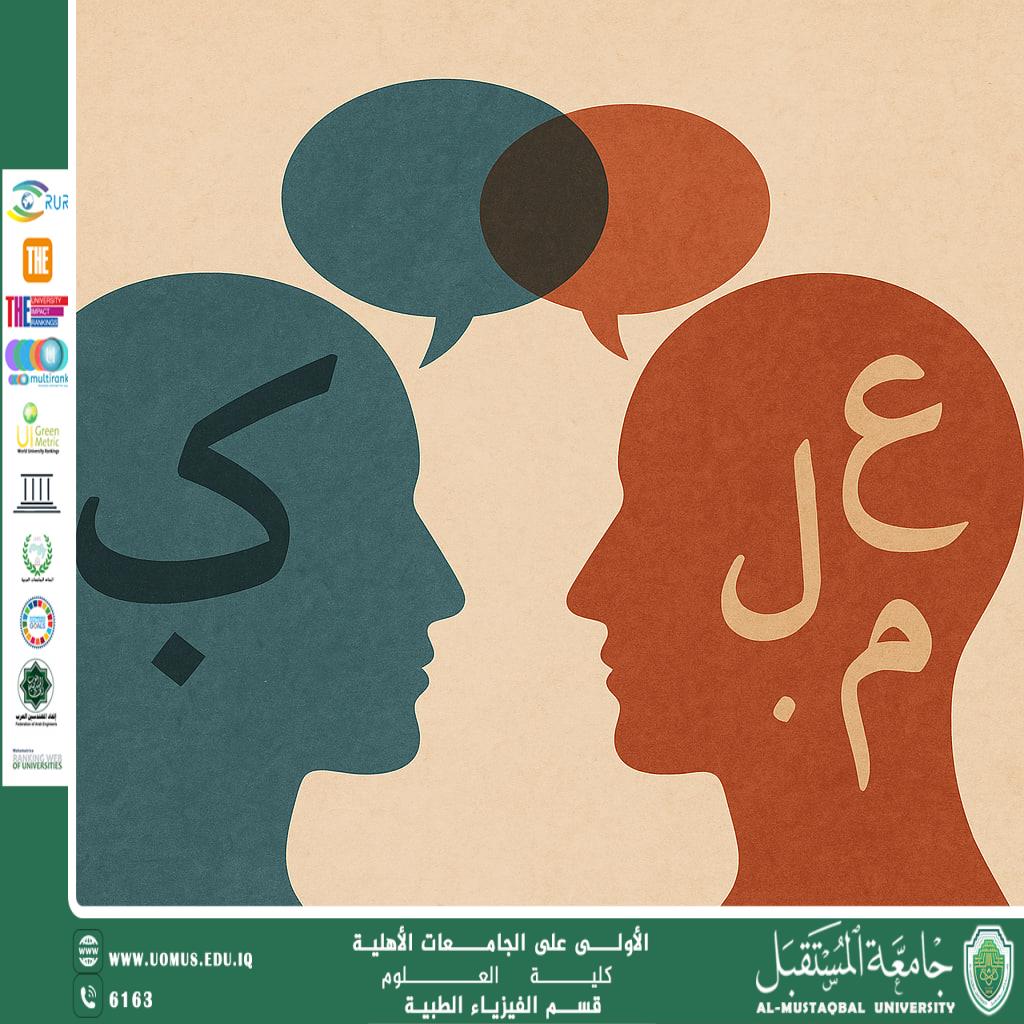
A scientific article by the lecturer (Assistant Lecturer Muhammad Ali Hussein) entitled “The Arabic Language between Classical and Colloquial Arabic: Conflict or Integration?”
Introduction<br />Arabic is one of the world’s oldest and most influential languages. It is the language of the Qur’an, and the foundation of a civilization that flourished for centuries in science, literature, and philosophy. However, modern Arabic speakers face a notable linguistic challenge: the duality between Modern Standard Arabic (MSA) and colloquial dialects. This raises a fundamental question: are they in constant conflict, or can they coexist in harmony?<br /><br />1. Understanding MSA and Dialects<br />Modern Standard Arabic (Fus’ha): The standardized form of Arabic used in official documents, literature, formal education, and media. It is derived from Classical Arabic.<br /><br />Colloquial Dialects (ʿĀmmiyya): These are informal, spoken varieties of Arabic that vary from country to country—and even between regions within the same country. They are used in everyday conversation.<br /><br />2. Signs of Tension Between MSA and Dialects<br />Education: Many children struggle with MSA in school because they are only exposed to dialects at home.<br /><br />Media: A large portion of media content—especially entertainment—is produced in dialects, sometimes marginalizing MSA.<br /><br />Linguistic Identity: Some argue that the dominance of dialects weakens the cultural and linguistic connection to classical and standard Arabic.<br /><br />3. Opportunities for Complementarity<br />Despite the apparent tension, MSA and dialects can be viewed as complementary in several ways:<br /><br />Accessibility Through Dialects: Dialects can make educational and cultural content more relatable and easier to understand for broader audiences.<br /><br />Pathway to MSA: Many writers and intellectuals began expressing themselves in dialects before transitioning to formal Arabic.<br /><br />Progressive Education Models: A gradual learning approach, beginning with familiar dialects and transitioning into MSA, can be effective, especially in early education.<br /><br />4. Real-World Examples<br />Some Arab countries have experimented with integrating local dialects in education or media, but such efforts have often sparked controversy over the role and prestige of MSA. On the other hand, modern media (such as children's programming or dubbed cartoons) has helped bring MSA closer to daily life in subtle, engaging ways.<br /><br />Conclusion<br />Modern Standard Arabic and regional dialects are not necessarily in conflict—they represent a complex, rich linguistic reality. MSA embodies history, identity, and cultural depth, while dialects reflect daily life and living culture. The real challenge lies in leveraging both to strengthen, rather than fragment, our linguistic heritage.<br /><br /><br /><br />"AL_mustaqbal University is the first university in Iraq"<br/><br/><a href=https://uomus.edu.iq/Default.aspx target=_blank>al-mustaqbal University Website</a>