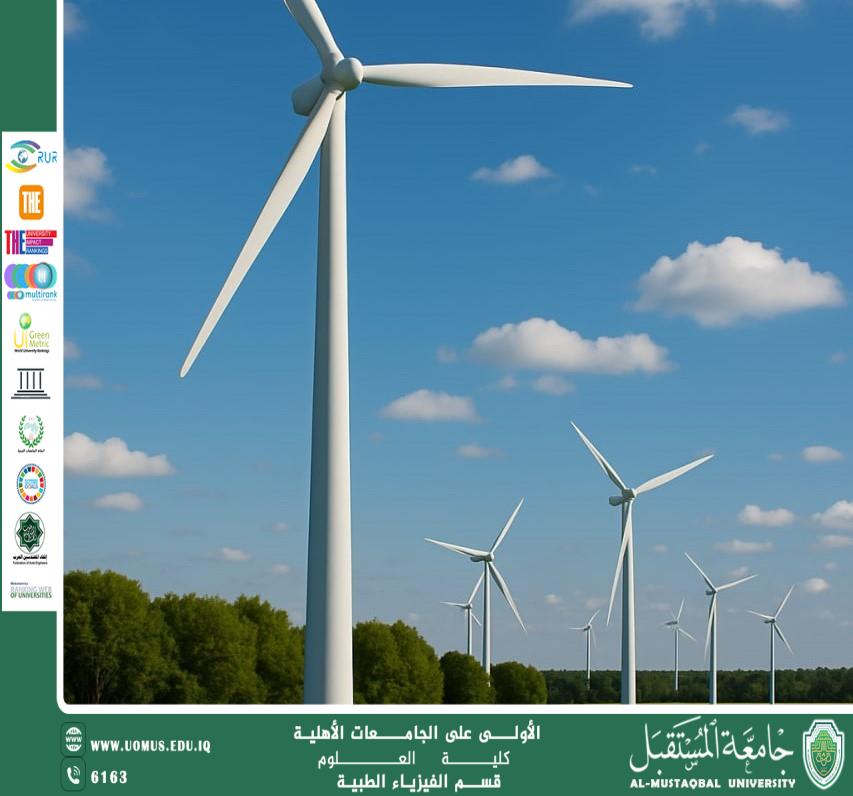
A scientific article by the lecturer (Assistant Lecturer Samaher Saad) entitled “The Impact of Wind on the Environment: Clean and Renewable Energy”
Introduction<br />In the face of global environmental challenges—such as climate change, air pollution, and heavy reliance on fossil fuels—there is an urgent need to adopt clean and sustainable energy sources. Wind energy has emerged as one of the most promising alternatives, offering a renewable power source with zero carbon emissions. It plays a vital role in environmental protection and advancing sustainability.<br /><br />1. What is Wind Energy?<br />Wind energy is generated by converting the kinetic energy of moving air into electricity using wind turbines. It is one of the oldest forms of harnessing nature’s forces—historically used for sailing ships and grinding grain—and today it is a key part of the global shift to green energy.<br /><br />2. Positive Environmental Impact of Wind Energy<br />Zero Harmful Emissions<br />Wind turbines produce electricity without releasing carbon dioxide or other pollutants during operation, making them environmentally friendly.<br /><br />Conservation of Natural Resources<br />Wind energy reduces dependence on nonrenewable fossil fuels like coal, oil, and natural gas.<br /><br />Lowering Carbon Footprint<br />Large-scale wind farms significantly reduce greenhouse gas emissions, contributing to the fight against global warming.<br /><br />3. Limited Environmental Drawbacks<br />Despite its many advantages, wind energy can have some minor environmental impacts, including:<br /><br />Impact on Birds and Bats<br />Birds and bats may collide with turbine blades, though this risk can be reduced through careful site selection and design.<br /><br />Noise and Visual Aesthetics<br />Some people oppose wind farms near residential areas due to noise or visual disruption.<br /><br />Land Use Changes<br />Large wind farms may alter local ecosystems, especially when built in environmentally sensitive areas.<br /><br />4. Environmental and Economic Feasibility<br />Wind energy is one of the most cost-effective sources of renewable energy in the long term. It also creates job opportunities in construction and maintenance, supporting a green economy. Furthermore, its operational and maintenance costs are relatively low compared to fossil fuel power plants.<br /><br />5. Future Outlook<br />The use of wind energy is rapidly expanding in countries like Germany, Denmark, China, and the United States.<br /><br />Technological advancements continue to improve turbine efficiency and reduce noise, enabling broader adoption.<br /><br />Wind energy is expected to become a central pillar of the global energy mix in the coming decades.<br /><br />Conclusion<br />Wind energy represents a promising future for clean power. It protects the environment, reduces pollution, and supports sustainable living. While there are a few environmental challenges, the overall benefits far outweigh the drawbacks—especially when projects are responsibly planned and implemented with environmental awareness.<br /><br /><br /><br />"AL_mustaqbal University is the first university in Iraq"<br/><br/><a href=https://uomus.edu.iq/Default.aspx target=_blank>al-mustaqbal University Website</a>