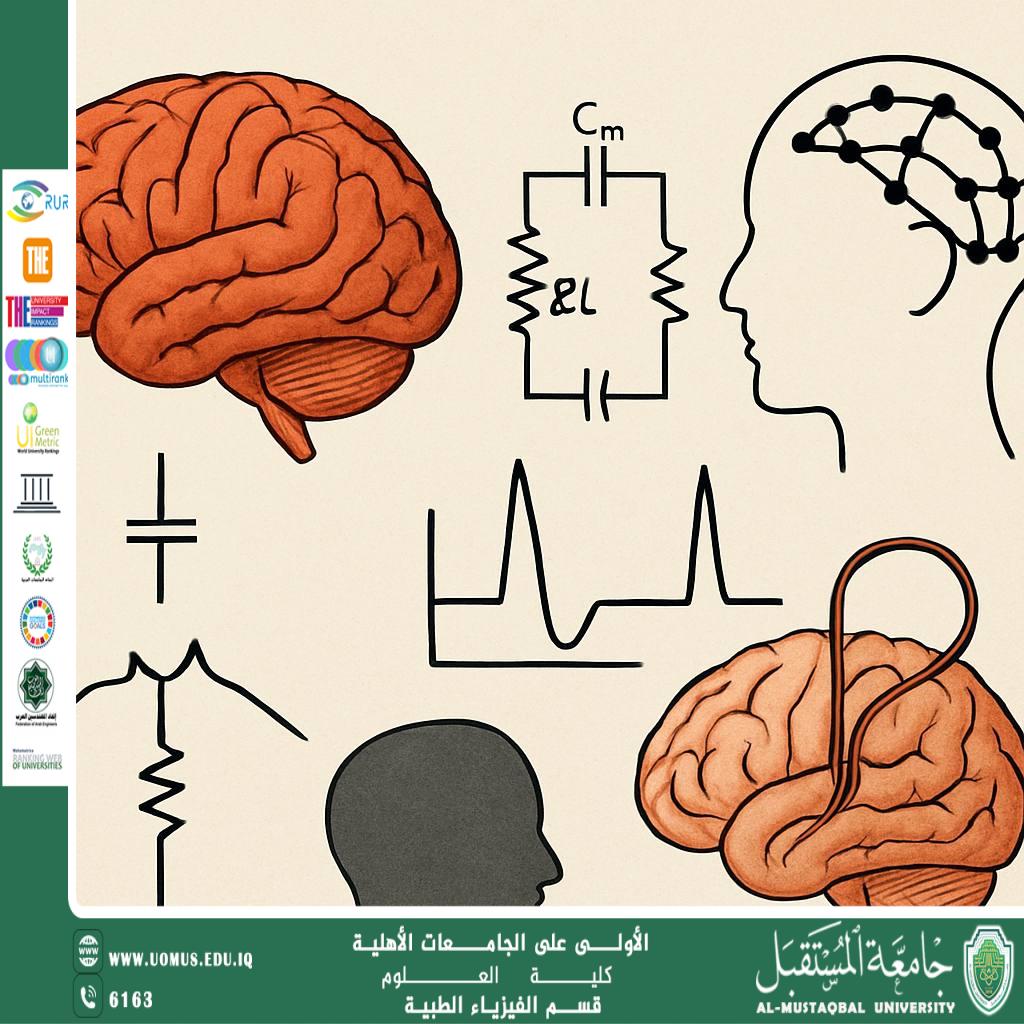
A scientific article by the teaching assistant (Hanin Hani) entitled “Electrical Modeling of Brain Activity: Applications in Neurophysics”
Introduction<br /><br />The human brain is one of the most complex systems in nature, consisting of billions of neurons that communicate via electrical and chemical signals. To understand this intricate system, scientists have turned to electrical modeling as a tool for analyzing and interpreting neural signals. Neurophysics is an interdisciplinary field that combines physics and neuroscience, using physical laws and models to study the electromagnetic behavior of the brain.<br /><br />⸻<br /><br />1. The Physical Basis of Brain Activity<br /><br />a. Neural Signals<br /><br />Neurons transmit information through electrical pulses known as action potentials. These are generated by the movement of ions (mainly Na⁺ and K⁺) across the cell membrane through specialized ion channels.<br /><br />b. Relevant Physical Laws<br /><br />Understanding neural signals requires applying:<br /> • Ohm’s Law: Describes the relationship between voltage, current, and resistance.<br /> • Kirchhoff’s Laws: Analyze current flow within complex neural circuits.<br /> • Electrical Equivalent Circuit Models: The neural membrane is modeled as a circuit with resistance and capacitance.<br /><br />⸻<br /><br />2. Electrical Models of Neural Activity<br /><br />a. Hodgkin-Huxley Model<br /><br />A foundational model in neurophysics, it uses differential equations to describe the ionic currents through the neuron membrane. This work earned the Nobel Prize and remains fundamental to computational neuroscience.<br /><br />b. Integrate-and-Fire Model<br /><br />A simplified model that describes how a neuron accumulates input until a threshold is reached, at which point it “fires” an action potential. It’s widely used in neural network simulations.<br /><br />⸻<br /><br />3. Applications of Electrical Modeling in Neurophysics<br /><br />a. Deep Brain Stimulation (DBS)<br /><br />Used to treat disorders like Parkinson’s disease, DBS involves implanting electrodes in specific brain regions. Electrical modeling helps optimize stimulation patterns for therapeutic effects.<br /><br />b. Brain-Computer Interfaces (BCIs)<br /><br />These systems interpret brain signals (e.g., from EEG) and translate them into commands for controlling prosthetics or computers. Electrical models are crucial for accurate signal interpretation.<br /><br />c. Understanding Neurological Disorders<br /><br />Conditions such as epilepsy are studied using electrical models to understand the mechanisms of abnormal brain activity and to predict seizure onset.<br /><br />d. Simulation of Artificial Neural Networks<br /><br />Inspired by biological neurons, these networks use simplified electrical models to power artificial intelligence systems. They are foundational in deep learning and computational neuroscience.<br /><br />⸻<br /><br />4. Conclusion<br /><br />Electrical modeling plays a pivotal role in connecting physics with neuroscience, helping to uncover the mechanisms of brain function, support the diagnosis of neurological disorders, and advance neurotechnological innovations. As computational physics and medical technology progress, these models will become even more accurate and predictive, offering profound insights into brain dynamics.<br /><br /><br /><br />"AL_mustaqbal University is the first university in Iraq"<br/><br/><a href=https://uomus.edu.iq/Default.aspx target=_blank>al-mustaqbal University Website</a>