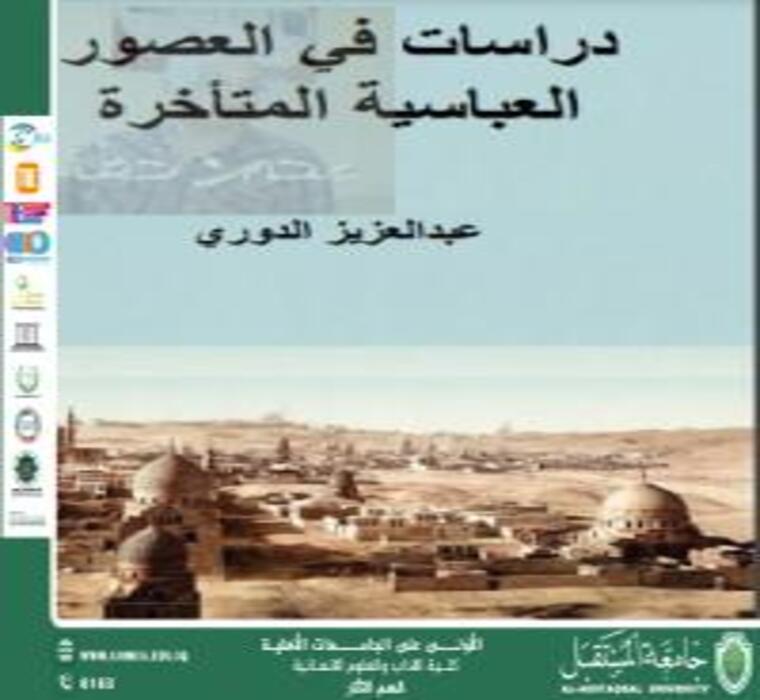
"Dr. Ali Farhan Al-Bakri, a faculty member in the Department of Archaeology, has written a scholarly article titled 'Studies in the Later Abbasid Periods / Prof. Dr. Abdul Aziz Al-Douri'."
Studies in the Later Abbasid Periods (Prof. Dr. Abdul Aziz Al-Douri) <br />Assoc. Prof. Dr. Ali Farhan Zweir – College of Arts, Department of Archaeology<br />In this article, I have attempted to summarize the foundational principles adopted by Dr. Abdul Aziz Al-Douri in his aforementioned book. The book was notably ahead of its time in emphasizing the importance of historical study that opens up to neighboring sciences, such as sociology. It also highlighted the necessity of not neglecting any events, regardless of their perceived significance. Marginal details may sometimes hold the truth, unlike the main narrative, which might be subject to distortion or fabrication. Due to the importance and seriousness of this study, I have dedicated this report to it.<br />Presentation<br />History, in general, continues to be a vast field of scientific research. It remains an expansive domain for intellectual conflict due to the multiplicity of opinions, ideologies, and prevailing theories—making it nearly impossible for two researchers to agree on a singular definition of the term “history” as a comprehensive concept encompassing the full structure and vocabulary of this discipline. History is inherently descriptive by nature across all its methodologies and prevailing schools.<br /><br />It is truly fascinating to encounter a study with such profound intellectual depth and mature academic perspective as that of Dr. Abdul Aziz Al-Douri in Studies in the Later Abbasid Periods. His work presents a solid academic vision of objective and integrated historical research. This becomes evident from the study’s introduction and the rich discussions it offers, despite its early publication at a time when the Arab intellectual and cultural institutions were still in the formative stages. At the time, dominant modes of study were traditional and ethnically driven. Thus, it is only logical that any scientific study from that early period would be shaped, both in form and content, by the prevailing cultural norms.<br /><br />Nevertheless, this study can be seen as pioneering and creative, as it transcended the conventional role of the historian and ventured into the philosophy of history. In his introduction, Dr. Al-Douri showed deep awareness of the need to explore marginal currents within society. Modern historical research does not shy away from relying on scrutinizing seemingly minor matters that may lead to truth—even if such topics fall under what is called "historical anomalies." When read with methodological and conscious care, these anomalies can yield coherent scientific results.<br /><br />In his effort to analyze and interpret historical events according to the scientific method he adopted, Al-Douri set forth the following guidelines:<br /><br />A holistic study of society, encompassing all aspects—social, political, economic, environmental, as well as myths and beliefs. It is essential to examine how these factors influence one another. Studying only a part of society is insufficient. To fully understand the nature of any society, one must study the historical condition in its entirety to form a logical and clear image, as these elements might historically operate in harmony. As Al-Douri stated:<br /><br />“It is impossible to understand Baghdadi society during the Buyid period, for instance, without studying the shuttar and ayyareen (vagabonds and rebels) and without addressing life in the districts of Karkh or Bab Al-Basra.” (Introduction, p. 5)<br />Likewise, Ibn Khaldun wrote in his Muqaddimah:<br />“One of the hidden errors in history is the neglect of changes in the conditions of nations and generations.” (Muqaddimah, p. 25)<br /><br />Al-Douri treated the historical event as a cohesive temporal structure, unified and progressively interconnected. Each event gives rise to the next, with this sequence collectively forming the broader, more dominant historical phenomenon. The researcher offers the Abbasid state as an example, analyzing its fall by identifying key points of weakness, also comparing it to the fall of the Umayyad state. He writes:<br /><br />“One of the inevitable weaknesses in historical research is dividing it into periods and studying each period in isolation as if it exists independently, whereas history transcends such segmentation.” (Introduction, p. 7)<br /><br />Dr. Al-Douri also stressed the importance of rejecting a rigid reading of history. Instead, he proposed a two-stage process for a conscious reading:<br /><br />Stage One: Adopting a dynamic methodology that can swiftly reference the past in ways that support future-oriented perspectives by examining prior events to achieve a more comprehensive and clearer historical understanding.<br /><br />Stage Two: Utilizing all available materials that support the truth, including documents and scholarly readings of biographical and campaign literature, without excluding texts perceived as non-historical.<br /><br />From this brief review, we draw two main benefits from Al-Douri’s book:<br /><br />First, he emphasized the importance of understanding the epistemological foundations that shape the intellectual discourse of any author. Modern academic study insists that the introductory section of any work must contain cognitive elements that transition it from mere hypothesis to the core of the text—rendering it a “key text” in the sense used by Mikhail Bakhtin. A well-informed author should ensure that the introduction serves as a set of functional cues pointing to the main themes of the text, as Michel Foucault suggests.<br /><br />Second, he highlighted the strong connection between history and sociology. No historical study can achieve the desired awareness without addressing this relationship. It is well established that history is a narrative and documentation of the dialectical development of societies and peoples, reflecting social transformations through event narration. The credibility and depth of historical research increase the closer it aligns with the essence of sociology. This was confirmed by scholars such as Ibn Khaldun and Nasif Nassar, who stated:<br /><br />“If true history is social history, and if the value of a historical writing increases the closer it comes to the model of social historical writing, or the more it includes a social content, then we must seriously consider the social concepts, judgments, and theories embedded in that historical writing to reveal its true value.” (The Concept of Nation Between Religion and History, p. 56)<br /><br />Based on these foundational principles, Dr. Al-Douri’s study reviews events and their historical developments over a long period—from the establishment of the Umayyad state to the collapse of the Abbasid state—while identifying the factors and circumstances that led to the rise and fall of both empires.<br /><br />Al-Mustaqbal University – The Premier University in Iraq.<br /><br /><a href=https://www.noor-book.com/%D9%83%D8%AA%D8%A7%D8%A8-%D8%AF%D8%B1%D8%A7%D8%B3%D8%A7%D8%AA-%D9%81%D9%8A-%D8%A7%D9%84%D8%B9%D8%B5%D9%88%D8%B1-%D8%A7%D9%84%D8%B9%D8%A8%D8%A7%D8%B3%D9%8A%D9%87-%D8%A7%D9%84%D9%85%D8%AA%D8%A7%D8%AE%D8%B1%D9%87-%D9%84-%D8%B9%D8%A8%D8%AF%D8%A7%D9%84%D8%B9%D8%B2%D9%8A%D8%B2-%D8%A7%D9%84%D8%AF%D9%88%D8%B1%D9%8A-pdf target=_blank>"The book Studies in the Later Abbasid Periods by Abdul Aziz Al-Douri."</a>