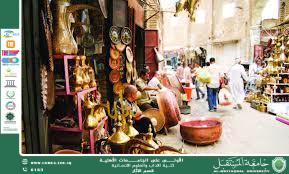
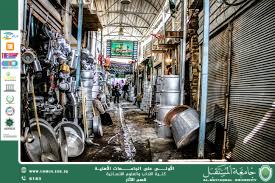
The faculty member (Asst. Lecturer Ali Ihsan Abd Ali) from the Department of Archaeology has written an article titled: "Traditional Markets in the City of Hilla (The Coppersmiths’ Market as a Model)."
Assistant Lecturer Ali Ihsan Abd Ali<br />Al-Mustaqbal University / College of Arts and Humanities / Department of Archaeology<br />[email protected]<br /><br />Traditional Markets in the City of Hilla (The Coppersmiths' Market as a Model)<br /><br />Al-Saffarin Market is considered one of the most significant cultural and heritage landmarks in the city of Hilla. It is one of the traditional craft markets that date back more than 300 years, making it one of the oldest markets in the city. This market, known for its traditional copperware craft, has witnessed a gradual decline due to the spread of imported copper products, the scarcity of raw copper materials, and the transformation of most of its shops into commercial stores serving other purposes.<br /><br />The market is located in the center of Hilla, within the covered Grand Market, near the historical Maqam al-Ghaybah, which was renovated in 2015 (1436 AH) by local philanthropists. The shrine is currently overseen by Abdul Ali Hamid Al-Saffar, who inherited this responsibility after the passing of his father. Most of the coppersmiths (saffarīn) used to reside in neighborhoods near the market, such as Al-Jubran, Al-Mahdiyah, and Al-Jam'iyin.<br /><br />The market has two branches: the first connects Al-Saffarin Market to the Grand Covered Market, while the second links it from its beginning to Haraj Market and from its end to the Blacksmiths’ Market. Currently, the length of the market stretches 73 meters from Maqam al-Ghaybah to the Traders’ Market, with a width of 3.20 meters. Historically, its length was approximately 95 meters and its width around 3.50 meters. Previously, the market's floor was paved with bricks, but due to modernization, it is now paved with concrete and features a central water drainage channel.<br /><br />The market contains around 56 shops, with 29 on the left side facing Maqam al-Ghaybah and 27 on the right. The dimensions of each shop are consistent: 2.5 meters in length, 3 meters in width, and about 6 meters in height. The ceilings are supported by iron beams (known as “shumman”).<br /><br />Many of the original crafts have been replaced with new professions such as carpentry, blacksmithing, tailoring, and tea selling. Only about 20% of the original coppersmith trade remains today. The decline is attributed to the replacement of traditional materials with modern ones like aluminum, which is now used in making various household utensils. This shift is due to the fact that brass (ṣufr), the traditional material, oxidizes and releases harmful substances, making it less suitable for modern use.<br /><br />Despite this, a few craftsmen continue practicing the original trade, either by developing it or by producing items upon customer request. Some still request traditional items for decorative purposes, given their heritage value passed down from ancestors. Historically, copper was considered as valuable as gold.<br /><br />Following the fall of the former regime in 2003, herbalists and collectors of traditional heritage began replacing old materials with modern ones such as aluminum (known locally as "fafoun"). Nevertheless, Al-Saffarin Market remains a vital heritage site in Hilla, a symbol of the city's rich artisan legacy. Revisiting the annals of history, we find that the Babylonians were among the first to utilize copper by smelting and shaping it into practical tools. The market earned its name from the “saffar” (coppersmiths) who practiced their craft there — a tradition that goes back more than 300 years.<br />Al-Mustaqbal University – The Premier University in Iraq.<br /><br /><a href=https://uomus.edu.iq/En/Default.aspx target=_blank>The Official Website of Al‑Mustaqbal University</a>