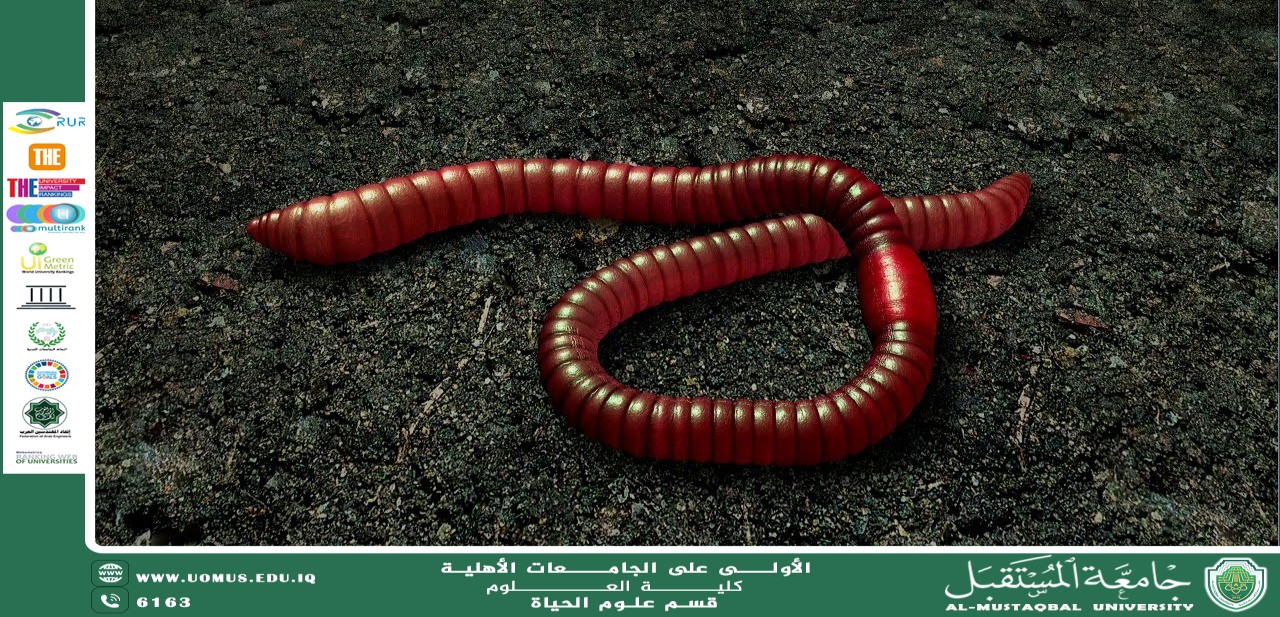
A scientific article by Ms. Nour El-Huda Azmi entitled Reproduction and Biodiversity in Annelids
Annelida (annelids) represent a broad group of invertebrates, characterized by their body segmented into recurring segments. This group includes diverse species such as earthworms, medical leeches, and marine worms.<br />Reproduction and biodiversity are important features for understanding the evolution of these organisms and their ecological roles in different biological systems, particularly in soil, freshwater, and saltwater.<br /><br />1. General Classification of Annelida<br />The phylum Annelida is divided into three main classes:<br /><br />Oligochaeta – such as earthworms.<br /><br />Polychaeta – marine worms.<br /><br />Hirudinea – such as medical leeches.<br /><br />Each class possesses unique reproductive and behavioral characteristics, which enhance their biodiversity and ecological distribution.<br /><br />2. Methods of Reproduction in Annelida<br />A. Sexual Reproduction<br />Most annelids reproduce sexually.<br /><br />Some are hermaphrodites, such as earthworms, possessing both male and female organs.<br /><br />Mating occurs through the mutual exchange of sperm between two individuals.<br /><br />After mating, a cocoon containing fertilized eggs is produced, which are released into the soil and later hatch.<br /><br />B. Asexual Reproduction<br />This occurs in some species, particularly marine worms.<br /><br />This occurs through regeneration, where an individual can regenerate lost parts or split into two separate organisms.<br /><br />This type of reproduction provides a rapid mechanism for reproduction in changing environments.<br /><br />3. Mechanisms of Regeneration<br />Annelid worms, especially polychaetes, have the ability to regenerate damaged or lost body parts.<br /><br />This regeneration is used in scientific research to understand:<br /><br />Mechanisms of tissue growth.<br /><br />Control of cell division.<br /><br />The potential of regenerative medicine.<br /><br />4. Biodiversity in Different Environments<br />Annelids live in a variety of environments: soil, lakes, rivers, and oceans.<br /><br />Many species have evolved physiological and behavioral adaptations that help them survive:<br /><br />Gills or special structures for respiration.<br /><br />Spines for movement or defense.<br /><br />Camouflage colors and patterns.<br /><br /><br />Al-Mustaqbal University is the first university in Iraq.