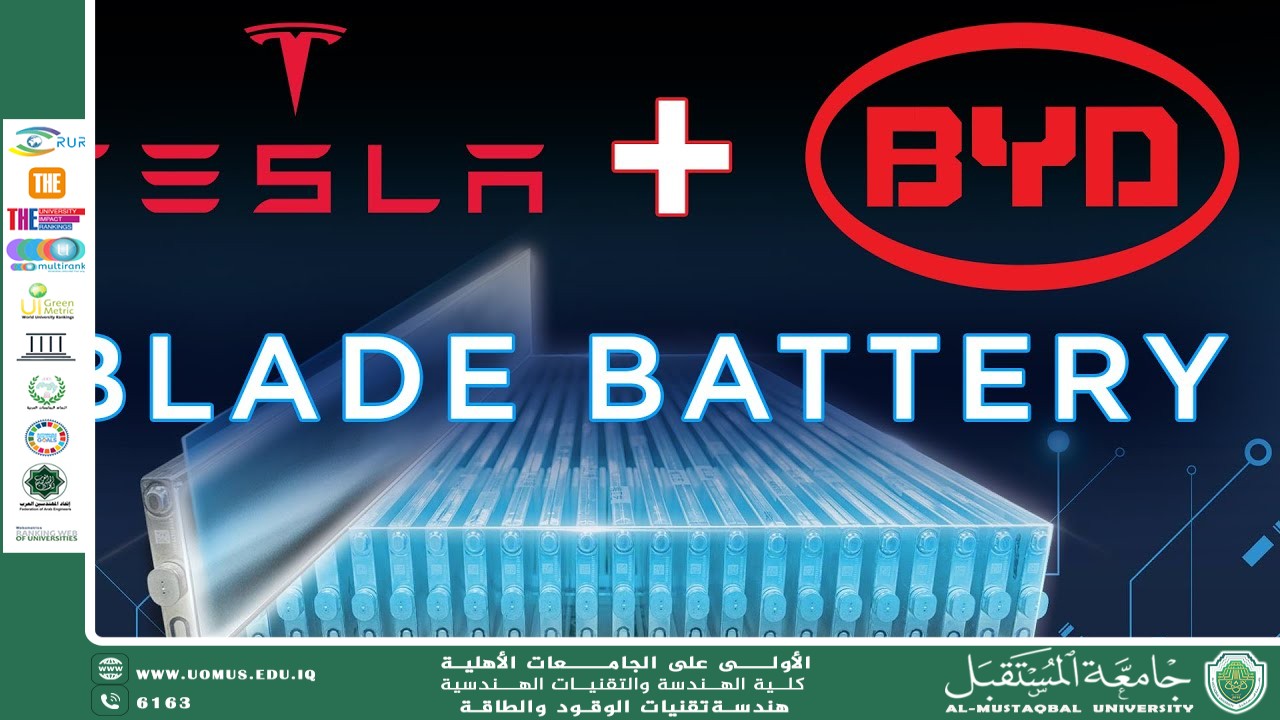
🔋 Blade Battery
🔋 Blade Battery: A Concise Overview<br />Dr. Malik Mustafa Mohammed<br /><br />SDG 7 – Affordable and Clean Energy<br />SDG 9 – Industry, Innovation and Infrastructure<br />SDG 11 – Sustainable Cities and Communities<br />SDG 13 – Climate Action<br />SDG 12 – Responsible Consumption and Production<br />The Blade Battery is a lithium iron phosphate (LiFePO₄ or LFP) battery developed by Chinese automaker and battery manufacturer BYD. It gets its name from its unique long, thin, blade-like structure, which allows for compact and modular installation within electric vehicle (EV) chassis. This design helps optimize space and improves safety.<br /><br />⚙️ Composition and Structure<br />The Blade Battery uses a LiFePO₄ cathode and a graphite anode, with a lithium salt-based electrolyte dissolved in organic solvents. A thin, microporous polymer separator is placed between the electrodes to prevent short-circuiting. The entire cell is shaped like a blade, which contributes to better thermal performance and structural integration within vehicles.<br /><br />⭐ Key Advantages<br />One of the most notable features of the Blade Battery is its exceptional safety. It is highly resistant to fire or explosion, even when punctured or exposed to high temperatures—making it much safer than traditional battery types like NMC (Nickel Manganese Cobalt). It also has a long cycle life, capable of over 3,000 charge cycles, which contributes to lower long-term ownership costs. Additionally, it is more environmentally friendly, as it avoids the use of expensive and controversial metals such as cobalt and nickel.<br /><br />Thanks to its design and chemistry, the Blade Battery is cost-effective, durable, and ideal for EVs focused on safety and reliability over ultra-high performance. It's currently used in vehicles such as the BYD Han and Tang.<br /><br />🔄 Comparison with NMC Batteries<br />While the Blade Battery excels in safety, longevity, and sustainability, it does have some limitations. It offers lower energy density, meaning EVs using LFP batteries generally have shorter driving ranges compared to those with NMC batteries. It also performs less efficiently in cold temperatures, which can affect range and charging speed in winter conditions.<br /><br />On the other hand, NMC batteries—which are commonly used in higher-performance EVs like Tesla (outside of China), BMW, and Nissan—offer higher energy density, better low-temperature performance, and faster charging, but are more expensive and less stable thermally.<br /><br />✅ Choosing the Right Battery<br />The Blade Battery is a great choice for users who prioritize safety, longevity, ethical sourcing, and cost-effectiveness—especially in urban EVs, buses, and fleets. However, for those who need longer range, faster acceleration, and better performance in cold climates, NMC batteries may be the preferred option.<br /><br />🚗 Adoption in the EV Industry<br />The Blade Battery has been adopted by BYD and is also used in Tesla’s standard-range models in China. Other manufacturers like BMW, Nissan, Volkswagen, and GM primarily use NMC batteries, while some—including Tesla and Ford—are moving toward a hybrid approach, using both LFP and NMC chemistries depending on vehicle model and market.<br />Al-Mustaqbal University The First University in Iraq<br />