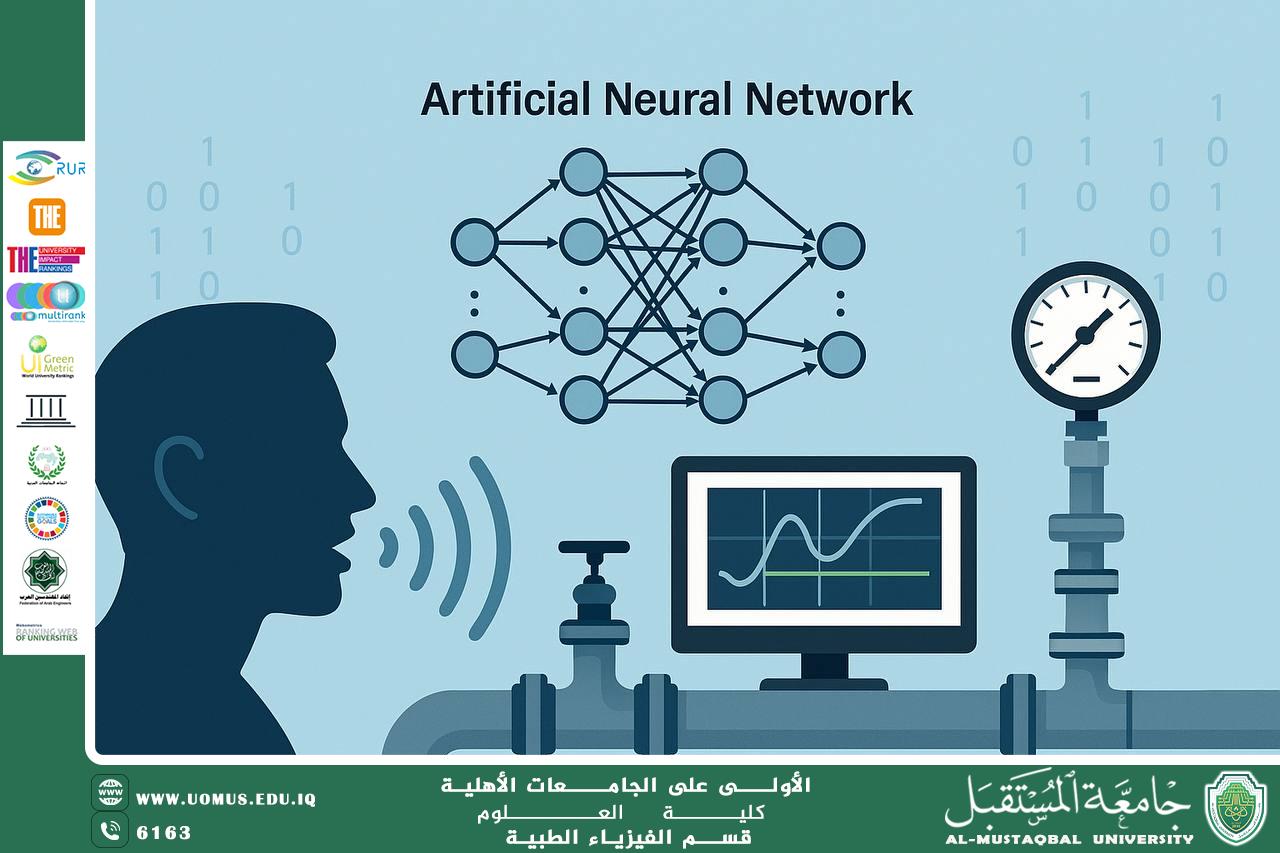
A scientific article by the lecturer (Assistant Lecturer Lubna Ali) entitled “Designing an artificial neural network for acoustic control in a pressure control system for petroleum product distribution pipelines.”
With the rapid development of artificial intelligence, artificial neural networks have become one of the most effective tools in enhancing industrial control systems. These networks are based on simulating the way the human brain works, as they learn from data and adapt to different conditions to achieve accurate and efficient performance. One of the key applications of this technology is voice control of pressure in oil product distribution pipelines—a field that combines artificial intelligence with industrial control engineering to ensure more efficient and safer operations.<br /><br />The Importance of Voice Control in Industrial Systems<br />Oil product distribution systems are among the most sensitive systems in the industrial sector. Controlling the pressure in pipelines requires high precision to avoid any malfunction that could lead to financial losses or environmental hazards. Traditionally, these systems have been controlled through mechanical or electronic means that depend on manual input, which may result in operational errors or delayed responses. This is where voice control comes into play, allowing operators to give direct voice commands to the system, reducing the need for manual intervention and increasing response speed.<br /><br />The Role of Artificial Neural Networks in Enhancing Voice Control<br />Artificial neural networks rely on analyzing and accurately recognizing voice patterns, making them ideal for this type of application. By training the network on a wide range of voice commands, the system can adapt to different accents and speech patterns, improving the accuracy of command recognition and reducing the likelihood of errors.<br /><br />Working Mechanism<br />Voice Data Collection: A set of different voice commands used by operators for pressure control is recorded.<br /><br />Data Processing: The audio signals are converted into digital representations using techniques such as Fourier Transform and wavelet analysis.<br /><br />Neural Network Training: Deep learning algorithms are used to train the network to recognize voice patterns and associate them with the correct actions.<br /><br />Control Execution: After training, the system can recognize voice commands in real-time and adjust the pressure accordingly.<br /><br />Challenges and Solutions<br />Challenge 1: Environmental Noise<br />Solution: Use signal enhancement techniques such as adaptive filters to reduce noise effects.<br /><br />Challenge 2: Voice Recognition Accuracy<br />Solution: Improve the neural network model using diverse training data and increasing the number of neural layers.<br /><br />Challenge 3: Response Speed<br />Solution: Enhance processing performance using specialized units such as GPUs (Graphics Processing Units).<br /><br />Practical Applications<br />Improving Efficiency of Oil Distribution Systems: The system can enhance automatic pressure adjustment operations, reducing the need for manual intervention.<br /><br />Reducing Operational Errors: Voice control helps reduce errors caused by inaccurate manual input.<br /><br />Enhancing Industrial Safety: The system can respond quickly to voice commands in emergency situations, improving operational safety.<br /><br />The use of artificial neural networks in voice control for oil product distribution systems represents a step towards improving operational efficiency and reducing the need for manual intervention. With the continued advancement of artificial intelligence, these systems are expected to become more accurate and reliable, contributing to the improvement of industrial production processes.<br /><br /><br /><br />"AL_mustaqbal University is the first university in Iraq"<br/><br/><a href=https://uomus.edu.iq/Default.aspx target=_blank>al-mustaqbal University Website</a>