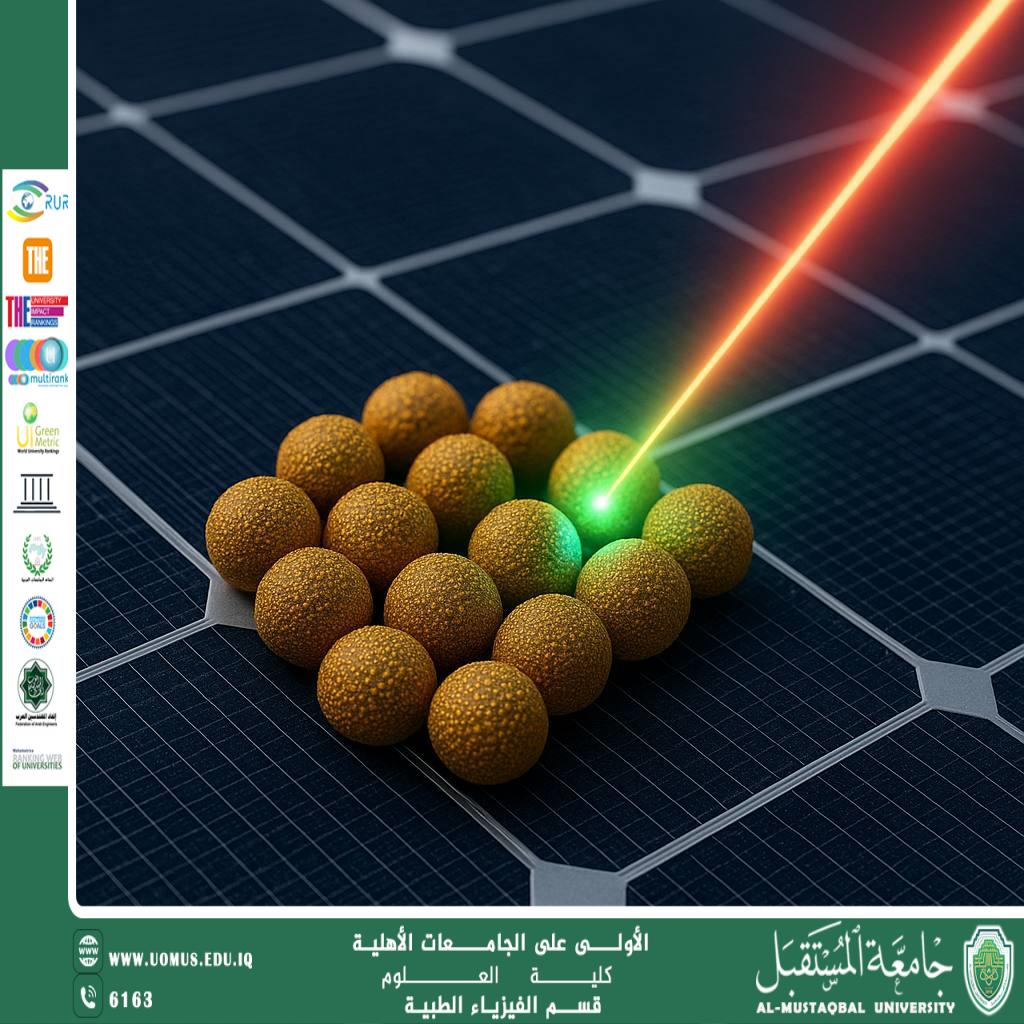
A scientific article by the teaching assistant (Haneen Hani) entitled "Nanotechnologies in Improving the Efficiency of Solar Cells"
Introduction<br /><br />As the world faces a growing demand for clean and sustainable energy, solar power has emerged as one of the most promising solutions. However, the efficiency of traditional solar cells remains relatively limited. This is where nanotechnology comes in, offering innovative ways to greatly improve the performance of solar cells.<br /><br />⸻<br /><br />What is Nanotechnology?<br /><br />Nanotechnology is a field of science that deals with designing and manipulating materials and devices at the nanoscale—about 1 to 100 nanometers, which is the size of atoms and molecules. At this tiny scale, scientists can precisely control the physical and chemical properties of materials.<br /><br />⸻<br /><br />How is it Used in Solar Cells?<br /><br />1. Improving Light Absorption<br /><br />Nanoparticles can be used to design surfaces that reflect less sunlight and absorb more of it. This means more sunlight can be converted into electrical energy.<br /><br />2. Reducing Energy Loss<br /><br />Nano-materials can reduce thermal and electrical energy losses inside the solar cell, making it more efficient.<br /><br />3. Creating Thin and Flexible Solar Cells<br /><br />Nanotechnology allows for the creation of lighter, thinner, and cheaper solar cells that can be installed on irregular surfaces like clothes, windows, or portable devices.<br /><br />⸻<br /><br />Real-World Examples<br /> • Quantum Dot Solar Cells: Use nanoscale semiconductor particles that absorb a wider range of light wavelengths.<br /> • Organic Nanostructured Cells: Use nano-engineered organic materials that are cheaper and more flexible than conventional cells.<br /><br />⸻<br /><br />Conclusion<br /><br />Nanotechnology has become a key tool in enhancing the efficiency and lowering the cost of solar energy. As research continues, it is expected that nanotech will play a crucial role in the global transition to clean and sustainable energy sources.<br /><br /><br /><br /><br />"AL_mustaqbal University is the first university in Iraq"<br/><br/><a href=https://uomus.edu.iq/Default.aspx target=_blank>al-mustaqbal University Website</a>