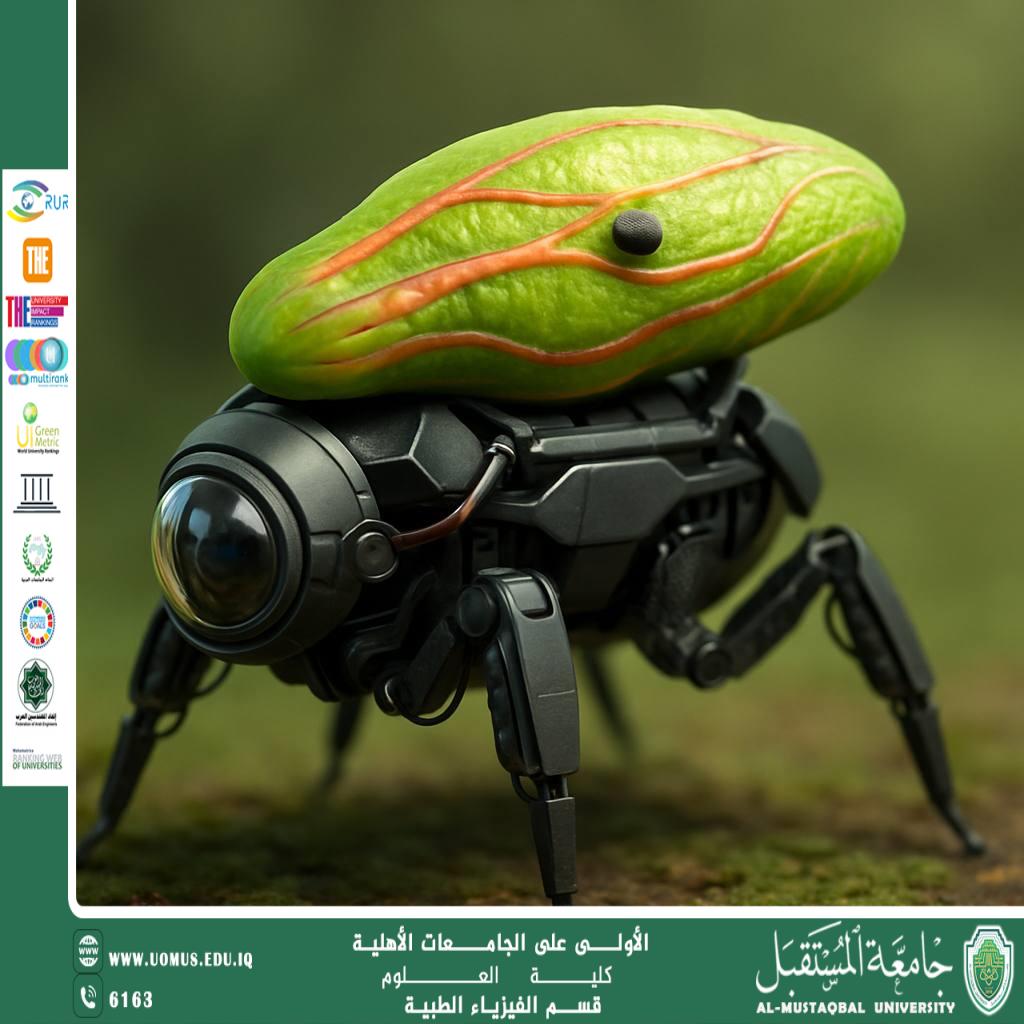
A scientific article by the teaching assistant (Ahmed Abdel Salam) entitled "Biorobots: When Technology Merges with Nature"
Introduction<br /><br />In recent years, the world has witnessed remarkable progress in the field of bio-robots—a special class of robots that are either inspired by living organisms or incorporate real biological components. This field represents a convergence of engineering, biology, and artificial intelligence, opening exciting possibilities in medicine, environmental science, and industry.<br /><br />⸻<br /><br />What Are Bio-Robots?<br /><br />Bio-robots are robotic systems designed based on biological principles. They may:<br /> • Mimic the movements or behaviors of living creatures like insects, birds, or fish.<br /> • Integrate living cells or biological tissues (creating hybrid systems).<br /> • Self-regulate, mimicking natural abilities such as healing or environmental adaptation.<br /><br />⸻<br /><br />Types of Bio-Robots<br /><br />1. Biomimetic Robots<br /><br />These robots are designed to imitate natural forms and functions:<br /> • A robot that walks like an insect on rough terrain.<br /> • A robotic arm that moves like a human arm.<br /><br />2. Biological Robots<br /><br />These include real biological elements, such as muscle cells or neurons, enabling them to move using biological signals.<br />Example:<br /> • Xenobots: Tiny robots made from frog cells that can move and interact with their environment.<br /><br />⸻<br /><br />Practical Applications<br /><br />✅ In Medicine<br /> • Precise delivery of drugs within the human body.<br /> • Minimally invasive surgery using soft, tissue-like robots.<br /><br />✅ In Environmental Science<br /> • Microscopic robots that collect pollutants from water or soil.<br /> • Biodegradable systems designed for one-time use in sensitive environments.<br /><br />✅ In Exploration<br /> • Flexible robots that can navigate through tight or complex spaces such as pipelines or caves.<br /><br />⸻<br /><br />Ethical and Technical Challenges<br /> • How do we control these hybrid organisms?<br /> • Could they pose risks if they malfunction or evolve?<br /> • Who is responsible for their actions if they contain living components?<br /><br />⸻<br /><br />Conclusion<br /><br />Bio-robots represent a true scientific breakthrough and an exciting example of how nature and technology can work together. While challenges remain, their potential to reshape medicine, sustainability, and exploration is enormous.<br /><br /><br /><br />"AL_mustaqbal University is the first university in Iraq"<br/><br/><a href=https://uomus.edu.iq/Default.aspx target=_blank>al-mustaqbal University Website</a>