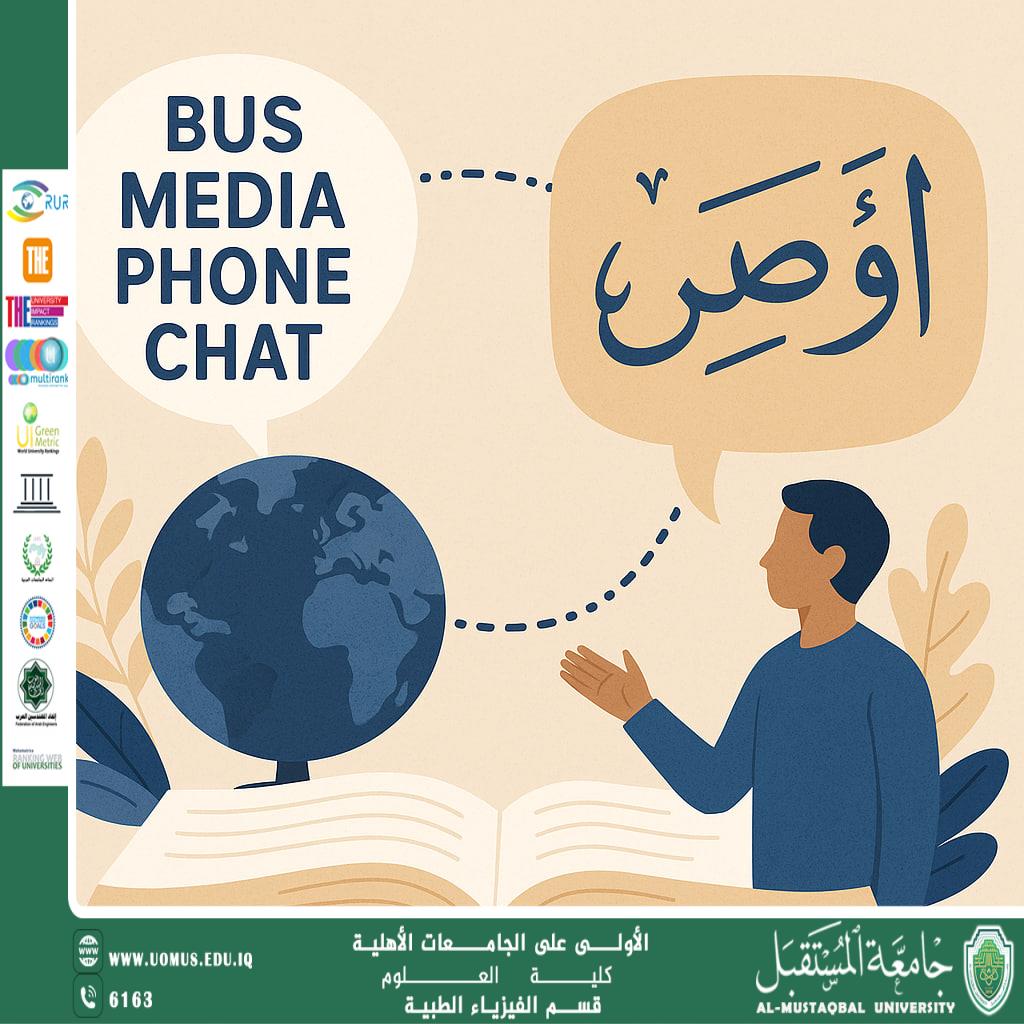
A scientific article by the lecturer (Assistant Lecturer Muhammad Ali Hussein) entitled “The Impact of Foreign Languages on Contemporary Arabic Vocabulary”
Introduction<br />In modern times, the Arabic language has undergone extensive interaction with various foreign languages, especially with global openness and rapid technological development. This interaction has led to the infiltration of many foreign terms into Arabic, whether in scientific and technical fields or everyday speech. This influence sparks ongoing debate between those defending the purity of the Arabic language and those who view linguistic interaction as a cultural necessity.<br /><br />Reasons Behind the Influx of Foreign Words<br />Scientific and Technological Development:<br />With the emergence of new concepts and tools that did not exist in the Arab environment, users resorted to borrowing foreign terms as they are, such as computer, internet, and robot.<br /><br />Media and Cultural Exposure:<br />The spread of foreign media, films, and social networking platforms has led to the frequent use of foreign words, especially among younger generations.<br /><br />Education in Foreign Languages:<br />The reliance on English or French in teaching sciences, medicine, and engineering in many Arab countries has further solidified the use of non-Arabized terms.<br /><br />Manifestations of Influence<br />Phonetic Arabization:<br />Using foreign words with slight phonetic modifications to fit Arabic pronunciation, e.g., fax, bus, social media.<br /><br />Semantic Arabization:<br />Translating the foreign word into an Arabic term with a similar meaning, e.g., mouse becomes "الفأرة", and virtual reality becomes "الواقع الافتراضي".<br /><br />Linguistic Duality:<br />Mixing Arabic and foreign words in the same sentence, e.g., “I need to update the system” rendered as “أحتاج أعمل أبديت للسيستم.”<br /><br />Positive and Negative Effects<br />Positive Effects:<br /><br />Enriching the Arabic language with new concepts.<br /><br />Facilitating communication in scientific and technical fields.<br /><br />Negative Effects:<br /><br />Weakening the use of original Arabic terminology.<br /><br />Creating a generational gap in language use.<br /><br />Threatening the language's identity if left unregulated.<br /><br />Efforts and Proposed Solutions<br />Arabizing modern terms through Arabic language academies and linguistic institutions.<br /><br />Encouraging Arabic content in internet and scientific research.<br /><br />Incorporating translation and Arabization concepts in educational curricula.<br /><br />Utilizing technology such as AI to develop modern Arabic electronic dictionaries.<br /><br />Conclusion<br />Despite the challenges Arabic faces amid global openness, it possesses enough flexibility and heritage to adapt to modern times—provided it is given the necessary attention and supported by scientific methods to preserve its identity without becoming isolated from the world.<br /><br /><br /><br />"AL_mustaqbal University is the first university in Iraq"<br/><br/><a href=https://uomus.edu.iq/Default.aspx target=_blank>al-mustaqbal University Website</a>